
 90 Day’s To Better Zzz’s Guarantee T&C apply

Holistic approach to better sleep: 2026 practical guide
What if better sleep depends less on finding one perfect product and more on getting a few everyday pieces to work together? If conflicting advice has left you unsure where to start, you’re not alone. A holistic approach to better sleep looks at your daily habits, bedroom environment and the support available to you, rather than relying on a single quick fix.
Small, realistic changes are often easier to maintain than a complete bedtime overhaul. This guide will help you identify what might be getting in the way, choose manageable steps that suit your circumstances and recognise when persistent problems deserve professional support.
We’ll look at routines, light, movement, food and drink, and the conditions in your bedroom. We’ll also explain how optional tools, including earthing bedding, might fit into a broader sleep plan without treating them as a cure or substitute for medical advice. Start with what feels practical, then build from there.
Key Takeaways
- A holistic approach to better sleep considers daily routines, your surroundings, wellbeing and professional care together, rather than relying on one quick fix.
- Review your sleep and wake timings, daylight, movement and wind-down habits to find practical changes that fit your life.
- Keep a brief sleep diary and try one manageable adjustment at a time. Use it to spot patterns, not to diagnose a condition.
- Self-guided changes may not be enough when sleep problems persist or affect daily life. Learn when it may be time to seek qualified healthcare support.
- See earthing bedding as an optional part of your routine, not a treatment. Sleep Earthed offers UK-sized fitted sheets with conductive silver threads in organic cotton.
What does a holistic approach to better sleep actually involve?
Trying one tip after another can be frustrating. You might avoid late coffee or follow a calming bedtime routine, yet still lie awake because stress is high, your schedule has shifted or your bedroom feels uncomfortable. Sleep is influenced by several connected factors, so a single change may not address the barrier that matters most to you.
A holistic approach to better sleep looks at the wider picture: everyday routines, your surroundings, general wellbeing and, when needed, professional care. It’s a practical way to consider how these parts of life interact with sleep, rather than expecting one quick fix to solve everything. It isn’t a diagnosis or a promise of a cure.
For a useful starting point, Sleep hygiene covers behavioural and environmental habits associated with sleep. A broader approach also recognises that personal circumstances shape what’s realistic. For example, a shift pattern or caring responsibilities may make a fixed bedtime difficult, so a repeatable wind-down routine could be a more achievable place to begin.
Here’s a video on a holistic perspective on insomnia:
Which parts of everyday life can affect sleep?
Sleep timing, daylight exposure, activity, stress and your bedroom environment are all worth considering. A changing work pattern may affect when you can wind down, for instance, while street light or household noise may disturb rest. These factors can overlap, but their influence differs from person to person and can change with life circumstances. You don’t need to alter everything at once. Note what seems relevant, such as a noisy room or an unpredictable schedule, and start there.
Why one-size-fits-all sleep advice often disappoints
A habit can be helpful and still leave another obstacle untouched. Reading before bed might help you relax, for example, but it won’t necessarily resolve an uncomfortable room or a schedule that clashes with your daily commitments. General suggestions are a starting point, not a personal prescription. Adapt sensible ideas to your routine and needs, then consider whether they are useful. Progress can be gradual, and results vary.
Thinking about these factors together helps you choose a practical next step without blaming yourself when a tip doesn’t work. It also leaves room to seek qualified healthcare guidance if sleep difficulties call for more than everyday adjustments.
How do daily routines and your sleep environment work together?
Your nights don’t begin at bedtime. The timing of your day, exposure to daylight, movement and opportunities to unwind all help shape the conditions you bring to bed. Going to bed and getting up at fairly consistent times may help create a recognisable rhythm, but it doesn’t have to be identical every day. Work patterns, caring responsibilities and other demands can make perfect regularity unrealistic.
Daytime rhythms help prepare for rest, whilst a comfortable, restful bedroom gives you a setting in which to wind down. Both matter, and small adjustments to either may be more manageable than trying to redesign your whole routine. Harvard Health Publishing offers practical advice on building a better nighttime routine, including ways to consider daytime habits alongside bedtime.
Which daytime habits are worth reviewing first?
Start by noticing, without judgement, how caffeine, alcohol, activity and daylight fit into your day. You might spot that your schedule changes significantly between workdays and days off, or that you spend little time outdoors. These are useful observations, not proof that any one habit is causing poor sleep.
Choose one manageable behaviour to adjust, such as taking a short walk in daylight or allowing a calmer transition before bed. Keep the change simple enough to fit your usual day, then observe what happens rather than changing several things at once. There’s no need to impose a universal cut-off time for drinks or activity. Your routine and response are personal.
How can you make the bedroom more sleep-friendly?
Take a practical look around your room. Is light from a window or screen bothering you? Do household sounds interrupt rest? Is your bedding comfortable, and does the room feel too warm or too cool for you? Try low-effort changes first, such as adjusting curtains, moving a light source or reducing avoidable noise. Comfort is personal, so notice what helps rather than chasing a perfect set-up.
If discomfort continues, consider whether something beyond the room needs attention. Ongoing pain, breathing concerns or other persistent symptoms aren’t simply a bedroom-design problem. Speak with a healthcare professional for appropriate advice.
For a holistic approach to better sleep, treat your routine and room as two parts of the same plan. If bedding is one of the practical details you’re considering, you can explore Sleep Earthed bedding options as an optional comfort choice, not a substitute for healthy habits or clinical care.
Which sleep strategies are useful, and when is self-help not enough?
A whole-person approach doesn’t mean avoiding clinicians or trying every remedy you see online. It means matching your response to the problem: everyday habits may be worth reviewing, whilst persistent or disruptive sleep difficulties may need professional assessment. Simple routine experiments can be a useful starting point, but they aren’t a replacement for treatment when that’s needed.
Be cautious of products or advice that promise to diagnose, prevent or cure a medical condition, especially when the claims aren’t clearly explained or supported. A trustworthy source should be open about what is known and what remains uncertain. Check health information against reliable guidance, such as the NHS page on insomnia, or relevant NICE recommendations. Calling a suggestion “natural” doesn’t, by itself, show that it’s effective or suitable for everyone.
How can you judge whether sleep advice is trustworthy?
Look for clear explanations rather than dramatic promises. Check whether the advice describes its limits, distinguishes personal experiences from established evidence and encourages medical help when appropriate. Treat claims of guaranteed results or quick cures with care. If a remedy could affect a health condition or interact with prescribed medicines, ask a qualified healthcare professional before trying it.
When should you speak to a healthcare professional?
Consider speaking to your GP or another appropriate healthcare professional if sleep problems persist, worsen or affect your daily life. You don’t have to wait until you feel unable to cope. A clinician can help explore possible causes and discuss suitable next steps.
Bring useful details to the conversation: how long the problem has been happening, what your nights and days are like, any symptoms you’ve noticed, and medicines or supplements you take. A brief record of your sleep routine may help you explain the pattern, but it isn’t a diagnostic test. Don’t stop or alter prescribed medicines without advice from the professional who manages them.
Depending on the assessment, a clinician may discuss psychological support such as cognitive behavioural therapy for insomnia (CBT-I), a structured approach that works with thoughts and behaviours linked to sleep. It isn’t a self-diagnosis or a one-size-fits-all remedy. A healthcare professional can advise whether it may be appropriate for you. A holistic approach to better sleep can include both manageable self-guided changes and professional care. Seeking help is part of that approach, not a failure of it.
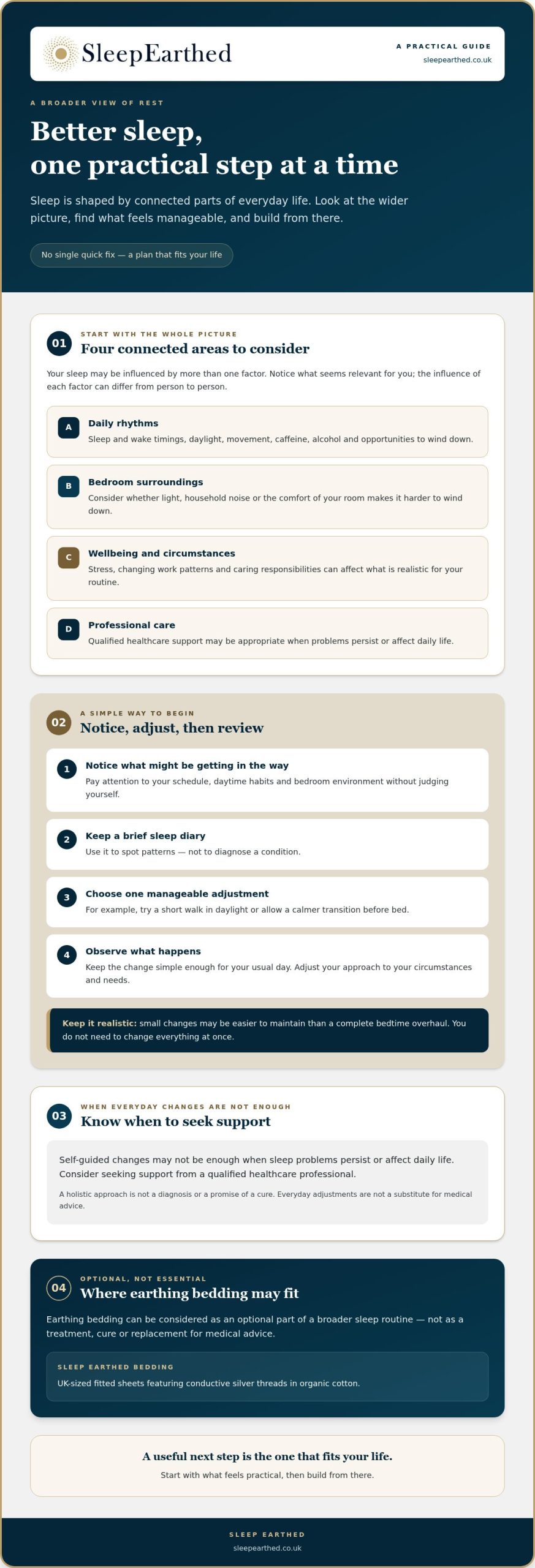
How can you build a realistic plan for better sleep?
A useful plan doesn’t need to overhaul your life. It should help you notice what’s happening, test one manageable change and decide whether it suits you. This keeps the process practical, rather than turning sleep into another task you have to get perfect.
Try this simple sequence:
- Notice patterns: Pay attention to your routine and what seems to affect your nights.
- Choose one change: Pick a step that feels realistic, such as making your wind-down routine calmer.
- Try it consistently: Give the change a fair opportunity, while allowing for the occasional disrupted night.
- Review and adjust: Keep what seems helpful. Reconsider anything that adds pressure or makes your routine harder.
Your plan can flex around work shifts, caring duties, travel or changes in health. During a demanding week, a small step may be more achievable than keeping an ideal schedule. If your circumstances change, adapt the plan rather than treating that as failure. A holistic approach to better sleep should work with your life as it is.
What should you record in a sleep diary?
Keep it brief. Note approximate bed and wake times, relevant daytime habits, and your own observations, such as whether you felt rested or found it hard to settle. You don’t need to record every detail or calculate a sleep score. If writing things down makes you anxious or overly focused on sleep, scale back or stop. A simple diary can help you describe patterns to a healthcare professional, but it isn’t a diagnostic tool.
How do you know whether a change is helping?
Look for patterns over time rather than judging a change by one night. Consider whether it feels manageable and whether your own sleep observations or daytime experience seem different. There’s no fixed timeline that works for everyone, and a diary won’t prove that one habit caused a particular result. Keep changes that feel useful; change course if an experiment brings more stress or disruption than benefit.
If comfortable bedding is one part of your plan, you could explore Sleep Earthed earthing bedding as an optional choice. Its UK-sized fitted sheets use conductive silver threads in organic cotton. Bedding is not a substitute for established sleep habits or professional care when you need it.
Where can earthing bedding fit into a broader sleep routine?
An earthing sheet is an optional bedding choice, not a shortcut to better sleep or a replacement for established habits and clinical care. It may be something to consider if it suits your preferences and feels comfortable, but it shouldn’t take the place of reviewing your routine or seeking professional advice when you need it.
Sleep Earthed offers UK-sized fitted earthing sheets made with conductive silver threads in organic cotton. Those are product details, not proof of a medical outcome. Don’t interpret product descriptions or another person’s experience as evidence that a sheet treats insomnia, anxiety, inflammation or any other health condition.
What should you consider before trying an earthing sheet?
Start with practical questions: will the bedding fit your bed, feel comfortable and suit your preferences? If you’re considering a sheet, read the grounding sheet setup guide for the stated setup details. Keep the choice in proportion. An optional bedding change is one small part of a wider sleep routine, not a substitute for healthcare guidance.
It also helps to distinguish what a product is made from and how it is used from what it can reliably do. A material description doesn’t establish a health benefit. If a claim sounds like a promise to prevent or treat a condition, look for clear evidence and limitations before relying on it.
How can you weigh claims and decide what to try?
For a discussion of the evidence and its limitations, read research on whether earthing sheets work. Personal experiences can be meaningful to the people describing them, but they don’t establish a universal or medically proven effect. Keep your expectations measured, and speak to a healthcare professional about persistent sleep problems or health concerns.
A holistic approach to better sleep puts everyday routines, bedroom comfort and suitable support first. An earthing sheet may be an optional addition if it fits your needs, but it isn’t essential to building a realistic plan.
If you’d like to consider that option, explore Sleep Earthed fitted earthing sheets and check the current guarantee terms before deciding. Choose based on the product information and your own preferences, without expecting a particular health outcome.
Start with one practical step towards better sleep
A holistic approach to better sleep doesn’t depend on finding one perfect fix. Look at how your routine, bedroom and wellbeing fit together, then choose one manageable change and review how it feels. If sleep problems persist or affect daily life, professional guidance belongs in the plan too.
Optional bedding may be part of your personal comfort choices, but it isn’t a proven treatment or a substitute for healthy habits or clinical care. Sleep Earthed offers UK-sized fitted earthing bed sheets made with conductive silver threads in organic cotton. The company also lists a 90-day better-sleep guarantee. Check its current terms before making a decision.
If you’d like to learn more, explore Sleep Earthed bedding and consider whether it suits your preferences. Keep your plan realistic, be patient with yourself and take the next step that feels right for you.
Frequently Asked Questions
What is a holistic approach to better sleep?
A holistic approach to better sleep considers daily routines, the bedroom environment, wellbeing and appropriate healthcare support together. It doesn’t mean trying every wellness trend or replacing medical advice with a product. Start with manageable changes that fit your circumstances, such as noting your sleep and wake pattern or making your room more comfortable. If sleep difficulties continue or affect everyday life, professional assessment may be an important part of the plan.
Can a bedtime routine help you sleep better?
A calm, repeatable bedtime routine may help some people shift from daytime activity towards rest. It doesn’t need to be elaborate: you could set aside time for reading, gentle stretching or quiet music, choosing what feels relaxing to you. There’s no single routine that suits everyone, and it isn’t a guaranteed solution. Try a few comfortable steps and review whether they help, rather than feeling you have to follow them perfectly.
How can I improve my sleep naturally?
Start by noticing which habits or surroundings might be affecting your rest, then try one practical change. You could review your sleep timing, daylight exposure, daytime activity or bedroom comfort. Keep the experiment manageable and observe how it feels, rather than changing everything at once. Be cautious of unverified supplements and cure-all claims. If poor sleep persists, worsens or disrupts daily life, speak with a healthcare professional instead of relying solely on self-help.
Is earthing bedding proven to improve sleep?
Earthing bedding shouldn’t be treated as a proven treatment for sleep problems. Sleep Earthed products use conductive silver threads in organic cotton, but those product details don’t establish a medical benefit. You may consider an earthing sheet as an optional personal bedding choice alongside broader sleep habits, not as a substitute for clinical care. Review evidence and its limitations before deciding, and seek professional advice about persistent or concerning sleep difficulties.
What should I do if I keep waking during the night?
If you keep waking, note when it happens and whether you’ve noticed changes in routine, discomfort or stress around the same time. These observations may help you describe the pattern, but they can’t confirm its cause. Avoid diagnosing yourself or assuming one factor explains every waking. If the problem continues, affects your daily life or comes with symptoms that concern you, discuss it with a healthcare professional who can assess your circumstances.
When should I seek professional help for poor sleep?
Speak with a healthcare professional if poor sleep persists, worsens, interferes with everyday life or concerns you. A brief record of your sleep patterns can help you explain what’s happening. Include relevant symptoms, medicines you take and any recent routine changes. A clinician can assess your circumstances and discuss suitable support. Don’t stop prescribed treatment or replace individual medical advice with a sleep product or a self-guided routine.
Do sleep trackers give an accurate picture of sleep?
Sleep trackers can help you notice broad patterns, but their estimates aren’t a medical diagnosis and may not precisely reflect what happened overnight. Treat the information as one observation, not a score you need to improve or a reason to change treatment. If tracking makes you anxious or disrupts your sleep, consider taking a break. For ongoing concerns, talk them through with a healthcare professional rather than relying on tracker data alone.