
 90 Day’s To Better Zzz’s Guarantee T&C apply

Earthing and Blood Viscosity: What Does the Evidence Really Show?
Can earthing really change blood viscosity, or does a promising result tell us less than it first appears? Claims about earthing and blood viscosity can sound like evidence of better circulation, even when research has not shown that earthing prevents or treats disease.
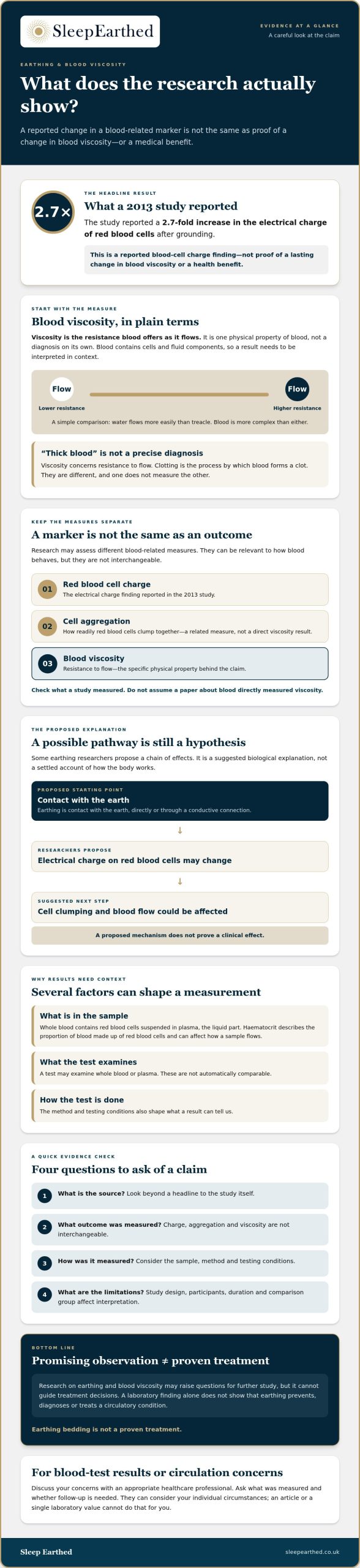
It is understandable to want a clear answer, especially when terms such as “zeta potential” and “red blood cell aggregation” make research harder to assess. A 2013 study reported a 2.7-fold increase in red blood cells’ electrical charge after grounding. That finding, however, should not be mistaken for proof of a medical benefit.
This article explains what blood viscosity measures, why results can be influenced by different factors, and what research on earthing has and has not established. It also shows how to distinguish an early laboratory finding from evidence that could guide healthcare decisions, and when to discuss blood-test results or circulation concerns with a healthcare professional.
Key Takeaways
- Blood-viscosity measurements describe one physical property of blood. A result needs context and is not a diagnosis on its own.
- Proposed explanations for earthing’s effects are different from evidence that directly measures blood viscosity.
- Check a claim’s source, the outcome measured and the study’s limitations before accepting its conclusion.
- Research on earthing and blood viscosity may suggest questions for further study, but it cannot guide treatment decisions.
- Discuss blood-test results or circulation concerns with a healthcare professional. Earthing bedding is not a proven treatment.
What does blood viscosity mean, and why does it matter?
What does a blood-viscosity result actually tell you? It describes one physical property of blood, not a diagnosis by itself. To assess claims about earthing and blood viscosity, first separate what the term means from what a particular test or study can establish.
Blood viscosity is the resistance blood offers as it flows. As a simple comparison, water flows more easily than treacle. Blood is more complex than either because it contains cells and fluid components, and a laboratory result needs to be interpreted in light of the test used and the person’s wider health picture. This topic is part of the study of the flow properties of blood, known as haemorrheology.
For a visual introduction to the topic, you can watch this video:
How is blood viscosity different from “thick blood”?
“Thick blood” is an informal phrase, not a precise diagnosis. It can refer to different concerns, so it does not tell you which test was done or what a result means. Viscosity and clotting are also different: viscosity concerns resistance to flow, while clotting is the process by which blood forms a clot. Both can matter to health, but one does not measure the other. A single viscosity result does not establish a circulation problem.
What can influence blood-flow measurements?
Whole blood contains red blood cells suspended in plasma, the liquid part. Haematocrit describes the proportion of blood made up of red blood cells, and this is one feature that can affect how a sample flows. Measurements may also differ according to whether a test examines whole blood or plasma, as well as the method and testing conditions. Results from different studies are therefore not automatically comparable.
Read a result in context rather than treating it as a verdict. If you are concerned about a blood-test result, symptoms or circulation, ask an appropriate healthcare professional what was measured and whether follow-up is needed. They can consider your individual circumstances; an article or a single laboratory value cannot do that for you.
How could earthing relate to blood viscosity?
Earthing, also called grounding, means making contact with the earth, either directly or through a conductive connection. That describes the practice, but does not establish what happens inside the body. The proposed link between earthing and blood viscosity is a separate question, and should be judged by what research actually measures.
Some earthing researchers propose that contact with the earth may allow electrons to move into the body and affect the electrical charge on red blood cells. They suggest that changes in this charge could influence how readily cells clump together, which may in turn affect blood flow. This is a proposed biological explanation, not a settled account of how the body works.
What do earthing studies actually measure?
Check the outcome measured rather than assuming that a paper about blood has measured viscosity. A study might assess red blood cell charge, cell aggregation or another blood-related marker. These measures may be relevant to how blood behaves, but they are not interchangeable with a direct viscosity measurement. Study design, participants, duration, comparison group and laboratory method also shape what the findings can tell us.
A 2013 paper titled “Earthing and blood viscosity” discusses blood-related outcomes, including red blood cell charge and aggregation. Those observations should not automatically be described as proof of a lasting change in blood viscosity or a health benefit. Check the original paper’s methods to see precisely what was measured.
Why proposed mechanisms need careful wording
A possible pathway can help researchers frame a question, but it does not prove the next steps in that explanation. Even if a laboratory measure changes, that alone cannot show that earthing prevents, diagnoses or treats a circulatory condition. Evidence addressing those clinical outcomes would be needed, not just a proposed mechanism or a change in a blood marker.
A proposed mechanism may explain how earthing could affect a blood-related measure, but it is not proof of a clinical effect. When reading headlines, look for the exact outcome measured and do not treat a laboratory finding as medical advice.
If you are interested in products used for earthing, Sleep Earthed offers earthing bedding and related products. These are product options, not treatments for blood viscosity or circulatory conditions.
Does the research prove that earthing changes blood viscosity?
Not conclusively. The often-cited 2013 paper, “Earthing (Grounding) the Human Body Reduces Blood Viscosity”, reports changes in red blood cell measurements after grounding. A shift in a related marker is not automatically proof that blood viscosity itself changed, or that anyone’s health improved. As CVPhysiology’s explanation of blood viscosity makes clear, viscosity is a physical property of blood flow, not a clinical outcome such as fewer cardiovascular events.
Use the table to separate what the study reports from what its results can reasonably establish:
| Study question | Design and participants | Reported outcome | Limitation and reasonable conclusion |
|---|---|---|---|
| Could grounding affect blood-related measures? | The 2013 paper reports measurements before and after a two-hour grounding session. Check the participant number, comparison group and full protocol in the original paper before relying on those details. | It reports a change in red blood cell zeta potential and reduced aggregation. These are not, by themselves, a direct measurement of blood viscosity. | The short-term findings suggest a possible change in measured blood-cell behaviour under the study conditions. They do not establish a lasting effect, a cause-and-effect relationship or a health benefit. |
What makes a study more or less convincing?
Study quality depends on more than a headline result. Check how many people took part, whether there was a comparison group, how outcomes were measured, and whether participants or researchers knew who received the intervention. Small or uncontrolled studies can be affected by measurement variation, participant differences and other sources of bias. A result is more persuasive if other researchers can repeat it and obtain similar findings.
For this paper, read the original methods and limitations rather than relying on a summary. Check which blood measure was tested and whether the study design can distinguish an effect of grounding from other explanations.
A blood marker isn’t a clinical outcome
Even a genuine change in a laboratory measure does not show that symptoms improve or disease risk falls. Evidence of cardiovascular benefit would need to demonstrate that clinical outcome directly. That link remains uncertain based on the finding described above.
The evidence offers a question for further research, not proof that earthing prevents or treats circulatory disease. This does not dismiss the result; it keeps the conclusion within what the measurements can reasonably support. For claims about earthing and blood viscosity, look for replicated research that directly measures viscosity and assesses meaningful health outcomes.
How should you assess earthing and blood-viscosity claims?
A study can report a measurable change without showing what that change means for health. Before deciding what a result supports, check the original research and compare its findings with the claim being made. This checklist can help you assess claims about earthing and blood viscosity without treating early findings as medical advice.
Questions to ask when reading a study
- 1. What exactly is the claim? Separate a claim about a laboratory marker from one about circulation, symptoms or disease. They are not the same outcome.
- 2. Was blood viscosity measured directly? Check the methods for the specific test used. If researchers measured red blood cell charge or aggregation instead, the result may be relevant to blood behaviour, but it is not a direct viscosity measurement.
- 3. Was the study designed to test earthing? Look at the participants, comparison group, duration and study design. A proposed link discussed by the authors is not necessarily the outcome the study tested.
- 4. Do the conclusions match the data? Read the limitations and see whether the authors acknowledge uncertainty. Be cautious if a headline or product description makes a broader promise than the paper’s results support.
Whenever possible, find the original paper rather than relying only on a headline, summary or promotional copy. An abstract can help you locate key details, but the methods and limitations show what was actually done and where the uncertainties lie.
When should you speak to a healthcare professional?
If you are concerned about a blood-test result, circulation symptoms or treatment, discuss your situation with an appropriate healthcare professional. They can interpret results in the context of your health and advise whether follow-up is needed. Seek help through an appropriate NHS service if symptoms are urgent or changing. Do not delay care, alter prescribed medication or replace established treatment with earthing.
This article is for general education, not diagnosis or individual medical advice. A study can help researchers investigate a question, but it cannot determine what a result means for you personally.
If you are exploring earthing as a practice, you can browse Sleep Earthed earthing products. They are products, not a proven way to change blood viscosity or treat a medical condition.
Where does Sleep Earthed fit into this evidence-led picture?
Sleep Earthed offers earthing products, including fitted earthing bed sheets and earthing pillow cases. These are bedding products designed for earthing, not medical equipment or proven treatments for blood viscosity. Their materials and design do not, by themselves, demonstrate that blood markers change or that a health condition can be prevented or treated.
That distinction is central to understanding earthing and blood viscosity. A product can provide a way to practise earthing, but evidence about its features is different from evidence that it changes a laboratory result or improves a clinical outcome. Keep those questions separate as you explore the topic.
What an earthing product can and cannot establish
Product information can explain what an item is and how it is intended to be used. It cannot replace independent research into a specific health claim. Sleep Earthed offers a 90-day better-sleep guarantee, which relates to sleep and should not be interpreted as a guarantee of changes to blood viscosity or other medical outcomes.
For broader background, read the grounding and earthing guide. Sleep Earthed also has related reading on earthing sheets, inflammation and chronic pain. That article covers a separate topic, so it should not be treated as evidence that earthing changes blood viscosity.
A sensible next step for curious readers
If you want to explore proposed explanations and research further, the science behind earthing sheets offers related educational reading. As you read, check which outcomes a study actually measured and keep proposed mechanisms distinct from demonstrated health effects.
If you have a personal concern about a blood test, circulation or treatment, speak with a healthcare professional who can consider your circumstances. Exploring earthing products is optional, and should not delay care or replace medical advice. If you are simply curious about earthing bedding, you can browse Sleep Earthed’s information at your own pace, without assuming a medical benefit.
Keep the evidence in perspective and choose your next step
Blood viscosity describes resistance to flow, but a result is only one part of a wider health picture. Research on earthing has explored blood-related measurements, yet a reported change in a laboratory marker does not establish that earthing prevents or treats circulatory disease. That is the key distinction when weighing claims about earthing and blood viscosity.
Check what a study actually measured, how it was carried out and what its limitations were. If you have questions about your own test results, symptoms or treatment, speak with a healthcare professional who can consider your individual circumstances.
If you are curious about earthing bedding as a product category, Sleep Earthed offers bedding and related products through its online shop. Explore Sleep Earthed’s earthing bedding range, or contact the brand by phone or email with product questions. Keep health decisions grounded in personalised medical advice, and take your time deciding what feels right for you.
Frequently Asked Questions
Can earthing reduce blood viscosity?
It has not been established that earthing reliably reduces blood viscosity or prevents or treats circulatory disease. Research has reported changes in blood-related measures, such as red blood cell behaviour, but these are not necessarily direct measurements of viscosity or proof of a clinical benefit. Evidence on earthing and blood viscosity remains preliminary. If you are considering earthing for a health concern, discuss it with a healthcare professional rather than relying on it as treatment.
What is blood viscosity in simple terms?
Blood viscosity is its resistance to flowing. You might picture the difference between water and treacle, although blood is more complex because it contains cells suspended in plasma. A viscosity result describes one aspect of blood behaviour, not your overall health. Its meaning depends on what was tested, the method used and your circumstances. A clinician can help explain what a particular result means for you.
Is blood viscosity the same as blood clotting?
No. Viscosity describes how much blood resists flowing, whereas clotting is the process by which blood forms a clot. Both relate to blood, but they are different properties and are assessed in different ways. A viscosity result does not tell you by itself whether your blood clots normally, and a clotting test is not a direct measure of viscosity. Ask the clinician who requested your tests to explain their purpose and results.
What evidence should I look for in an earthing study?
Start with the original paper, then check whether it measured blood viscosity directly or another marker, such as red blood cell aggregation. Look for the number and characteristics of participants, the study design, duration, comparison group and measurement method. Consider whether the researchers acknowledge limitations and whether independent studies have replicated the finding. A headline or product description may simplify results, so compare its claim with the paper’s actual data and conclusions.
Can I use earthing instead of prescribed blood-thinning medicine?
No. Do not stop, reduce or replace prescribed blood-thinning medicine with earthing unless the clinician responsible for your care advises you to change your treatment. Earthing has not been established as a substitute for prescribed medicine. If you are concerned about side effects, your dose or a test result, contact your prescriber or another appropriate healthcare professional for advice. Do not delay seeking care to try an earthing product.
Does a change in a blood test prove earthing improves health?
No. A change in a laboratory measurement may be worth investigating, but it does not by itself show that symptoms improved, disease risk fell or treatment is effective. First check what the test measured and whether the study included a suitable comparison. Researchers would need evidence about meaningful health outcomes to support claims of clinical benefit. An individual result should be interpreted in context by an appropriate healthcare professional.
Who should I ask about a blood-viscosity result?
Ask the healthcare professional who arranged the test, or your GP, to explain what was measured and how the result fits your health history. A result needs context, including the test method and any other relevant findings. If you have new, worsening or urgent symptoms, contact an appropriate NHS service rather than seeking guidance from product information. This article is educational and cannot diagnose a condition or interpret your personal results.