
 90 Day’s To Better Zzz’s Guarantee T&C apply

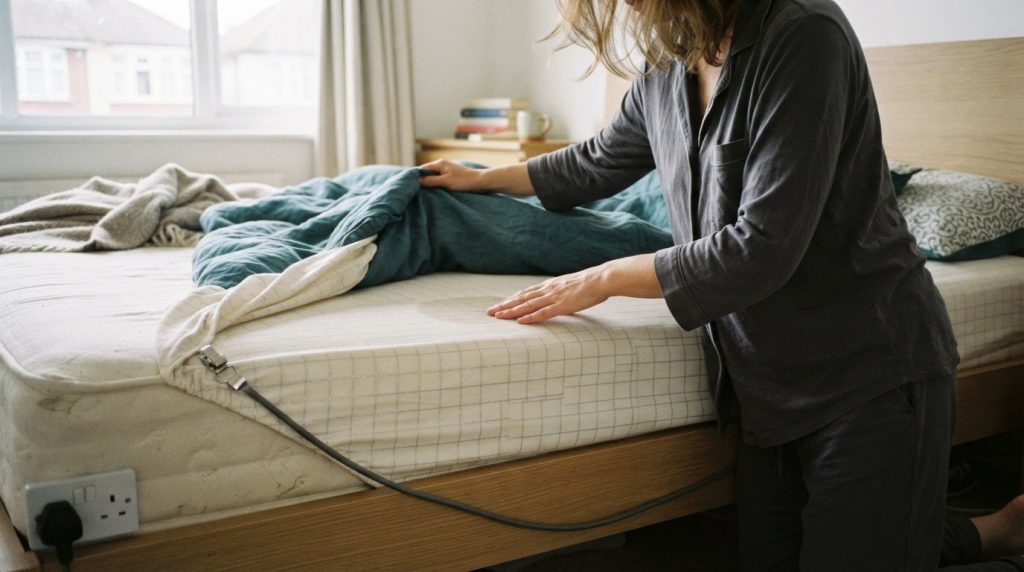
Newer studies have made the picture more interesting, but not conclusive. A 2025 trial included 60 adults with poor sleep, yet the grounding sheet effectiveness over time still depends on more than a promising headline: the evidence is developing, and washing or sweat may affect the conductive silver in a sheet. It’s reasonable to wonder whether a sheet that seems to work at first will keep doing so after regular use.
Grounding sheets are designed to connect the body to the earth through conductive material. How the sheet is used and cared for matters when considering what it may do over time. This article reviews what the evidence does and doesn’t suggest, explains how grounding sheets work, and explores how washing and perspiration may affect conductivity. It also offers practical context for interpreting claims about sleep and other possible effects without treating early findings as settled proof.
Key Takeaways
- Newer studies offer points of interest on sleep and inflammation, but the overall evidence still calls for careful interpretation.
- Learn how conductive material creates an earthing connection, and why the layers between you and the sheet can matter.
- Washing and perspiration may affect silver threads over time, so gentle, suitable laundry care is worth understanding.
- Rather than relying on a fixed replacement timeline, look at the sheet’s condition and whether it still conducts effectively.
Possible effects on sleep and inflammation
Grounding research has examined sleep, cortisol and inflammation, but studies use different methods and populations. That distinction matters when judging whether a reported change might apply to you. Some research involved people using conductive mats, while other studies examined rats. Findings in rodents can suggest questions for future research, but they cannot establish the same effects in people.
The Ghaly and Teplitz sleep study followed 12 people using conductive mats in their beds for eight weeks. Researchers collected saliva at baseline and again at week six to assess cortisol. The study reported that grounding at night better aligned cortisol with its natural 24-hour circadian rhythm. Cortisol follows a daily pattern, so the finding concerns timing, rather than a simple claim that levels always fall.
This study offers a specific example involving people, but its small group limits how broadly its results can be applied. It also doesn’t show that everyone using a grounding sheet will sleep better. Sleep can be affected by routines, stress and the sleeping environment. A change observed during a study doesn’t, on its own, establish that grounding caused every reported improvement.
Other research adds animal findings, not a settled answer for human sleep. A 2024 rat study used EEG, a way to measure brain activity, and reported increased REM and NREM sleep in rodents on earthing mats. REM and NREM are different stages within the sleep cycle. The result may be relevant to further investigation, but rats aren’t a substitute for trials measuring sleep in people.
Inflammation is also part of the emerging research. A 2025 South Korean study on rats suggests grounding may reduce inflammation. That finding is preliminary evidence from animals; it doesn’t show that grounding treats inflammation in people. The distinction is especially important when a proposed effect is discussed as a health benefit, rather than as an observation that needs testing in human studies.
A 2025 randomised, double-blind, placebo-controlled trial examined an earthing mat and sleep quality in 60 adults with poor sleep. Its design includes a comparison with a placebo, but the fact that a trial took place isn’t itself proof of benefit. Consider what each study measured, who took part, and whether it involved humans or animals. Taken together, the sleep and inflammation findings offer questions worth investigating, not a guarantee of an individual result.
Evidence for grounding-sheet effectiveness
Grounding research uses different equipment, participants and measurements, so its results don’t all answer the same question. One study reported that a participant began to feel pain subside after 30 minutes, according to the study’s authors. That is an individual observation, not evidence that grounding reliably relieves pain for everyone. A reported change also doesn’t establish which part of the setup caused it.
Other studies measured short-term changes rather than outcomes after regular use. In a yoga study, participants used grounding mats during an hour-long session and had lower blood viscosity. A small study observed improved heart rate variability after 20 minutes of grounding, with further improvement during longer grounding. These findings describe measurements taken in particular settings. They don’t establish that a sheet will produce the same changes during sleep.
Exercise studies offer another example of why context matters. One grounding study involved eight healthy men after exercise, whilst another involved 71 people during the COVID-19 pandemic and was conducted by phone. Differences in participants and methods make direct comparisons difficult. An osteopathic thesis assessed 15 earthing papers using the Cochrane Risk of Bias tool and judged the supporting evidence questionable. Study quality matters alongside the result reported.
How do grounding sheets compare with grounding mats or barefoot outdoor grounding? Sheets and mats both provide a conductive surface, while barefoot outdoor grounding involves direct contact with the ground. The evidence described here includes different forms of grounding, so results from one setup shouldn’t automatically be treated as proof for another.
Are grounding sheets safe with UK electrical systems and RCD protection? RCD protection doesn’t prove that a sheet’s earth connection is working correctly. These are separate considerations. A grounding sheet relies on a suitable earth connection, so an RCD alone cannot show that the setup is functioning as intended.
What risks or side effects should users consider? Cleveland Clinic flags a safety caveat for people with pacemakers or other implanted devices using grounding mats. The Earthing Institute warns that combining grounding with anticoagulant medication may possibly cause excess blood thinning. These cautions don’t prove harm will occur, but they matter when considering personal circumstances. None of the grounding studies reviewed on this topic was a trial involving people with fibromyalgia, so the findings shouldn’t be treated as evidence for that condition.
Overall, findings such as the 30-minute pain observation and the yoga-session measurements are specific to their study settings. They don’t establish lasting benefits from a grounding sheet. Consider the equipment used, the outcome measured and whether the study involved people like you before drawing conclusions.
How washing and sweat may affect sheet effectiveness
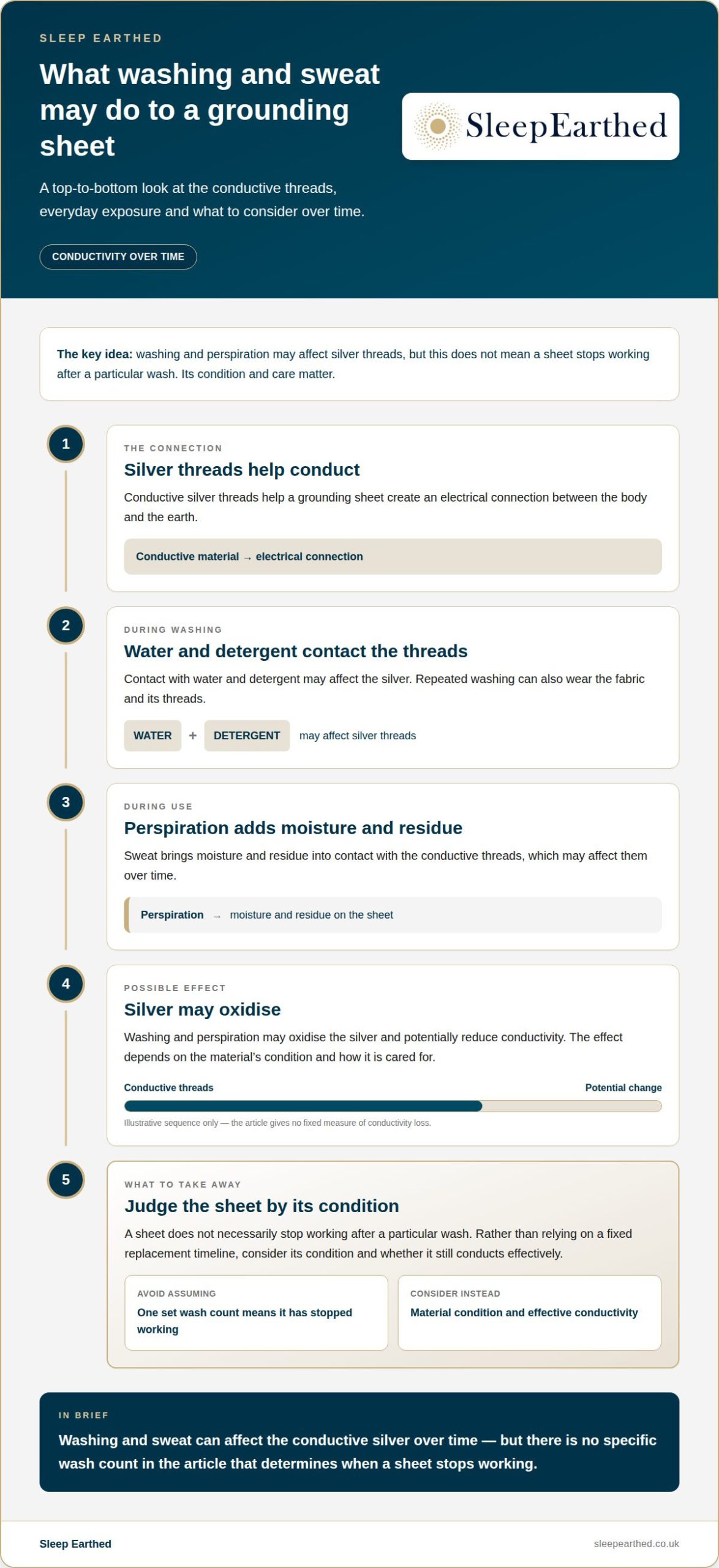
Conductive silver threads help a grounding sheet create an electrical connection. Washing and perspiration can affect the threads: contact with water, detergent and sweat may oxidise the silver and potentially reduce conductivity. That doesn’t mean a sheet stops working after a particular wash. The effect depends on the material’s condition and how it is cared for.
Think of the sheet as both bedding and a conductive surface. Repeated washing can wear its fabric and threads, while sweat brings moisture and residue into contact with them during sleep. These are different influences, but both matter to the material over time. A change in feel or appearance alone can’t tell you whether its electrical connection has changed.
Follow the care instructions supplied with the specific sheet. Check the guidance for detergent, temperature, drying and ironing. These details can vary between products, so a routine for ordinary cotton bedding may not suit conductive fabric. Don’t guess by choosing a hotter wash or stronger cleaning product to remove a mark.
Choose laundry products with the sheet’s care needs in mind. Green Sheets laundry detergent are an option for washing earthing sheets. Use the product as directed and follow the sheet’s own care instructions too. A detergent recommendation isn’t a reason to disregard the garment label, which remains the guide for washing and drying that particular item.
After washing, dry the sheet as its care instructions direct before putting it back on the bed. Inspect the surface for obvious changes such as damaged fabric, worn areas or loose threads. These signs don’t measure conductivity, but they can reveal physical wear that needs attention. Don’t pull at the conductive threads or use abrasive cleaning methods.
Sweat is harder to control than a wash cycle. A warm night, close-fitting sleepwear or damp bedding can increase contact with perspiration. Don’t treat sweat as a way to restore conductivity: perspiration may contribute to silver oxidation. If the sheet becomes damp, follow its care guidance rather than adding an unapproved cleaning step.
If performance seems different after regular use, consider the whole setup before blaming washing alone. Body contact, the sheet’s position and the condition of its conductive surface can all affect the connection. A visual inspection can reveal fabric damage, but it can’t establish electrical performance. A suitable meter can test continuity, but it can’t demonstrate a health benefit.
For grounding sheet effectiveness over time, consistent care is more useful than an arbitrary washing schedule. Follow the sheet’s washing instructions, choose a suitable detergent and watch for fabric wear. Washing and sweat may affect conductivity, but the practical question is whether the material and electrical connection remain intact.
How grounding sheets work
A grounding sheet uses conductive material to create a pathway between the sleeper and an earth connection. In sheets made from organic cotton with silver threads woven throughout, the threads provide the conductive element. A connection lead links the sheet to earth. The intended pathway runs from the conductive surface, through the lead and to earth.
For that pathway to include you, your skin needs to touch the conductive area. A hand or foot resting on the sheet, for example, can provide contact. Thick clothing, another sheet or a mattress protector between you and the conductive surface may interrupt that contact. The fabric can be connected correctly, yet you may not be touching it.
Layers matter particularly with mattress pads. Some grounding mattress-pad manufacturers advise having only one layer between the body and the pad to maximise conductivity. Other manufacturers generally recommend a fitted sheet made from natural fibres, such as 100% cotton, over a grounding sheet. These points refer to different setups: follow the care and use instructions for the particular product.
A grounding sheet doesn’t generate electricity. Its conductive threads are intended to connect the body with the earth, not to act as a powered heating element. A loose lead, damaged conductive area or unsuitable connection can affect this pathway. A visual check may reveal damage, but it can’t confirm electrical continuity.
Carbon-infused earthing mats differ from silver-thread sheets and rely on sweat to make the earth connection. In a silver-thread sheet, conductive threads are woven through the material instead. This distinction helps explain why construction and how the surface is used matter.
Think of the setup as three connected parts: the conductive surface, the person touching it and the earth connection. If one part is missing, the intended pathway is incomplete. A grounding sheet beneath several layers, for example, may provide less direct skin contact than one used as directed. Likewise, a loose connection lead can break the link to earth.
A suitable meter can help assess whether the sheet has electrical continuity through its connection. That reading answers a technical question about the pathway, not whether someone will sleep better or experience another health effect. The studies discussed earlier measure outcomes separately. Understanding the materials and contact points explains how a sheet is designed to work, without treating conductivity as proof of a health benefit.
How long do grounding sheets last before they need replacing?
There’s no dependable replacement age that applies to every grounding sheet. Its usable life depends on the condition of its fabric and conductive threads, how it is washed, and whether its connection remains intact. A sheet used gently and cared for according to its instructions may wear differently from one washed harshly or regularly pulled at the seams.
Start by checking the physical condition. Look for thinning fabric, holes, fraying edges, loose stitching or damaged areas where conductive threads are woven. A tear across the area you sleep on, for example, is more concerning than a small mark that hasn’t damaged the material. Visible wear can reveal fabric problems, but appearance alone can’t establish whether the sheet still conducts.
Next, consider the sheet’s care history. Repeated washing, unsuitable detergent and rough handling may affect the fabric and silver threads. Follow the sheet’s washing and drying instructions each time, rather than relying on a routine for ordinary cotton bedding. If the instructions specify gentle handling, a hotter cycle or abrasive cleaning can work against the material’s intended longevity.
Check the connection hardware too. A loose lead, damaged plug or insecure connection can interrupt the pathway, even if the sheet looks sound. Include the connection points when assessing the whole setup. If a cable or plug is visibly damaged, the sheet’s appearance alone isn’t evidence that the complete arrangement remains in good condition.
A suitable meter can help assess electrical continuity between the conductive surface and its connection. For instance, if a sheet looks intact but a meter no longer shows continuity, that gives a different indication from visual inspection. A meter reading concerns the electrical pathway; it doesn’t establish a health effect or explain exactly why the reading changed. Follow the meter’s testing instructions.
Replacement may make sense if physical damage affects the conductive area, the connection can’t be restored safely, or testing indicates continuity has been lost. A loose connection may be the problem rather than the sheet itself, so assess these parts separately. Conversely, a tidy appearance doesn’t prove the conductive pathway is working. These checks can help avoid replacing a usable sheet solely because of its age.
For a practical decision, consider three things: fabric condition, secure connections and a continuity test. An intact sheet with a sound connection presents different signs from one with frayed conductive areas and a failed test. There’s no useful calendar rule that fits every sheet. Its condition and electrical pathway provide a more relevant basis for deciding whether to keep using it or replace it.
Sleep Earthed
Sleep Earthed offers earthing bedding for readers considering how a sheet fits their sleep setup and care routine. The range includes UK Sized Fitted Earthing Bed Sheets, Earthing Pillow Cases, an Earthing Half Sheet and an Earthing Recovery Bag. The right format depends on how you plan to use conductive bedding, where you want body contact and whether a fitted sheet or separate layer suits your bed.
If you’re considering a new sheet, replacing worn bedding or choosing between formats, Sleep Earthed offers options to weigh against the practical points in this guide. Research doesn’t make product choice a health decision, so focus on construction, use and care. For help choosing from Sleep Earthed’s earthing bedding, get in touch with the team.
Make your next step a considered one
Before changing your sleep setup, decide what you want to learn from the change. Are you mainly concerned with how the bedding fits your routine, how you’ll care for it, or whether its electrical connection remains intact? Keeping that question clear can help you make a practical choice without treating personal experience as proof of a wider health effect.
If you try a different arrangement, make a brief note of the setup and any changes you notice in your usual routine. This gives you a more useful reference point than relying on memory alone. It also keeps your view of grounding sheet effectiveness over time focused on your own experience, rather than on a promise research hasn’t established.
If you’d like to talk through your questions or consider the available options, Contact Sleep Earthed with your questions. Take the next step at a pace that feels right for you.
Frequently Asked Questions
But what about the newer studies?
Newer studies make the evidence more current, but they don’t settle whether grounding improves sleep or health. A 2025 randomised, double-blind, placebo-controlled trial examined an earthing mat for sleep quality in adults with poor sleep. Its design is intended to compare results fairly, but the existence of a trial alone doesn’t show what it found. Look for reported outcomes, limitations and independent studies reaching similar conclusions.
How does it work?
A grounding sheet is designed to connect the person touching it to earth through conductive material. If clothing or a blanket separates your skin from the conductive area, for example, the intended contact may be interrupted. The sheet doesn’t generate power. Its purpose is to provide a conductive route, so the material’s condition, skin contact and a sound connection all matter.
So what should you actually do?
Use the sheet according to its care and connection instructions, and treat any change in sleep as a personal observation rather than proof of a health effect. When troubleshooting, consider the whole setup: the connection, direct contact with the conductive surface and visible wear. A continuity test can assess the electrical pathway, while a brief sleep note can help you describe any changes you notice.
What is the science behind grounding sheets?
The technical idea is electrical continuity: conductive threads connect to an earth point, creating a pathway when you touch the material. That describes how the product is intended to work, not whether it improves health. Research needs to measure outcomes separately, using suitable comparisons and clear methods. A continuity test answers an electrical question; it can’t show that grounding caused a change in sleep or wellbeing.
What is a grounding sheet and how is it supposed to work?
A grounding sheet is bedding made with conductive material, such as silver threads, and a connection lead. It is intended to provide a route between the person touching it and earth. A hand resting directly on the conductive surface, for instance, can make contact, while an intervening layer may reduce it. It isn’t a powered blanket and isn’t intended to heat the bed.
What scientific evidence supports grounding sheets for sleep or health?
Some studies have measured sleep-related outcomes, cortisol, pain or other physical markers, but their methods and participants differ. This makes it difficult to treat all findings as one consistent result. Check whether a study involved people or animals, what it measured, and whether its design included a comparison group. Evidence of a measured change isn’t automatically evidence that grounding sheets treat a health condition.
Do grounding sheets remain effective over time, and what affects their performance?
They may remain conductive, but performance depends on the condition of the conductive material and the electrical connection. Fabric that looks clean can still have a damaged connection, for example, while an intact sheet may not work as intended if its lead is loose. A continuity test can help assess the pathway. It measures the electrical connection, not whether the sheet delivers a particular health outcome.
Do grounding sheets lose conductivity after repeated washing?
Repeated washing and sweat may contribute to oxidation of silver threads, which could reduce conductivity. Sleep Earthed’s care guidance recommends washing at 40°C with non-bio eco detergent, separately, and avoiding fabric conditioner, bleach, Oxi-based products and strong fragrances. Green Sheets detergent strips are an option; follow the sheet’s own care instructions as well.