
 90 Day’s To Better Zzz’s Guarantee T&C apply

Safe Detergents for Silver Fabric: A Practical Guide
If you’re wondering what detergents are safe for silver fabric, start with the care instructions for the specific item, then compare those with the detergent’s ingredients and directions. Everyday laundry products can contain additives that aren’t suitable for every textile, so don’t rely on broad claims such as “natural” or “eco-friendly”.
As a practical starting point, choose a gentle, non-bio detergent without chlorine bleach, phosphates or fabric softener, unless your item’s care instructions say otherwise. Sleep Earthed recommends Green Sheets, a fragrance-free, non-bio option that is free of parabens, phosphates and chlorine bleach.
This guide explains how to compare labels, which ingredients to look for and how to wash silver-thread bedding with care. Use the product-specific washing guidance alongside the detergent label, rather than guessing from a product’s marketing claims.
Key Takeaways
- For silver-thread fabric, start with the item’s care instructions and choose a detergent suited to its textile construction.
- When comparing detergents, check the formulation for fragrance, enzymes, bleaching agents and fabric conditioners.
- Liquids, powders and strips differ in handling and dosing, but no format is automatically the best choice for every fabric.
- Follow the fabric care guidance, detergent directions and instructions for any additional laundry products.
- Sleep Earthed recommends Green Sheets as a fragrance-free detergent option for silver-thread bedding.
What does “safe for silver fabric” mean when choosing a detergent?
Silver-thread fabric has silver incorporated into a textile. It is different from a silver object such as jewellery, tableware or a plated surface, so use textile-care instructions rather than advice for cleaning silverware.
For fabric, “safe” means following the item’s care guidance and choosing a detergent that fits its construction. There is no single detergent rule for every silver-thread item. The base fabric, how the silver is incorporated and the maker’s washing directions can all affect the appropriate care.
Why silver-thread fabric needs textile-specific care
Because the silver is part of a fabric structure, begin with the textile’s care instructions. References such as Silver Nanoparticles in Textiles provide background on silver materials and their uses, but they don’t establish the construction or care requirements of a particular item. Don’t assume every silver-containing fabric behaves in the same way.
It also helps to separate two questions: does the item look clean, and does it retain its intended electrical conductivity? Appearance doesn’t measure conductivity, and a detergent label can’t prove that conductivity has been retained. If conductivity matters for your item, use product guidance or a suitable measurement method rather than relying on appearance alone.
Why product-specific washing instructions come first
Check the washing instructions for your specific item before choosing a programme or detergent. Products containing silver thread can have different fabrics and construction, so their care directions may differ. General advice for delicate laundry is a starting point, not a substitute for those instructions.
Sleep Earthed provides a guide to caring for silver earthing sheets. Use it to inform decisions about detergent, water temperature, cycle and drying. If general online advice conflicts with guidance for the specific item, follow the item’s instructions.
Once you know what the care directions allow, compare detergent labels and follow the product’s dosing instructions. Sleep Earthed recommends Green Sheets, a fragrance-free detergent option. This is a detergent recommendation, not a guarantee that conductivity will be maintained. The answer to what detergents are safe for silver fabric starts with the textile’s care guidance, then considers the detergent within those limits.
Which detergent ingredients deserve a closer look for silver fabric?
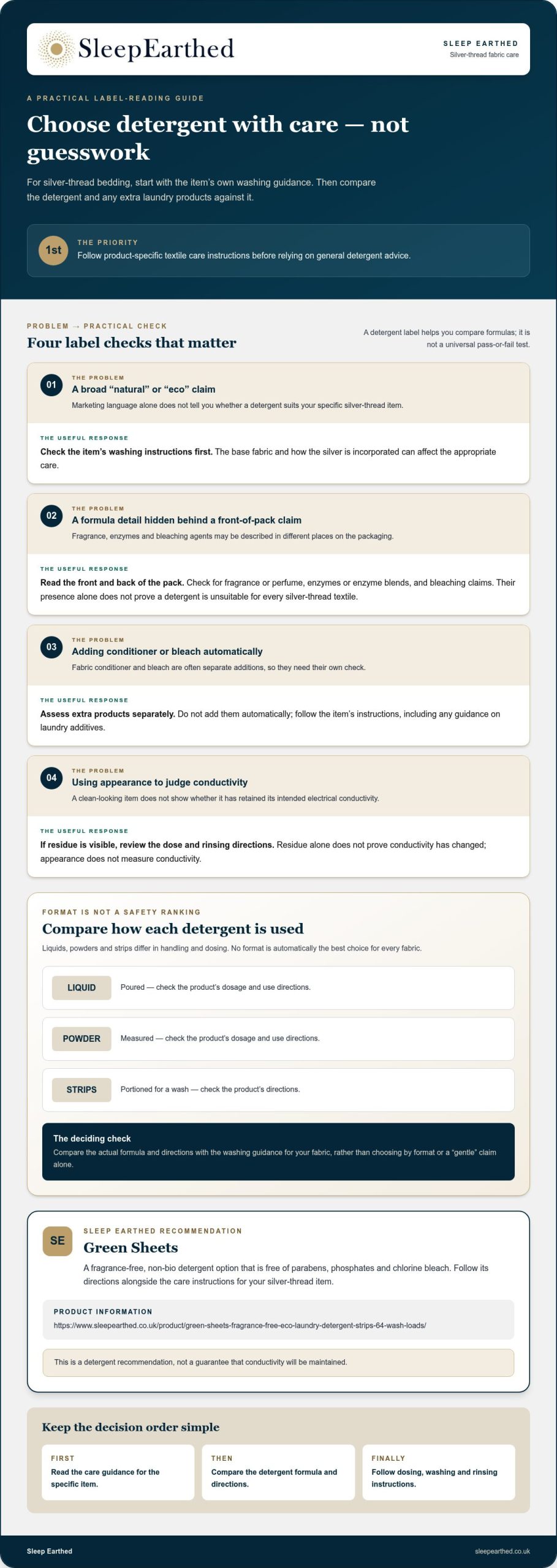
A detergent label helps you compare products, but it isn’t a universal pass-or-fail test for silver-thread fabric. Check for fragrance, enzymes, bleaching agents and fabric conditioners to understand more about the formula and how it is intended to work. Their presence alone doesn’t prove a detergent is unsuitable for every silver-thread textile.
Let the item’s care guidance govern your choice. It relates to the specific fabric and construction, while the detergent label describes the formula. Words such as “natural” or “eco” describe a product’s positioning, not necessarily its suitability for your item.
Fragrance, enzymes and other formula claims
Check both the front and back of the pack for fragrance or perfume claims. Look at the product information for enzymes, which may be described by function or as an enzyme blend. Bleaching claims may also appear prominently on packaging. A simpler formula can make products easier to compare, but it doesn’t guarantee compatibility. Check the details against the item’s care directions.
Fabric conditioner, bleach and residue concerns
Fabric conditioner and bleach are often separate laundry additions, so assess them independently from the detergent. Don’t add them automatically. Follow the item’s instructions, including any guidance on extra products. If detergent remains visible on the fabric after washing, review the dose and rinsing directions. Residue alone doesn’t prove that conductivity has changed.
As you compare products, ask yourself:
- Does the item’s care guidance restrict particular ingredients or laundry additives?
- Does the detergent label identify fragrance, enzymes or bleaching agents?
- Are you considering the whole formulation, rather than relying on one highlighted claim?
- Are you adding conditioner or bleach separately, and do the care instructions permit it?
These checks help you make a considered choice without treating every ingredient as a threat. A fragrance-free or non-bio label can narrow your options, but it doesn’t replace the textile’s washing guidance. Visible residue is a reason to review the amount used or the rinse directions, not proof of a conductivity change.
For a fragrance-free option, Sleep Earthed recommends Green Sheets. It is non-bio and free of parabens, phosphates and chlorine bleach. Follow its directions alongside the care instructions for your silver-thread item. The aim is to make an informed choice, not to treat any formula as a promise about conductivity.
How do detergent liquids, powders, and strips compare for silver fabric?
Liquid, powder and strip detergents differ in how you handle and dose them, but format alone doesn’t tell you whether a detergent suits a particular silver-thread textile. Formulations vary between products and brands. Compare the actual label and directions with the item’s care instructions instead of choosing solely for convenience or a “gentle” claim.
What to weigh up when comparing detergent formats
Liquid is poured, powder is measured and strips are portioned for a wash. Check the product’s dosage and use directions, then see whether they fit the washing instructions for your fabric. Clear product information makes comparison easier, but no format is automatically safer.
| Format | What to check | Limitations |
|---|---|---|
| Liquid | Ingredient information, dosing directions and any care-related instructions. | The liquid format alone doesn’t indicate whether the formula suits your textile. |
| Powder | Label details and how to measure the recommended amount for the wash. | Ease of measuring varies, and powder is not automatically more or less suitable. |
| Strips | Ingredients, directions and how the product is portioned for a load. | A pre-portioned format doesn’t establish compatibility with silver-thread fabric. |
Use the table as a comparison aid, not a ranking. Two liquids can have different formulations, just as two powders or two strips can. Read the information for the exact product you’re considering. A convenient dose or reassuring front-of-pack description doesn’t answer every care question.
If the item’s care guidance sets limits, follow them first. Then check whether you can use the detergent as directed within those limits. Don’t fill gaps in unclear label information with assumptions based on format or marketing language. What detergents are safe for silver fabric depends on matching the product information to the textile’s washing instructions.
Where Green Sheets fit into the comparison
Sleep Earthed recommends Green Sheets, a fragrance-free laundry strip option. The strip format makes it straightforward to portion detergent, while its product information gives you details to compare with your item’s care directions. Follow both sets of instructions. This recommendation is not a guarantee about conductivity or fabric lifespan.
Choose based on the label and the textile’s needs, not on whether the detergent comes as a liquid, powder or strip. Check the formulation and directions, then pick a format you can use as instructed. Convenience can make a routine easier, but it isn’t evidence of fabric compatibility.
How can you check a detergent label before washing silver fabric?
Make the label check in order: start with the care instructions for your item, compare them with the detergent’s directions and formulation, then consider anything else you plan to add to the wash. This keeps the textile’s requirements at the centre of your decision instead of letting one front-of-pack claim decide for you.
A simple label-checking sequence
- Check the textile instructions. Find the care label or product-specific guidance and note any limits on washing or laundry additives. Use the silver earthing sheet care guide linked earlier for washing-procedure details, rather than substituting general advice for the item’s own directions.
- Read the detergent information. Check the directions, dose guidance and listed formulation details. Consider the whole product, including claims about fragrance, enzymes or bleaching agents, rather than treating one ingredient as the only factor.
- Assess additional products. Include conditioner, stain treatments and bleach in your check. Leave out extra products unless the textile-care instructions allow them.
Use this checklist when comparing options: Does the detergent’s full formulation and its directions fit the item’s care instructions, and are any additional laundry products permitted?
Sleep Earthed recommends Green Sheets, a fragrance-free laundry detergent option. Compare its directions with the instructions for your particular textile before washing.
When conductivity or fabric condition raises questions
A visible deposit, a change in feel or an unexpected appearance after washing can prompt you to review the detergent dose, product directions and wash process. These observations may point to a care issue, but they aren’t a verified conductivity result. Looking clean or feeling different cannot, by itself, confirm whether electrical conductivity has changed.
For background on material considerations, Sleep Earthed’s silver-thread quality guide explains why the material matters. If you’re trying to understand a concern with an earthing sheet, the earthing sheet troubleshooting guide offers relevant next steps. A mark or residue is something to assess, not proof of a change in conductivity.
The practical answer to what detergents are safe for silver fabric is to match the detergent’s complete directions and formulation to the item’s own care guidance. For product-care information and suitable washing options, explore Sleep Earthed’s silver-thread bedding guidance.
Which detergent should Sleep Earthed readers choose for silver-thread bedding?
There isn’t one detergent that suits every silver-thread textile by default. Start with the washing guidance for your bedding, then choose a product whose label and directions fit it. This bases the decision on the item you own, not a general claim about a detergent type or ingredient.
A practical recommendation without overpromising
For silver-fabric care, Sleep Earthed recommends Green Sheets, a fragrance-free, non-bio detergent option. Its product information gives you a clear starting point for comparison. Before washing, read its directions alongside the care guidance supplied with your bedding, and use it as instructed.
This is a measured recommendation, not a claim that one detergent can restore conductivity or guarantee a particular result. Detergent selection is one part of textile care. Keep washing and drying choices consistent with the specific item’s instructions, even when a product seems convenient or is marketed as gentle.
Keep your care routine specific to the item
Once you’ve chosen a detergent, keep the routine consistent. Have the care information accessible, follow the product directions each time and avoid extra laundry products unless the textile instructions allow them. If you change detergent, check its formulation and directions again instead of assuming a similar format means an identical product. Similarly, bedding specialists such as My Store advise following precise manufacturer care instructions to preserve the lifespan of specialised sleep accessories.
A brief check before each wash can help:
- Confirm you’re following the guidance for this particular sheet or bedding item.
- Check that the detergent directions fit the recommended wash.
- Review any additional products you plan to use.
- If something seems amiss after washing, distinguish what you can observe from what would require a conductivity measurement.
A visible mark, residue or change in feel may be a reason to review the wash routine, but appearance alone doesn’t establish whether conductivity has changed. For care questions, use guidance relevant to the product rather than assumptions or instructions for a different textile.
So, what detergents are safe for silver fabric? Choose a clearly labelled product that can be used in line with the item’s own washing guidance. Green Sheets is Sleep Earthed’s recommended option, but the bedding’s product-specific instructions remain the guide. A thoughtful routine is more useful than expecting any detergent to guarantee fabric performance.
Explore silver-thread bedding and related care information at Sleep Earthed.
Make your next wash a considered one
Before your next wash, keep the care instructions for your silver-thread bedding close by. That makes it easier to check a detergent label and avoid relying on assumptions or a single marketing claim. The answer to what detergents are safe for silver fabric starts with the guidance for the specific item, followed by a careful look at the product directions.
For a detergent option, Sleep Earthed recommends Green Sheets, a fragrance-free laundry detergent strip. Use it in line with its directions and your bedding’s care guidance. No detergent should be treated as a guarantee of conductivity or fabric performance.
Explore Sleep Earthed bedding and care guidance for silver-thread earthing bedding and related care information. A little attention before washing can make it easier to care for your fabric with confidence.
Frequently Asked Questions
Can I machine-wash silver-thread bedding?
Yes, if the care instructions for your specific bedding allow machine-washing. Check the stated settings before starting rather than assuming all silver-thread items can be treated alike. Use detergent according to its label, and avoid other laundry products unless the item’s guidance permits them. Sleep Earthed recommends Green Sheets as a fragrance-free detergent option to consider.
Can I use stain remover on silver fabric?
Use a stain remover only if the item’s care instructions allow it and the product label says it is suitable for the textile. A treatment designed for ordinary clothing may not suit every silver-thread fabric. Check its directions before applying it, and don’t mix it with other laundry products unless both labels permit that use. If the care guidance doesn’t address stain treatment, avoid experimenting on the fabric.
Should I wash silver-thread bedding separately from other laundry?
Not necessarily. Follow the bedding’s washing instructions. If they allow a mixed load, sort laundry by colour and choose other items with compatible care requirements. For example, avoid combining a delicate sheet with garments whose fastenings or rough surfaces might snag it. Washing separately can be practical if you’re unsure about the other items, but it isn’t a universal requirement.
How often should I wash silver-thread bedding?
There isn’t one washing schedule for every person or product. Follow the care guidance supplied with your bedding and wash it when it needs freshening or has become soiled. Consider normal use and visible dirt rather than following a fixed interval that may not suit your circumstances. Use the recommended washing method each time.
Can hard water leave residue on silver fabric?
Hard water can contribute to mineral deposits on laundry, while detergent that hasn’t rinsed away may also leave visible residue. If you notice a mark or film, check the detergent dose and washing directions, and follow the bedding’s rinsing guidance. A deposit is something to investigate, but it doesn’t by itself show that the fabric’s conductivity has changed.
What should I do if my earthing sheet no longer tests as conductive after washing?
Repeat the test using the meter’s instructions and check that the sheet and testing connections are set up as directed. Make sure the sheet is dry before testing if its care guidance requires this. A single result doesn’t identify the cause, so don’t assume detergent is responsible. Sleep Earthed’s Test Meter can be used for checking, and its troubleshooting guidance can help you consider possible setup or product-care issues.