
 90 Day’s To Better Zzz’s Guarantee T&C apply

Earthing Sheet Myths and Facts: What Does the Evidence Say in 2026?
What if an earthing sheet makes the electrical connection it’s designed for, but that still doesn’t prove it improves your health? That distinction is central to earthing sheet myths and facts, and it can get lost when confident marketing claims appear alongside mixed research.
If you’re unsure what to believe, start by separating a measurable connection from a health outcome. A connection to earth can help explain how a sheet is intended to work, but it isn’t, by itself, evidence of better sleep, less pain or another health benefit. Research remains preliminary, and small studies can’t settle every question.
This guide separates proposed explanations from proven outcomes, looks at what research can and can’t tell us, and offers practical ways to assess product claims and connection guidance. The aim is to help you make an informed decision without relying on hype or personal stories alone.
Key Takeaways
- Use earthing sheet myths and facts to distinguish an intended earth connection from claims about what a sheet may do for your health.
- Understand the basic connection pathway and the role of conductive materials, such as the silver threads in Sleep Earthed bedding.
- Separate proposed explanations, early research and personal reports from established clinical findings.
- Follow the product instructions and test guidance when checking a sheet’s connection. A test result is not proof of health benefits or overall safety.
- Compare materials, intended use and the clarity of claims, then decide whether trying a sheet feels worthwhile given the uncertainty and individual differences.
Earthing Sheet Myths and Facts: What Does “Grounded” Actually Mean?
Wellness claims can make earthing sheets sound straightforward, yet it’s worth asking what “grounded” means and whether a connection proves anything about health. To make sense of earthing sheet myths and facts, first separate a product’s intended function from the outcomes people hope it might deliver.
An earthing sheet is bedding designed to create an electrical connection between its conductive material and earth. That intended connection does not, by itself, demonstrate a health benefit. “Grounding” and “earthing” are commonly used for the same general practice in this context. The terms describe the idea, not proof that a product works as claimed.
For a neutral overview of the concept and the debate around it, see What is earthing. It also helps explain why wellness language shouldn’t be mistaken for an established medical term or conclusion.
To hear a discussion of the claims and questions around grounding, watch this video:
Myth: “Earthing” and “grounding” mean different things
In discussions of earthing sheets, these terms generally refer to the same proposed practice: connecting a person or conductive product to earth. A change in wording doesn’t change what a sheet is designed to do, and neither term proves a medical effect. Look beyond the label. Check the product’s materials, instructions and the evidence for any specific benefit being claimed.
Fact: a product claim needs more than a plausible explanation
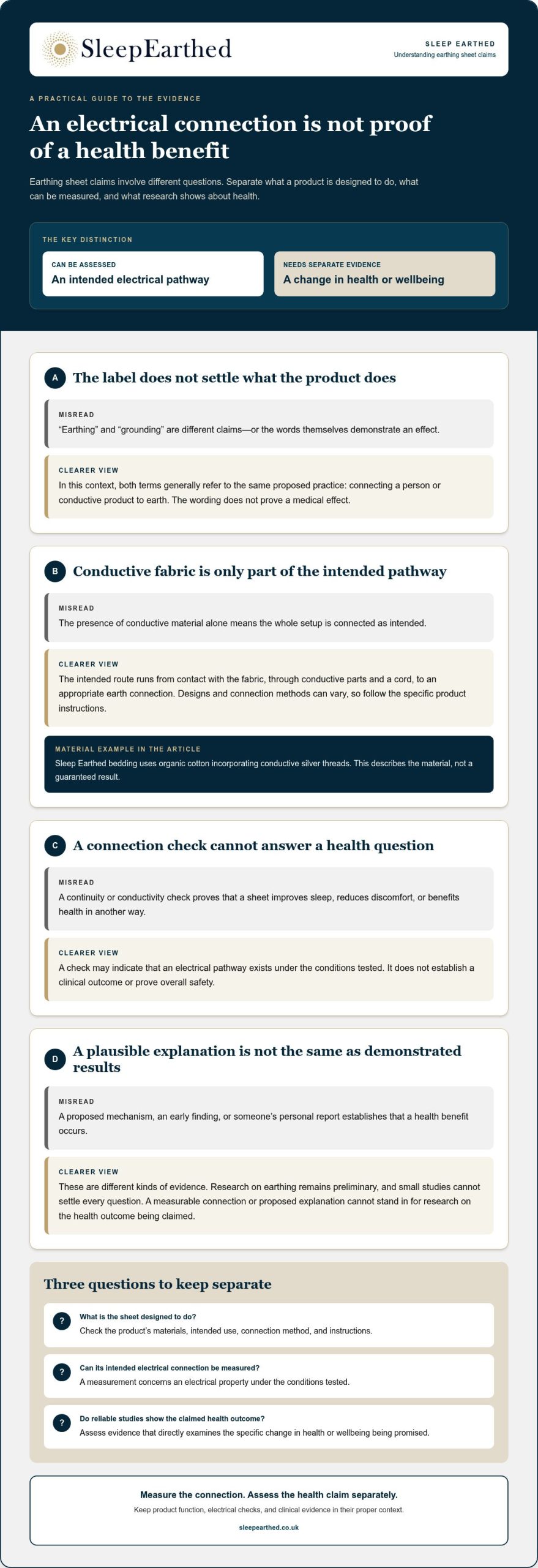
Ask three separate questions. What is the sheet designed to do? Can its intended electrical connection be measured? Do reliable studies show that using it improves a health outcome? Each question calls for a different kind of evidence.
A proposed mechanism is an explanation of how something might work. A measurement can show an electrical property under the conditions tested, but it can’t establish that someone will sleep better or feel less pain. Clinical outcomes are changes in health or wellbeing assessed through research with people. Each step needs its own evidence: a plausible explanation or measurable connection can’t stand in for demonstrated results.
When assessing a claim, check exactly what has been measured and whether the evidence relates to the outcome being promised. Next, consider how an earthing sheet is intended to make its connection.
How Earthing Sheets Are Intended to Work: Connection, Conductivity and Claims
An earthing sheet’s intended function depends on a connected pathway, not simply on the presence of conductive material. In general terms, conductive parts of the fabric connect through a cord to an appropriate earth connection. The intended route runs between the person in contact with the fabric and earth. Designs and connection methods can vary, so follow the instructions for the specific product rather than assuming every sheet is set up in the same way.
Demonstrating an electrical connection is not the same as demonstrating a health benefit. A continuity or conductivity check may indicate that an electrical pathway exists under the conditions tested. It can’t show that using the sheet improves sleep, reduces discomfort or produces another health outcome. Those claims need evidence that directly examines the outcome in people.
What do conductive threads do in an earthing sheet?
Conductivity describes a material’s ability to support the movement of electrical charge. In bedding, conductive threads are incorporated into the fabric and form part of the intended pathway to earth. Sleep Earthed bedding uses organic cotton incorporating conductive silver threads. This describes the material, not a guaranteed result. Performance depends on the product and its connection being used as directed.
A conductive thread can form part of a pathway, but it doesn’t independently establish that the whole setup is connected as intended or that the connection changes health. A material label alone confirms neither point. When comparing products, look for clear information about both the fabric and the connection method.
Does an electrical explanation prove the health claims?
No. An explanation of how a connection might work is a proposed mechanism. It may offer a reason to investigate a product, but it isn’t evidence that a particular benefit occurs. Even if a connection can be measured, that measurement concerns an electrical property, not a clinical outcome such as a change in sleep or wellbeing.
Claims about electron transfer are sometimes used to explain the theory behind earthing. That language doesn’t establish that electrons produce a therapeutic effect. Each claimed outcome needs suitable research of its own; it can’t be inferred from conductive material or a measurable connection. The clinical perspective on earthing also discusses the limitations of the available evidence, a useful reminder to read health claims cautiously.
For a product example, you can review Sleep Earthed bedding and consider its materials and instructions alongside the evidence. In the wider picture of earthing sheet myths and facts, assess the connection and any claimed outcome as separate questions.
Earthing Sheet Health Claims: What Research Shows and What Remains Uncertain
Health claims about earthing sheets don’t all rest on the same kind of evidence. Ask whether you’re reading about a proposed explanation, an early research finding, someone’s personal experience or an established clinical result. These categories shouldn’t be treated as interchangeable.
- Proposed mechanism: an explanation of how earthing might affect the body. It’s a theory to investigate, not proof of an outcome.
- Preliminary research: early findings that may prompt further study, but need careful assessment and confirmation.
- Personal report: an individual’s account of what they noticed. It can be meaningful to them, but doesn’t establish cause and effect.
- Established clinical finding: an outcome supported by a sufficiently reliable body of research. Claims made for earthing sheets shouldn’t be presented as established clinical benefits without that level of evidence.
The research on the health implications of earthing reviews proposed mechanisms and research in this area. When reading a review, look at the studies it discusses and consider their design and limitations. The existence of a published paper doesn’t prove that every claim has been confirmed.
Myth: a personal success story proves the sheet caused the change
Someone may genuinely feel that a sheet helped them. Their experience deserves respect, but a story alone can’t show what caused the change. Sleep, for example, can also be influenced by routine, the bedroom environment and other factors. Without a way to separate these influences, one person’s improvement can’t establish that the sheet will have the same effect for someone else.
Fact: promising or preliminary findings still need careful interpretation
Before relying on a study, check what it tested: its design, the number and characteristics of participants, whether it included a comparison group, and which outcome it measured. A finding about one outcome doesn’t automatically support a different claim. Results from a limited study can’t justify broad promises for every user.
That calls for measured language rather than a sweeping verdict. Current uncertainty calls for caution, not medical certainty. The available information shouldn’t be used to declare earthing sheets proven treatments or to conclude definitively that they can have no effect. Claims should match the strength and scope of the research.
When weighing earthing sheet myths and facts, keep personal reports and early findings in perspective. Earthing products shouldn’t replace medical advice or prescribed treatment. If you have a health concern, speak with an appropriate healthcare professional rather than relying on a bedding product to address it.
How to Check Earthing Sheet Claims and Connection Without Guesswork
A check can help you understand whether a sheet appears to have the intended electrical pathway, but it can’t answer every question about the product or its effects. Use the instructions supplied for the specific sheet, as designs and connection methods can vary. Don’t assume a test method or result applies to every product.
- Read the product instructions first. Check how the sheet is meant to connect and what equipment, if any, the instructions specify.
- Check the intended connection. Follow the maker’s guidance for that particular setup. A cord being attached doesn’t, on its own, show that the connection is correct.
- Use only the supplied test guidance. Follow its stated method and interpretation. If the instructions don’t cover your setup or the result is unclear, pause rather than guessing.
For help understanding the intended arrangement, refer to the grounding sheet setup guide. If something seems wrong or you can’t make sense of a result, review the earthing sheet troubleshooting guidance.
What can a conductivity check tell you?
A suitable check, performed as instructed, may indicate whether electrical continuity exists along the pathway being checked. Continuity means there is an electrical route between the points tested. The result applies to that check and its conditions. It doesn’t establish overall product quality, confirm that every part of a setup is safe or verify a health claim.
A continuity result also can’t show whether reported changes in sleep or wellbeing were caused by grounding. That question requires evidence about health outcomes, not an electrical measurement. Keep the two kinds of information separate when reviewing a product or your own experience.
What should you do if the connection is unclear?
Stop and return to the product instructions if the connection or test result doesn’t make sense. Don’t improvise a test method or draw conclusions from a result the guidance doesn’t explain. If you’re unsure about a product-specific step, contact Sleep Earthed with your question. For concerns about the electrical setup itself, seek advice from an appropriately qualified person rather than treating a sheet test as an electrical safety check.
That’s the sensible approach to earthing sheet myths and facts: verify only what the instructions say a check can verify, and don’t turn a connection result into proof of a health effect. To review the bedding and its intended use, view Sleep Earthed earthing sheets.
Choosing an Earthing Sheet with Realistic Expectations
Once you’ve separated the intended electrical connection from health claims, choosing a sheet becomes a practical decision. Compare the materials, how each product is meant to connect, how clear its instructions are and whether its claims are presented carefully. These details can help you assess the product, but they can’t predict how you’ll feel.
Which questions should you ask before trying an earthing sheet?
Before deciding, check whether the product information answers these questions clearly:
- What materials are used? Look for a plain description of the fabric and any conductive components.
- How is it intended to connect? The product instructions should explain the setup. Vague phrases such as “balances your body” aren’t evidence of an effect.
- What does the evidence support? Be cautious if a product page presents a proposed mechanism or personal testimonial as confirmation of a health outcome.
- Does it suit your bedding needs? Check the product’s intended use and practical instructions, then consider whether it fits your preferences, separately from any possible health effects.
For a closer look at the evidence and its limitations, read research on whether earthing sheets work. It’s a useful next step if you want to weigh the claims before deciding whether to try one.
How can you keep expectations balanced?
If you choose to use an earthing sheet, notice your own experience without treating it as scientific proof. Changes in sleep or wellbeing may have more than one influence, and people can respond differently. Keeping a simple note of what you notice may help you reflect, but it won’t establish what caused a change.
Sleep Earthed offers earthing bedding made with conductive silver threads in organic cotton. This information about the materials and intended use can help you decide whether the bedding suits your needs, but it isn’t a promise of a medical result. Earthing products shouldn’t replace prescribed treatment or advice from a healthcare professional. If you have a health concern, seek appropriate medical advice.
The most sensible approach to earthing sheet myths and facts is neither to accept every promise nor to dismiss your own curiosity. Check the details, keep expectations measured and choose what feels right for you. You can review Sleep Earthed earthing bedding as one option.
Make an Informed Choice About Earthing Bedding
The clearest lesson from these earthing sheet myths and facts is that an intended electrical connection and a proven health benefit are two different things. A check may help assess the connection when carried out as instructed, but it can’t show that a sheet caused a change in sleep or wellbeing.
Research into earthing remains uncertain, so weigh claims carefully. Look for clear details about materials, intended use and instructions, and treat personal stories as individual experiences rather than proof of what will happen for you. If you have a health concern, seek appropriate medical advice.
Sleep Earthed offers UK-sized fitted earthing bed sheets made with organic cotton and conductive silver threads. These details explain the materials and intended design, not a guaranteed or medically established outcome. Take your time, review the product information and decide what suits your needs.
Explore Sleep Earthed earthing bedding and make your next step with clear expectations.
Frequently Asked Questions
Do earthing sheets really work?
An earthing sheet can work as designed to create an electrical connection to earth, but that doesn’t establish that it produces a health benefit. Consider two separate questions: whether the sheet and its connection provide the intended conductive pathway, and whether reliable research demonstrates the health outcome being claimed. Evidence for benefits remains limited, so treat broad promises cautiously and look for clear explanations of what has actually been tested.
Are earthing sheet health benefits scientifically proven?
No established health benefit should be assumed from the available evidence. Research into earthing includes preliminary findings, but limited studies don’t automatically support broad claims for every person or product. A useful way to approach earthing sheet myths and facts is to check what a study measured, how it was designed and whether its findings have been confirmed. A plausible explanation or personal testimonial isn’t the same as proof of a clinical benefit.
Can an earthing sheet improve sleep?
Some people report changes in their sleep, but personal experiences can’t establish that a sheet caused them. Sleep can be influenced by factors such as routine and bedroom environment, and people may respond differently. Research into earthing and sleep remains limited, so improvement isn’t guaranteed. If you choose to try a sheet, consider your own experience without treating it as scientific proof or a replacement for seeking help about ongoing sleep concerns.
How does an earthing sheet connect to the earth?
An earthing sheet is designed to connect its conductive material to earth through a suitable connection, following the product’s instructions. For example, Sleep Earthed bedding uses conductive silver threads in organic cotton. The exact connection method can vary, so follow the guidance supplied with your sheet rather than assuming all products are set up in the same way. A described connection explains intended use, not proof of a health outcome.
How can I test whether my earthing sheet is conductive?
Use only a suitable test method described in the instructions for your specific sheet. A check performed as directed may indicate whether there’s electrical continuity along the points tested. It can’t establish that the whole setup is safe, confirm overall product quality or show that grounding caused a health change. Don’t guess at readings or test methods. If the instructions don’t explain your result, pause and seek product-specific guidance.
Are earthing sheets safe to use overnight?
Don’t assume every sheet or setup is safe simply because it’s intended for overnight use. Follow the product instructions and use only the connection method specified for that sheet. If a cord, connection or test result is unclear, stop and review the guidance before continuing. A continuity check isn’t a complete electrical safety assessment. If you’re concerned about the electrical setup, seek advice from an appropriately qualified person.
Can I use an earthing sheet instead of medical treatment?
No. An earthing sheet shouldn’t replace prescribed treatment, medical advice or care for a health concern. The evidence for claimed health benefits remains uncertain, and a product’s intended electrical connection doesn’t establish that it can treat a condition. If you’re considering changing or stopping treatment, speak with your healthcare professional first. You can discuss personal experiences with them, but don’t rely on a bedding product as a substitute for appropriate care.