
 90 Day’s To Better Zzz’s Guarantee T&C apply
Grounding Sheet Setup Guide: How to Properly Install Your Sleep Earthed Bedding
Does the idea of plugging your bedding into a UK wall socket feel a bit like mixing water and electricity? It’s a question we hear almost daily at Sleep Earthed, and it’s completely natural to feel a flutter of hesitation when you first look for a grounding sheet setup guide. You want the restorative benefits of the Earth’s electrons to help with morning stiffness, but you also want to know, with absolute certainty, that your sanctuary remains safe and shock-free. We understand that the technical side of earthing can seem daunting, especially with recent updates to UK electrical standards like the British standard on earthing in homes BS 7671.
This guide is designed to replace that uncertainty with total confidence, walking you through every step to ensure your silver-threaded bedding is perfectly synced with the ground beneath your home. We’ll explore how to verify your home’s wiring using a simple socket tester, the clever safety role of the 100kΩ resistor, and the practical checks you can perform to prove those electrons are truly flowing whilst you sleep. By the time you’ve finished reading, you’ll have a perfectly installed grounding station and the peace of mind that comes with a job well done.
Key Takeaways
- Learn how to identify your components and follow our grounding sheet setup guide to ensure your silver threads are properly connected for maximum sleep recovery.
- Understand the difference between using a standard UK 3-pin plug and a Grounding Rod Kit, allowing you to choose the most effective connection for your home’s specific wiring.
- Discover how to use a Sleep Earthed Test Meter to verify your connection, providing absolute certainty that electrons are transferring safely whilst you sleep.
- Master the simple care routine required to keep your silver-threaded bedding conductive, including why regular washing is essential for long-term performance.
- Successfully install your earthing station to help reduce morning stiffness and improve your overall sleep quality through reliable, natural grounding.
Getting Started with Your Sleep Earthed Grounding Sheet
When your parcel arrives from our UK manufacturing facility, the first thing you’ll notice is the weight and quality of the organic cotton. By the way, did you know that Sleep Earthed are the only company in the world that manufactures their sheets in the UK – all the rest are 100% made in China ? Inside the package, you’ll find three essential components: your Sleep Earthed fitted sheet, a dedicated connection cord, and a specially designed UK earthing plug. Before you head to the bedroom, take a moment to unfold the fabric and hold it up to the light. You’ll see a fine grid of silver threads woven directly into the cotton. These aren’t just for show; they are the conductive "engine" of your bedding. As you follow this grounding sheet setup guide, checking that these threads are visible and consistent across the surface ensures you’ll have a reliable connection from day one.
We chose a fitted design specifically because it stays taut against the mattress. A loose sheet can bunch up or slide, which often breaks the vital contact between your skin and the conductive silver. By keeping the surface flat and secure, we ensure that whether you’re a side sleeper or someone who moves around at night, you’re always in the "sweet spot" for electron transfer. It’s a simple design choice that makes a significant difference to the consistency of your sleep recovery.
Understanding the Science of the Connection
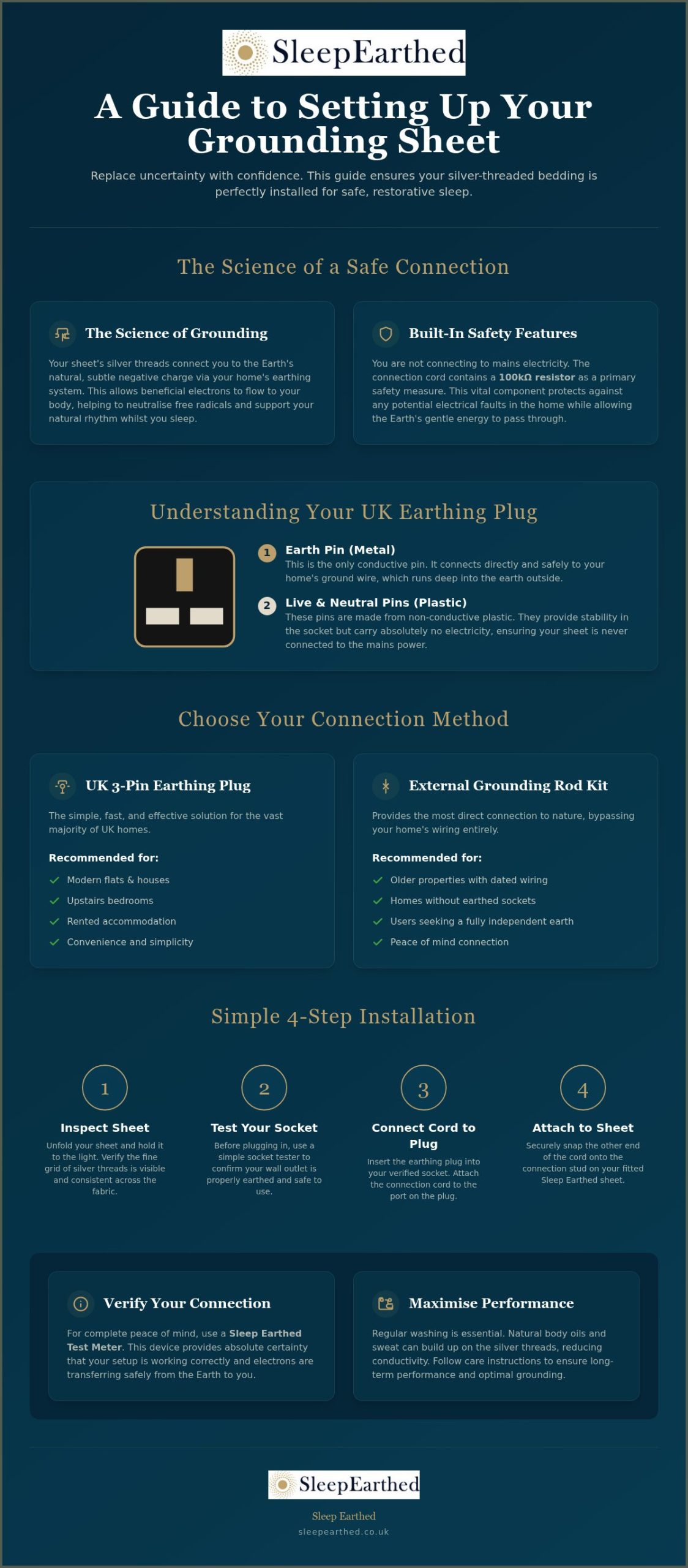
The Concept of Earthing relies on the simple physical principle that the Earth carries a subtle negative electrical charge. When your skin touches the silver threads, your body effectively becomes part of this circuit. Electrons flow from the ground, through your home’s earthing system (or a grounding rod), and into the sheet. Organic cotton is our preferred carrier because it’s breathable and natural, allowing these electrons to move freely whilst keeping you comfortable. It’s this direct skin contact that facilitates the physiological benefits, helping to neutralise free radicals and support your body’s natural rhythm. If you’d like a deeper understanding of the principles behind this practice before continuing with your setup, our complete UK guide to grounding and earthing for better sleep and recovery covers the science and terminology in full.
Safety First: Dispelling UK Electrical Myths
It’s perfectly normal to feel a bit wary about "plugging in" your bed. However, our earthing plugs are fundamentally different from those on your toaster or lamp. The two bottom pins (live and neutral) are made of non-conductive plastic. Only the top pin, the earth pin, is metal. This means no electricity from your mains supply ever reaches the sheet. We’ve also built a 100kΩ safety resistor into every connection cord. This acts as a protective limit, guarding against rare electrical faults in the home whilst allowing the tiny, beneficial electrons to pass through. You aren’t connecting to the power; you’re simply using the safety "drain" of your house to reach the ground safely.
Choosing Your Connection: UK Mains Plug vs External Grounding Rod
One of the most frequent questions we receive at Sleep Earthed is whether it’s better to use the wall socket or go straight into the garden. There isn’t a single "right" answer; it’s about what works best for your specific home and lifestyle. This part of our grounding sheet setup guide helps you weigh up the convenience of the UK mains plug against the directness of an external rod. We provide both options because we want you to have maximum flexibility, ensuring you can find a setup that feels right for you without any technical stress.
When to Use the UK Earthing Plug
For the vast majority of our customers, the UK 3-pin earthing plug is the ideal solution. It’s perfect for those living in modern flats, terraced houses, or upstairs bedrooms where trailing a wire outside simply isn’t practical. Since UK electrical standards are some of the highest in the world, your home’s earth terminal is a reliable and safe pathway to the ground. It’s a true "plug and play" experience. You don’t need any tools, and you don’t need to worry about the weather. If you have a standard grounded socket near your bed, you’re ready to go in seconds. It’s also the best choice for anyone in rented accommodation who can’t start running permanent cables through window frames or wall vents.
The Benefits of an External Grounding Rod
While the plug is convenient, some people prefer the peace of mind that comes with bypassing the house’s electrical system entirely. If you live in a much older property with dated wiring, or if you simply want the most direct link to nature possible, the Grounding Rod Kit is for you. This method is often favoured by those who have read the research on grounding and inflammation and want to replicate those study conditions as closely as possible by connecting directly to the soil.
To set this up, you’ll need access to a patch of soft earth or a garden border near your bedroom window. You simply push the stainless steel rod into the ground and run the thin, long-reach cable through a window gap or a wall vent. It’s a straightforward process that takes about ten minutes. If you’re looking for that "pure" connection and have easy access to a bit of soil, this is a brilliant way to go. For a full walkthrough of the process, our complete guide on how to install a grounding rod kit covers every step in detail, including how to avoid underground cables and route your connection safely. If you’re ready to make the switch to a more direct connection, you can find our Grounding Rod Kit in our online shop. Just remember to consider your proximity to the garden and whether you’re happy to have a small cable passing through your window frame before you decide.
Step-by-Step Installation Guide for Your Earthing Bedding
Once you’ve decided on your connection method, it’s time for the physical assembly. This grounding sheet setup guide makes the process as simple as changing your usual duvet cover. Following these steps ensures you have a reliable, long-lasting connection for your sleep sanctuary.
- Step 1: Fit your Sleep Earthed sheet onto the mattress. Because our sheets are tailored to UK bed sizes, they should feel snug and secure without any loose bunching or sliding. We suggest giving the sheet a quick wash before use, but that’s optional.
- Step 2: Locate the metal connection stud. You’ll find this small, circular snap on the corner of the sheet, usually positioned so it sits near the headboard or top of the bed.
- Step 3: Attach the coiled cord. Take the "snap" end of the cord and press it firmly onto the sheet’s stud until you hear or feel a distinct click. Connect the other end to your earthing plug.
- Step 4: Insert the plug into your wall socket. In the UK, the earth connection is always active, so it doesn’t matter if the socket switch is in the "on" or "off" position.
- Step 5: Safety check. Route the cord under the bed frame or along the skirting board. This keeps your bedroom tidy and prevents the cord from becoming a tripping hazard if you get up during the night.
Positioning Your Grounding Sheet for Best Results
Whilst some people prefer to place a thin, natural fibre sheet over their earthing bedding, direct skin contact is always the gold standard. The silver threads work most efficiently when they touch your body directly. If you do choose to use a secondary sheet, ensure it’s made of 100% cotton or linen, as synthetic materials can block the flow of electrons. Keeping the cord tidy is also vital; a coiled cord is great for flexibility, but tucking it neatly away ensures your bedroom remains a calm, clutter-free space. Most users find that placing the connection stud at the head of the bed keeps the cable entirely out of the way.
Setting Up the Earthing Pillowcase and Half Sheets
If you’ve added an Earthing Pillow Case or a Half Sheet to your setup, you can target specific areas like the head, neck, or lower back. Many of our customers use multiple products at once to maximise their recovery. You can either use a second earthing plug in a nearby socket or use a splitter if you’re short on space. The key is ensuring everything shares a common ground. This approach is perfectly safe and ensures your entire body is supported by the Earth’s natural charge throughout the night, whether you’re using a full fitted sheet or just a targeted Half Sheet.
Verifying the Connection: How to Test Your Grounding Setup
Whilst some sources suggest you’ll simply "feel" the difference once you’re grounded, we believe technical verification is the only way to be 100% certain. Subjective sensations like a slight tingle or a sense of relaxation are wonderful, but they aren’t a substitute for a physical test. This stage is the most satisfying part of any grounding sheet setup guide because it provides the "aha!" moment when you see the science in action. By using a dedicated meter, you can confirm that your sanctuary is correctly established and that electrons are free to move from the Earth into your body.
The "Is It Working?" Peace of Mind
Using the Sleep Earthed Test Meter is a straightforward process that takes less than a minute. You simply connect one lead to the earth pin of your socket and touch the other lead to various points on your sheet. When you get the correct reading it confirms that your circuit is complete. Continuity is the uninterrupted path for electrons to flow from earth to skin. If the light doesn’t appear, don’t panic. It’s often something simple, like a cord that hasn’t quite clicked into place or a bit of dust on the connection stud. Over many years, silver can also oxidise if not cared for properly, which can occasionally hinder the connection, but a quick test helps you identify these minor issues before they affect your sleep recovery.
Troubleshooting Common Setup Issues
If your test fails, the first place to look is the wall socket itself. In some older UK properties, particularly those that haven’t been rewired in several decades, you might find a socket that isn’t actually grounded. This is rare, but it’s a vital safety and functional check. You should also inspect your connection cord for any internal breaks. Whilst the cords are durable, they can sometimes be damaged if they are pinched by a heavy bed frame or pulled too tight. If you find yourself staring at a dark meter and aren’t sure why, we’ve put together a detailed earthing sheet troubleshooting guide to help you find the fix.
Getting your setup right from the start means you won’t have to guess if you’re receiving the benefits. If you want to take the guesswork out of your routine, you can find our Sleep Earthed Test Meter in our shop. It’s a small investment for the total confidence that your bedding is performing exactly as it should be, night after night.
Maximising Performance and Caring for Your Conductive Silver Bedding
Setting up your bedding is only the first step. To keep those electrons flowing year after year, you need to understand how to maintain the silver threads that make the magic happen. Many people worry that washing will wear out the conductivity, but the opposite is actually true. Over time, your body’s natural oils, perspiration, and any skin lotions you use can build up on the fabric. This creates a non-conductive film over the silver threads. Regular washing strips away these barriers, keeping the metal surface clean and ready to transfer electrons. In our experience, a sheet that is washed regularly performs significantly better than one left on the bed for months on end. For a full breakdown of the correct techniques, our guide on how to wash grounding sheets explains exactly which products and temperatures to use without damaging the silver fibres.
As we move through 2026, we find that a well-maintained Sleep Earthed sheet typically remains highly effective for around 2+ years. Eventually, silver will naturally oxidise or wear down from physical friction, but following a strict care routine ensures you get the maximum value from your investment. This grounding sheet setup guide wouldn’t be complete without emphasising that what you don’t use in the laundry is just as important as the washing itself.
The Sleep Earthed Care Routine
Stick to a 40°C wash cycle with a mild liquid detergent. You must avoid bleach, whitening agents, and fabric softeners at all costs. These chemicals are far too aggressive and will tarnish the silver threads, essentially turning your earthing sheet into a standard cotton one. Regarding the drying process, air drying is the gentlest method for the silver. If you must use a tumble dryer, keep it on a low heat setting. High heat can damage the delicate bond between the silver and the cotton fibres. We recommend washing your sheet every one to two weeks to maintain optimal electron flow with Green Sheets detergent.
Beyond the Bed: Expanding Your Grounding Station
Your bedroom is the primary recovery zone, but you don’t have to stop there. Many of our customers integrate a conductive yoga mat into their morning routine to stay grounded whilst stretching or meditating. If you’re often away from home, using an earthing recovery bag is an excellent way to maintain your connection in hotels or whilst camping. It’s about creating a consistent environment of grounding that supports your well-being wherever you happen to be.
To conclude your setup, run through this final checklist: is the sheet snug on the mattress? Is the cord firmly clicked into the stud? Is the plug in the wall? Have you verified the connection with your meter? If the answer is yes, you’ve successfully established your grounding station. You can now rest easy, knowing your Sleep Earthed bedding is working hard to support your recovery while you sleep.
Ready for a Restorative Night’s Sleep?
You now have all the tools and knowledge needed to transform your bed into a high-performance recovery station. From choosing between a UK mains plug and an external rod to mastering the washing routine that keeps your silver threads active, this grounding sheet setup guide has covered the essentials for a perfect connection. Remember that testing your setup with a meter is the only way to swap uncertainty for absolute confidence in your sleep environment. It’s a simple check that ensures you’re receiving the full benefits of the Earth’s electrons every single night.
All our sheets pillowcases and meditation mats are manufactured in the UK at our dedicated facility in Herefordshire, ensuring the highest standards of craftsmanship. Our friendly team is always on hand if you need a bit of extra technical support to get things just right. We’re so confident in the quality of our bedding that we provide a 90-day better-sleep guarantee to give you total peace of mind. Browse our range of UK-made Sleep Earthed fitted sheets and start your journey toward reduced morning stiffness and deeper recovery today. You’re only a few clicks away from a more natural, grounded way to rest.
Frequently Asked Questions
Is it safe to use a grounding sheet during a thunderstorm?
Yes, it’s safe to use your bedding during a storm because our connection cords include a 100kΩ resistor designed to limit current. However, if a lightning strike is very close, the massive surge could theoretically bypass standard home protection. For absolute peace of mind, some of our customers choose to unplug their sheet until the weather clears. It’s a bit like unplugging your television; it isn’t strictly required, but it’s a sensible precaution during severe electrical activity.
Can I use an extension lead with my earthing plug?
You can use an extension lead as long as it is a grounded UK model with a functional earth connection. Most standard multi-way blocks in the UK are earthed, but it’s worth checking with a socket tester first. If the extension lead is faulty or ungrounded, your sheet won’t be able to transfer electrons. This is a common query in our grounding sheet setup guide, as many bedrooms have limited wall sockets near the bed.
Do I need to have the wall socket switched on for the sheet to work?
No, you don’t need to have the switch in the "on" position for the earthing to function. In a standard UK 3-pin socket, the earth terminal is permanently connected to the ground regardless of whether the power is flowing to the live pin. This means you can keep the switch off to save energy or if you simply prefer it that way. Your Sleep Earthed sheet will continue to work perfectly throughout the night.
Can I wear pyjamas whilst using a grounding sheet?
You can certainly wear pyjamas, though direct skin contact with the silver threads is always the most effective way to ground. If you prefer to wear nightwear, stick to natural materials like 100% cotton, silk, or wool. These fibres allow for better electron transfer than synthetic polyesters. Even with a thin layer of clothing, the subtle moisture from your skin helps maintain the connection, ensuring you still receive the benefits of your grounding station.
Will the grounding sheet work if I have a mattress protector underneath?
Yes, a mattress protector placed underneath your Sleep Earthed sheet will not interfere with the grounding process. Since your body is touching the earthing sheet directly on top, the layers beneath it don’t affect the flow of electrons from the earth to your skin. Just ensure the fitted sheet is snug and makes good contact with your body. The protector simply stays where it belongs, keeping your mattress clean without blocking your recovery. But putting another sheet over the top is not good practice at all – See here for why.
How do I know if my UK wall socket is properly earthed?
The most reliable way to check your socket is by using a dedicated socket tester or our Sleep Earthed socket tester. Whilst UK wiring is generally excellent, older properties can sometimes have "floating" earths or loose connections. A tester provides an immediate visual confirmation that the earth pin is correctly linked to the ground. It’s a small step that gives you total confidence that your bedding is performing exactly as it should. If you find your socket isn’t properly earthed and want to explore an alternative, our step-by-step guide to installing a grounding rod kit explains how to bypass your home’s wiring entirely for a direct soil connection.
Can pets use the grounding sheet with me?
Pets are more than welcome on your grounding sheet and they often gravitate toward it naturally. Animals are very sensitive to the Earth’s energy and they can benefit from the same inflammatory support as humans. Their fur won’t block the connection, and as long as they are touching the sheet, they’ll be grounded too. It’s a lovely way to share the restorative benefits of your Sleep Earthed bedding with your four-legged companions.
What happens if I accidentally wash my sheet with fabric softener?
If you accidentally use fabric softener, the silver threads will become coated in a non-conductive layer. This will if you continue to do this stop the sheet from working. You should wash the sheet again immediately on a 40°C cycle using a mild liquid detergent and no additives. This second wash should strip away the fabric softener and restore the conductivity, as detailed in our grounding sheet setup guide maintenance section. For a complete overview of safe washing methods that protect your silver threads long-term, our complete care guide for washing grounding sheets walks you through every step. If you’re also weighing up which base fabric best supports long-term conductivity and skin comfort, our guide comparing organic cotton vs regular cotton grounding sheets explains how your choice of fabric affects both performance and durability.