
 90 Day’s To Better Zzz’s Guarantee T&C apply
Earthing Sheet Troubleshooting: Step-by-Step UK Guide 2026
Imagine waking up after several weeks of use and wondering if those silver threads are still doing their job or if a few trips through the washing machine have silenced them. It’s a common worry we hear at Sleep Earthed; that nagging doubt that your investment might just be an ordinary piece of cotton now. Effective earthing sheet troubleshooting doesn’t require a degree in electrical engineering, but it does require a little bit of practical know-how to ensure your connection to the ground is solid.
It’s completely natural to want physical proof that your wellness tools are performing as they should rather than just taking it on faith. We’ll help you swap that uncertainty for total confidence by showing you exactly how to verify your equipment is working perfectly. This guide walks you through the simple steps to test your setup, from checking your UK plug sockets to mastering basic multimeter settings or using our bespoke Sleep Earthed Test Meter for a stress-free check.
Key Takeaways
- Gain physical proof that your equipment is working so you can enjoy a perfectly earthed sleep without any lingering doubts.
- Understand the practical differences between testing for sheet continuity and measuring your own body voltage using a standard multimeter.
- Use our professional earthing sheet troubleshooting steps to isolate faults in your connection lead or verify the earth bond in your home’s electrical sockets.
- Discover the best ways to care for your silver-threaded bedding to maintain high conductivity and protect your Sleep Earthed 90-day guarantee.
Why Testing Your Earthing Sheet is Essential for Better Sleep
When you climb into bed, you can feel the softness of the organic cotton and the quality of the weave. However, the most important part of your Sleep Earthed bedding is actually something you can’t see or feel: the flow of electrons from the ground into your body. Because this process is entirely invisible, relying on a "set and forget" mentality can leave you wondering if you’re actually getting the benefits you paid for. Physical verification is the only way to be certain that the silver threads are still doing their job correctly.
These silver threads act as a conductive highway. They are woven into the fabric at high density to ensure that no matter how you toss and turn, you remain connected to the earth’s surface. Over time, however, life happens. Body oils, skin creams, and even the minerals in your local UK tap water can build up on these delicate silver fibres. Silver can also oxidise when exposed to certain chemicals or heavy perspiration, which may eventually hinder its performance. This is why earthing sheet troubleshooting isn’t just for when things go wrong; it’s a vital part of maintaining your wellness investment and ensuring your sleep environment remains effective.
Does Grounding Work if I Cannot Feel It?
It’s a question we get asked often: "Should I feel something?" The short answer is usually no. Whilst some sensitive individuals report a slight tingle amongst the silver threads, most of us feel nothing at all. This lack of sensation often leads to the mistaken belief that the sheet isn’t working or that any benefits are simply a placebo effect. To understand the science better, it helps to look at the broader context of Energy medicine and Earthing. The transfer of electrons is a subtle electrical shift that balances your body’s potential with the earth’s. Just because it’s quiet doesn’t mean it isn’t happening. By using a meter, you move from "hoping" it works to "knowing" it works, providing the mental peace of mind that allows for a truly restful night.
When Should You Test Your Sheets?
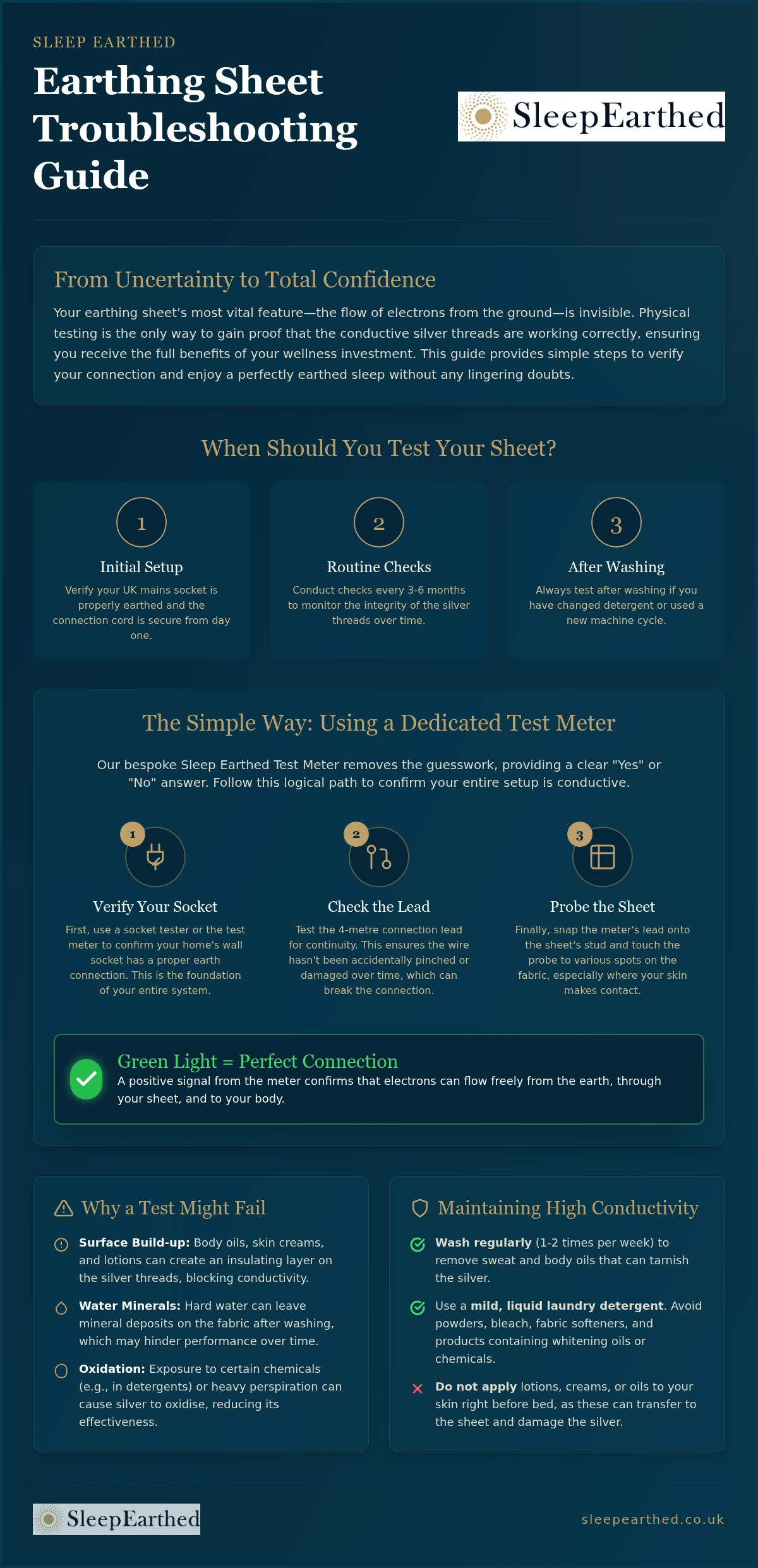
We recommend a proactive approach to testing rather than waiting for a problem to arise. There are three key moments when you should pull out your testing kit. First, perform an initial setup verification to ensure your UK mains socket is properly earthed and your connection cord is seated correctly. Second, conduct routine checks every three to six months to monitor the integrity of the silver threads as they age. Finally, always test after washing if you’ve changed your detergent or used a new cycle. Regular earthing sheet troubleshooting ensures that your Sleep Earthed products continue to provide the conductive surface required for a perfectly earthed sleep, year after year.
Method 1: The Simple Way with a Dedicated Conductivity Meter
For most of us, we want to know if the sheet works without having to learn the life of an electrician. This is where a dedicated meter shines. It’s designed for one specific job: testing continuity. In the world of earthing sheet troubleshooting, this is the most straightforward path to peace of mind because it provides a clear "yes" or "no" answer. You aren’t guessing at fluctuating numbers; you’re looking for a simple confirmation that the circuit is complete.
The process follows a logical three-step path. First, you verify the mains socket is actually connected to the house earth. Second, you check that your 4-metre connection cable hasn’t been pinched or damaged over time. Finally, you probe the sheet itself to ensure the silver threads are still conductive. When the meter shows continuity, it signifies that electrons can flow freely from the ground to your body. This is vital because research on grounding and inflammation highlights that maintaining this consistent electrical connection is key to the physiological benefits of earthing. If you’re unsure about your current setup, using a Sleep Earthed Test Meter is the quickest way to get a definitive answer.
Using the Sleep Earthed Test Meter
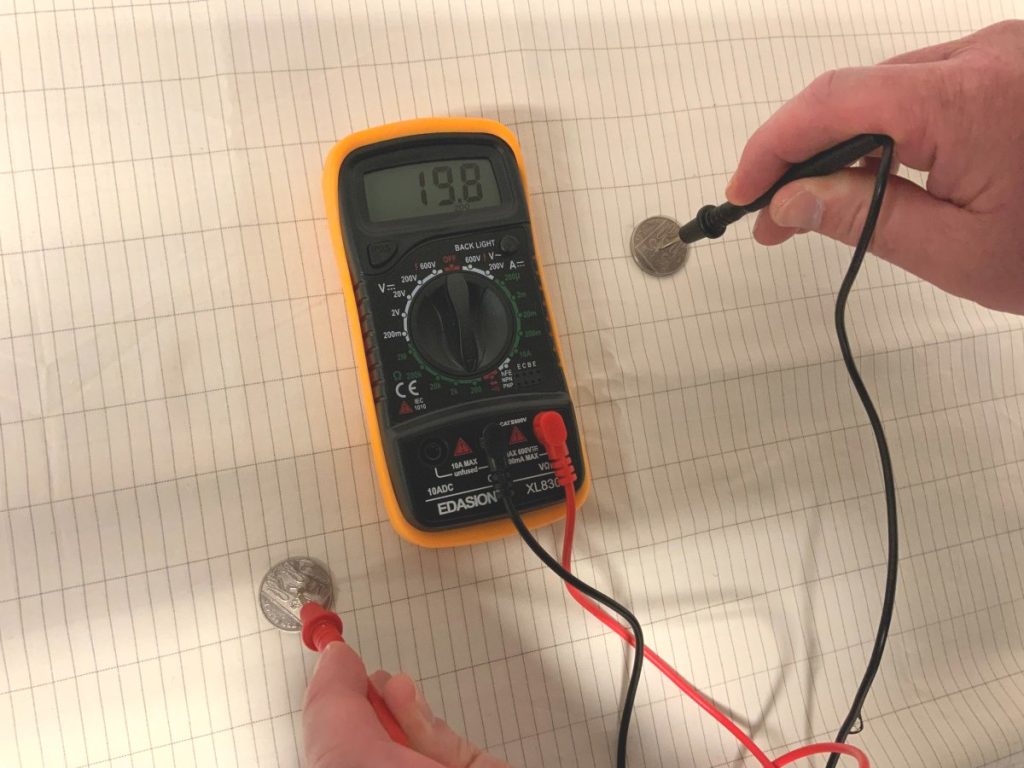
Our bespoke meter is designed to make this as easy as possible. You simply press the meter’s probe onto the sheet’s stud button and use the probe to touch different areas of the fabric with the probe and a 10p coin or similar ( see picture above ). It’s important to test several spots, especially the areas where your skin makes the most contact, rather than just near the connection point. This ensures the silver thread density is still high enough across the entire surface. It removes the technical barriers that often make earthing sheet troubleshooting feel daunting for beginners. Plus we have a full guide on how to do it too here.
Understanding UK Socket Safety
One of the great advantages of living in the UK is our 3-pin plug system. The top pin is always the earth pin, and it’s longer than the others to ensure it connects first for safety. Sleep Earthed plugs are specifically designed to only have a metal connection on that top pin. The bottom two pins are made of plastic and carry no electricity whatsoever. They are simply there to open the safety shutters of the socket. If you live in an older UK property, it’s a sensible idea to use a basic socket tester first. This confirms that your house wiring is actually bonded to the earth before you even plug in your sheet.
Method 2: Using a Multimeter to Measure Body Voltage
If you enjoy seeing the raw data for yourself, using a digital multimeter is the next step in your earthing sheet troubleshooting journey. Whilst our dedicated meter tells you if the sheet is conductive, a multimeter shows you the actual effect the sheet has on your body’s electrical state. It measures "body voltage," which is essentially the electrical pressure your body picks up from the wiring and appliances in your bedroom. In a typical UK home with a 230V supply, your body acts like an antenna, often carrying several volts of alternating current (AC) just by standing near a bedside lamp or a mobile phone charger.
The goal of this test is to see that voltage drop the moment you touch your Sleep Earthed bedding. You’ll need to set your multimeter to AC Volts (marked as V~). If your meter isn’t "auto-ranging," set the dial to the lowest whole number above 2. In many modern environments, we look for readings in millivolts (mV) once the connection is made. It’s important to remember that your body voltage will never truly hit zero. Even amongst the best grounding equipment, ambient electromagnetic fields (EMFs) from the atmosphere and household electronics will always create a tiny bit of "noise" on the meter. Anything below 100mV is generally considered an excellent result for a grounded sleeper.
Step-by-Step Multimeter Setup
Please consult a qualified electrician if you are in any doubt about completing this test.
To begin, plug your black lead into the earth pin of a verified UK socket. You can use an earthing plug for this to make it easier. Hold the metal tip of the red lead between your thumb and forefinger whilst standing away from the bed. This establishes your "base" reading. Now, sit or lie down on your Sleep Earthed sheet. You should see the numbers on the screen tumble immediately. For the most accurate results, try a "Full Body Contact" test by lying down normally. A "Hand Test" is quick, but having more skin surface area against the silver threads will always provide a more significant and stable voltage drop.
Continuity vs. Body Voltage: Which is Better?
Both methods have their place in earthing sheet troubleshooting, but they tell you different things. Continuity testing is about the physical health of the product, whilst body voltage is about the biological result. Use the table below to decide which test suits your needs.
| Feature | Continuity Testing | Body Voltage Testing |
|---|---|---|
| Ease of Use | Very High (Simple green light) | Moderate (Requires dial settings) |
| Required Tool | Sleep Earthed Test Meter | Digital Multimeter |
| Best For | Checking if silver threads are worn | Proving the immediate grounding effect |
| Accuracy | Excellent for product integrity | Excellent for environmental analysis |
Ultimately, if your multimeter shows a significant drop when you touch the fabric, your system is working. If the numbers don’t budge, it’s time to look at the physical connections or the age of the sheet itself.
Troubleshooting: Why Your Earthing Sheet Might Fail the Test
If you’ve followed the testing methods in the previous sections and the results weren’t what you expected, don’t panic. It doesn’t necessarily mean your sheet is beyond repair. Effective earthing sheet troubleshooting is simply a process of elimination to find the "Weak Link" in your system. This link is usually found in one of three places: the electrical source, the connection lead, or the fabric of the sheet itself. By isolating each part, we can usually get you back to a perfectly earthed sleep quite quickly.
One of the most common physical issues is silver oxidation. Silver is a natural element, and whilst it’s incredibly conductive, it can tarnish when exposed to certain chemicals or heavy perspiration. This isn’t possible to seeith the naked eye. Whilst a little bit of tarnishing is normal, heavy oxidation can eventually create a barrier that stops electrons from moving. Similarly, cable fatigue is a frequent culprit. If the 4-metre lead is pulled taut or pinched by a bed frame, the internal wire can snap near the snap button, even if the plastic casing looks fine. A hoover is also the single largest cause of snapped leads when vacuuming under the bed.
Washing Mistakes That Kill Conductivity
Silver threads are hardy, but they have two main enemies: bleach and essential oils used in detergents. Using detergents with bleach or oxy-based whiteners will strip the conductivity from the silver fibres pretty quickly. Even if you use the right detergent, fabric softeners and heavy body lotions can coat the silver in an insulating film. If the electrons can’t make direct contact with your skin because of a layer of dried lotion or softener, the sheet effectively stops working. To ensure your bedding lasts, it’s vital to follow our specific earthing sheet washing instructions.
Socket and Cable Faults
Sometimes the problem lies within the walls of your home. If your UK socket isn’t properly bonded to the earth, no amount of earthing sheet troubleshooting on the fabric will help. You can isolate this by testing your connection lead independently; simply touch one probe of your meter to the plug’s earth pin and the other to the snap button. If the cable is fine but the socket is faulty, you might consider bypassing the house wiring entirely. Using a Grounding Rod Kit allows you to run a wire directly to the soil outside, providing a pure, "clean" connection that’s completely independent of your mains supply.
If you have checked your connections and followed the care steps but still aren’t seeing the results you expect, we recommend browsing our full range of replacement parts at Sleep Earthed to refresh your setup.
Maintaining Conductivity: Long-Term Care for Sleep Earthed Products
Once you’ve mastered the basics of earthing sheet troubleshooting, the goal is to ensure you rarely have to use those skills again. Whilst our silver-threaded bedding is designed for durability, its lifespan is directly tied to how well the conductive fibres are protected from environmental build up. Think of your sheet like a high-performance piece of kit; it needs the right care to keep the electron highway open. By following a few simple maintenance habits, you can extend the life of your bedding and ensure that every night’s sleep is as perfectly earthed as the first.
We stand by the quality of our craftsmanship at Sleep Earthed, which is why we offer a 90-day better-sleep guarantee. We’re confident that our high-density silver weave provides a superior connection compared to thinner, mass-market alternatives. However, if you do find that conductivity has dropped after a year or two of heavy use, you don’t always need to replace the entire set. Often, just replacing a worn connection lead can solve the issue. If you’re storing your sheets for an extended period, perhaps whilst decorating or travelling, always keep them in a cool, dry place inside a breathable cotton bag to prevent moisture from accelerating silver oxidation.
The Sleep Earthed Difference
What sets us apart is our commitment to manufacturing right here in the UK. Because we control the production process, we ensure the silver thread density is high enough to withstand regular washing whilst maintaining its conductive properties. Our UK-sized fitted earthing sheets aren’t just about convenience; they ensure a snug, secure fit that keeps the fabric in constant contact with your skin. If you ever find yourself stuck with a technical query, we’re just a phone call or email away. We’re a small team that genuinely cares about your well-being, and we’d much rather help you through some earthing sheet troubleshooting than see you struggle with a setup that isn’t performing.
Next Steps for Your Grounding Journey
Testing your sheet is often just the beginning. Many of our customers choose to expand their setup once they see the physical proof of conductivity. You might consider adding earthing pillowcases to your bed or even using earthing recovery bags for deep tissue repair after exercise. If you practise yoga or meditation, it’s also worth exploring the differences between a grounding mat for yoga vs meditation to find the right conductive surface for your mindfulness routine. To help you stay informed, we’ve put together a guide on the science of grounding to separate the facts from the fiction as we move into 2026.
Before you head off for a restful night, here is your final checklist for a perfectly grounded bedroom:
- Verify your UK socket earth connection with a socket tester.
- Ensure your connection lead is snapped securely onto the sheet’s stud.
- Test the sheet surface every 3-6 months with a conductivity meter.
- Wash regularly with mild detergent and avoid all fabric softeners.
- Wait at least 30 minutes after applying body lotions before climbing into bed.
Secure Your Connection to the Earth
You have moved from wondering if your setup works to having the practical tools to prove it. Whether you choose the technical detail of a multimeter or the simplicity of a dedicated probe, the goal remains the same: absolute confidence in your sleep environment. By following these methodical steps for earthing sheet troubleshooting, you can quickly identify if a simple lead replacement or a slight change in your washing routine is all that’s needed to restore your connection to the ground.
At Sleep Earthed, we take immense pride in our products, which are manufactured in the United Kingdom to the highest standards. We stand by our high-density silver weave with a 90-day better-sleep guarantee and provide UK-based technical support if you ever need a friendly expert to guide you through a test. Don’t leave your wellness to chance when physical proof is so easy to obtain. It is time to stop second-guessing and start enjoying the restorative rest you deserve.
Ready to verify your setup? Ensure your sleep is protected with the Sleep Earthed Test Meter and sleep soundly knowing your connection is perfect.
Frequently Asked Questions
How often should I test my earthing sheet?
We recommend testing your equipment every three to six months to ensure the silver threads remain highly conductive. It is also a sensible idea to perform a check if you change your laundry detergent or move your bed to a different socket. Regular testing gives you the peace of mind that your Sleep Earthed bedding is still providing the wellness benefits you expect.
Why does my multimeter show 0.02 instead of 0.00?
It is perfectly normal to see a small residual reading like 0.02V or 20mV rather than a flat zero. Modern UK homes are full of electromagnetic fields from Wi-Fi routers and internal wiring that create a tiny bit of electrical noise. As long as you see a significant drop from your base reading when you touch the sheet, the system is working correctly.
Can I test my earthing sheet with a simple lightbulb or screwdriver?
No, you should never attempt to test grounding equipment using mains-powered bulbs or makeshift tools. These methods are incredibly dangerous and carry a high risk of electric shock. For safe earthing sheet troubleshooting, always use low-voltage, battery-operated devices like a digital multimeter or our bespoke conductivity meter to get an accurate and safe reading.
Does a continuity test prove that the sheet is actually grounding me?
A continuity test proves that the physical path for electrons is open from the UK plug pin all the way to the fabric. Whilst it doesn’t measure your body’s specific voltage, it confirms the equipment is physically capable of grounding you. If the circuit is complete and your skin is in contact with the silver, the grounding process will occur naturally.
Can I use a multimeter to test if my socket is earthed safely?
Whilst a multimeter can measure voltage between the live and earth ports, we don’t recommend this for non-experts due to the risks of working with mains power. It is much safer to use a dedicated UK socket tester . These inexpensive plug-in devices provide a clear light signal to confirm your house wiring is safe and properly bonded to the earth.
Will my earthing sheet still work if I wear pyjamas?
Yes, your sheet will still function through thin pyjamas made of natural fibres like cotton or silk. Your body naturally produces a small amount of perspiration whilst you sleep, which creates a conductive bridge between your skin and the silver threads. However, for the most efficient electron transfer, we always suggest having some direct skin contact with the bedding.
Does washing the sheet frequently reduce its conductivity?
Regular washing every one to two weeks actually helps maintain conductivity rather than reducing it. Cleaning removes the insulating body oils and skin cells that can coat the silver fibres and block the flow of electrons. As long as you follow our care guide and avoid bleach or fabric softeners, frequent washing is the best way to protect your investment.