
 90 Day’s To Better Zzz’s Guarantee T&C apply

Signs Grounding Is Working for You: A Practical Checklist
What if feeling better and being electrically connected are two different things? If you’ve started grounding, you may be wondering whether your sleep, comfort or mood feels different, and whether that proves your setup is working. The signs grounding is working for you can be personal and gradual, but they can’t confirm an electrical connection on their own.
It helps to treat these as two separate questions. This practical checklist shows you how to notice changes in your day-to-day experience without assuming they’re guaranteed or caused by grounding, and how to assess your setup with a connection check. It also explains what to do if the result is unclear, so you can take a sensible next step rather than guess. Evidence for grounding’s potential effects is still developing, so keep personal observations separate from what a meter can tell you.
Key Takeaways
- Possible signs grounding is working for you may include changes in sleep or morning comfort, but experiences vary and aren’t guaranteed.
- Keep brief notes on what you notice, and consider how routine, comfort and other life changes might affect your experience.
- A connection check can tell you about the tested setup, not whether grounding has caused a health benefit.
- Review your experience, setup and connection separately before deciding what to try next.
- Sleep Earthed bedding uses conductive silver threads in organic cotton; individual results can’t be promised.
What signs grounding is working for you might you notice?
Have you tried a grounding product and found yourself wondering whether anything has changed? That’s a reasonable question, especially if you’re hoping for reassurance. The signs grounding is working for you won’t look the same for everyone, and there’s no particular sensation or result you should expect. You might notice a difference in how your nights feel, how comfortable you are in the morning, or how easily the product fits into your routine.
Here, “grounding” means the wellness practice, rather than the different electrical meanings of earthing. The Earthing (disambiguation) page shows how the term can refer to more than one subject. Keeping that distinction in mind helps separate personal experience from electrical testing.
Which personal changes are worth noticing?
There’s no need to look for a dramatic before-and-after moment. Instead, notice ordinary details and describe them in your own words. For example, jot down whether you remember waking during the night, how you’d describe your sleep, and whether you felt rested when you got up. These are observations, not targets you’re expected to meet.
Comfort matters too. Does the sheet or other product feel comfortable? Is it straightforward to fit into your usual bedtime routine? These practical details can help you decide whether the setup suits you, even if you don’t notice a change in how you feel. A few simple notes are more useful than ticking off promised benefits: write what happened, rather than what you think you ought to experience.
Why a perceived change is not proof
If you sleep differently after starting a new routine, the timing alone can’t establish what caused the change. Your schedule, stress, room temperature, comfort or other changes in daily life may also play a part. Likewise, not noticing a difference doesn’t tell you whether the product is connected.
A personal observation is not proof that your product is electrically connected. A connection check, in turn, cannot show that grounding has produced a health benefit. These are separate questions: one concerns what you experience, another concerns the tested electrical connection, and clinical evidence is a broader question about whether an intervention has a demonstrated health effect. Keep those conclusions distinct.
If you’d like a fuller discussion of what research can and can’t tell us, Sleep Earthed explains whether earthing sheets work. Treat your notes as a personal record, not a diagnosis or a verdict on the product. That lets you reflect without dismissing your experience or reading more into it than it can show.
Why grounding signs can be subtle, inconsistent, or absent
It’s natural to look for a clear answer after trying something new. But a grounding sign is a personal observation, such as noticing a change in your sleep or comfort. It isn’t a diagnostic measure or a guaranteed outcome of using a product. Some people may notice a difference, others may find their experience varies from night to night, and some may notice nothing in particular.
There are ordinary reasons for that variation. Expectations can shape what catches your attention, while changes to your bedtime routine, room temperature, stress or general comfort can affect how a night feels. These factors don’t make your experience unimportant. They’re a reminder to interpret it carefully, without assuming one cause explains every change.
How to interpret changes without jumping to conclusions
A simple diary can help you look back more clearly. Use the same plain-language descriptions each time, such as “woke once”, “felt comfortable” or “took a while to settle”. You could also note routine changes, like a later bedtime or an unusually warm room. The aim isn’t to run a scientific study at home, but to give yourself a fair record instead of relying on memory alone.
If you notice a pattern, treat it as something to reflect on, not proof of cause. One better night, or a run of unsettled ones, can’t establish that grounding made the difference. The signs grounding is working for you are personal impressions to consider alongside the wider context of your daily life.
What no noticeable change can and cannot tell you
Not noticing a difference isn’t a personal failure, and it doesn’t show that you’ve used a product incorrectly. People vary in what they notice, and expecting a particular sensation can make the experience feel confusing. Equally, feeling no change cannot tell you whether a sheet has electrical continuity. That requires a suitable connection check, not a judgement based on how you feel.
A perceived experience describes how you feel; a connection reading describes the tested electrical pathway. Neither should be used as a substitute for clinical advice. If you have a health concern or a change in symptoms, speak with an appropriate healthcare professional rather than relying on a grounding product to explain or address it.
Keeping these questions separate can make the process feel less pressured. Record what you notice, allow for other influences and use a connection check if you want to assess the setup. If you’re reviewing bedding options, explore Sleep Earthed earthing bedding without assuming it will produce a particular personal result.
Personal signs versus a connection check: what should you compare?
It helps to separate two questions: what are you experiencing, and is there an electrical connection through the setup? Each needs a different kind of check. If you’re trying to identify signs grounding is working for you, a sleep or comfort note can describe your experience. It can’t establish how electricity is travelling through the product.
| What you’re checking | How you check it | What it can reasonably indicate |
|---|---|---|
| Personal experience | Your own notes on sleep, comfort or ease of use | How you feel and whether you’ve noticed a change |
| Product setup | Review the connections and arrangement against the product instructions | Whether the setup appears to follow the intended arrangement |
| Electrical connection | Use a suitable test meter as instructed | Information about the connection being tested |
Personal symptoms and electrical continuity answer different questions. A meter result isn’t evidence of improved sleep, recovery or any other health outcome. Equally, feeling different doesn’t confirm continuity.
What a test meter can help you assess
A test meter can help you assess a grounding setup, provided you follow the instructions for both the meter and the product. The result relates to the specific connection being tested, so it isn’t a general verdict on every part of your setup or on how you feel. Sleep Earthed offers a test meter, and its Sleep Earthed Test Meter guide explains how to use it.
A result without a clear interpretation can be frustrating. Avoid guessing at readings or applying a threshold from another device or method. Follow the meter’s instructions, make sure you’re testing the intended points, and treat the result as connection information only. If the check is unclear, review the setup instructions before drawing conclusions.
How grounding methods differ in contact
Grounding products don’t all make contact in the same way, so don’t assume a check or experience with one method applies directly to another. Earthing bedding, for example, is made with conductive silver threads in organic cotton. Carbon-infused earthing mats rely on sweat to connect to the earth, which is a different contact condition. These distinctions describe how contact is made, not which method is more effective.
Compare like with like: the product’s intended setup, the contact involved and the specific point tested. That gives you a clearer basis for checking the connection while keeping personal observations separate. Neither a particular sensation nor a meter reading can establish a health benefit.
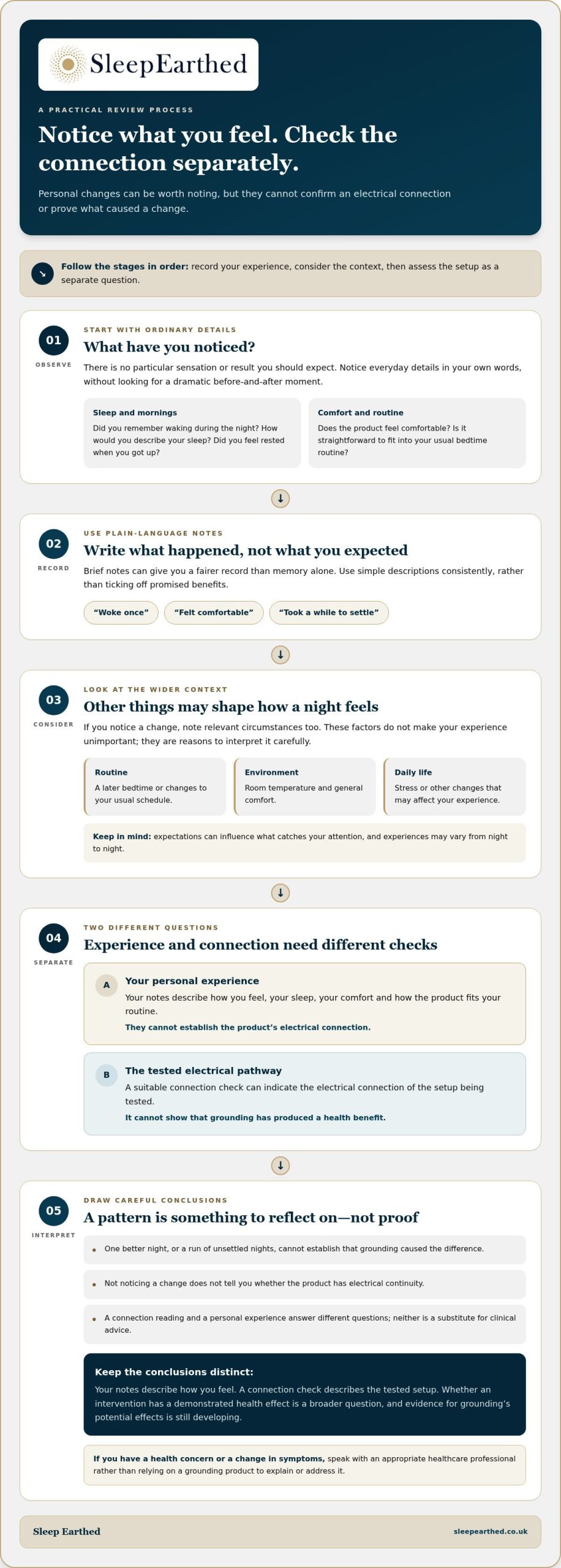
A simple checklist for reviewing your grounding experience
If your experience feels unclear, there’s no need to force a conclusion. Work through the questions in order: record what you’ve noticed, review how you’re using the product, check the connection if appropriate, then reflect on the information you have. This separates personal experience from setup details and makes it easier to choose a practical next step.
- Note your experience. Make a brief daily entry about sleep, comfort and anything relevant that changed in your routine. Use your own words and don’t set a deadline for noticing results.
- Review the setup. Check that the product is arranged and used according to its supplied instructions. If you’re using an earthing sheet, the grounding sheet setup guide can help you review the general arrangement.
- Check the connection. If you have a suitable test meter, follow its instructions and those for your product. Treat the result as information about the connection tested, not as a measure of how you feel.
- Reassess calmly. Look at your notes and setup separately. You may notice a pattern, mixed experiences or no clear difference. Each is a fair observation, not a required result.
Track your own observations consistently
A short note is enough. You might record whether you remember waking, how comfortable you felt, and whether something such as a later bedtime or a change in your usual routine could be relevant. Keep the descriptions consistent where you can, so “rested”, for example, means roughly the same thing to you each time.
Compare your entries with your own earlier notes, not someone else’s experience or a list of expected benefits. If the picture is mixed or unclear, leave it that way rather than trying to make the entries point in one direction. This gives you a balanced record of the signs grounding is working for you, if any, without treating every night as a test.
Review the setup before interpreting the result
Check the product instructions for the intended setup and make sure you’ve followed them. If something still seems unclear, use the relevant earthing sheet troubleshooting guide to work through common setup questions. Don’t open household wiring or attempt electrical repairs as part of your review.
Once you’ve checked what you can safely assess, pause before deciding what the result means. A personal change doesn’t confirm a connection, and a connection check doesn’t establish a health outcome. If you’re ready to review bedding options, explore Sleep Earthed earthing bedding and consider which format fits your routine.
Choosing a grounded next step with Sleep Earthed
You don’t need a firm conclusion about your experience before deciding what to do next. Keep the two questions separate: your notes describe what you’ve noticed, while a suitable meter check provides information about the tested connection. Neither tells you whether grounding has caused a health change. Mixed or absent observations are still useful information about your experience, not a reason to force a result.
When earthing bedding may suit your routine
Think about practical fit: whether bedding feels comfortable, works with your usual bedtime routine and is something you’re happy to use as directed. Sleep Earthed offers earthing bedding made with conductive silver threads in organic cotton, alongside related products including a test meter. These are options to consider, not a promise of a particular result. Earthing bedding isn’t a substitute for medical advice or treatment.
Sleep Earthed also offers a 90-day better-sleep guarantee. That is a separate product policy, not a connection reading or evidence of an individual health outcome. If you’re considering the bedding, read the guarantee information alongside the product details so you can make an informed choice. The guarantee isn’t a prediction of how you personally will feel.
What to do if you remain unsure
Start with the product’s supplied instructions. If you’re using an earthing sheet, revisit the setup guide and troubleshooting resource to review the arrangement before drawing conclusions. Keep questions about your personal experience separate from questions about the setup. If you want to assess the connection, use the Sleep Earthed Test Meter according to its instructions; its guide is there to help with setup checking, not to assess health effects.
Decide what you’re trying to clarify before taking another step. If you want to understand your experience, continue making simple notes in your own words. If you want to assess whether the setup is connected, review the instructions and use an appropriate test meter. If you have a health concern, speak with a healthcare professional rather than relying on a product to diagnose or treat it.
The signs grounding is working for you, if you notice any, remain personal observations. A connection check answers a different, more specific question. Sleep Earthed’s range includes earthing bedding and a test meter, so you can explore options that match your practical needs without assuming a particular outcome. Choose based on comfort, intended use and the kind of information you’re looking for.
To see the bedding and related products, explore Sleep Earthed at your own pace.
Take your next step at your own pace
You don’t need to turn your grounding experience into a test you have to pass. Give yourself room to decide what feels practical, whether that means continuing your routine, adjusting how you use the product in line with its instructions, or taking time to reflect before making changes. The signs grounding is working for you are personal, so let your own needs guide the pace rather than feeling you must reach a particular conclusion.
It may help to ask yourself a simple question: does this approach fit comfortably into your life? Your answer can guide what you do next, even if you’re still unsure about what you’ve noticed. There’s no need to force a result or compare your experience with anyone else’s. A thoughtful choice can be worthwhile in itself.
When you’re ready, consider which option best suits your routine. Explore Sleep Earthed earthing bedding and accessories at your own pace, and choose only what feels relevant to you.
Frequently Asked Questions
What are the first signs grounding is working for you?
There isn’t one reliable first sign to look for. Some people may notice a change in how they settle at bedtime or feel on waking, whilst others notice no difference. If you’re wondering about the signs grounding is working for you, focus on a specific, ordinary detail, such as whether you woke feeling more or less rested than usual. Treat it as a personal observation, not proof of cause.
How long does it take to notice a difference from grounding?
There’s no established timeframe that guarantees you’ll notice a difference. You might observe something quickly, much later, or not at all. Rather than counting down to an expected result, make brief notes and compare similar circumstances where possible, such as work nights with other work nights. That can help you notice patterns without turning a particular number of days into a pass-or-fail test.
Can a test meter tell me whether grounding is working?
A test meter can provide information about the electrical connection at the points being tested, when used as instructed. It can’t tell you whether grounding has improved your sleep or health. Read the instructions for your specific meter and product, and don’t interpret a reading using a threshold from another device. If you’re unsure what the result means, revisit the meter guidance rather than guessing.
Does not feeling different mean my grounding sheet is not working?
No. Not noticing a change in how you feel doesn’t establish whether a grounding sheet has an electrical connection. These are separate things to assess. Check that you’re using the sheet as its instructions describe, and use an appropriate meter if you want to assess the connection. If the setup or result remains unclear, pause and review the guidance before deciding what to do next.
What happens if grounding seems to make my sleep worse?
Don’t assume straight away that the sheet caused the change. Consider practical factors such as whether the bedding feels comfortable or whether something else in your routine has shifted. If the product is uncomfortable, stop using it while you review its instructions and setup. If sleep problems persist or concern you, speak with a healthcare professional; a grounding product shouldn’t replace medical advice or treatment.
Is a grounding sheet test the same as noticing better sleep?
No. A sheet test concerns the electrical connection being checked, whilst noticing better sleep describes your personal experience. You could have a connection reading without noticing any sleep difference, or feel that your sleep has changed without having checked the connection. Keep those observations separate in your notes, and avoid using either one as evidence for what the other can establish.
Can grounding work if I do not feel a change?
If by “work” you mean that a setup has an electrical connection, not feeling different can’t confirm or rule that out. A suitable test can offer information about the connection; your experience can tell you how you feel. Neither establishes a health benefit. You’re not required to notice a sensation or improvement, so use the evidence relevant to the question you’re asking and keep expectations realistic.