
 90 Day’s To Better Zzz’s Guarantee T&C apply
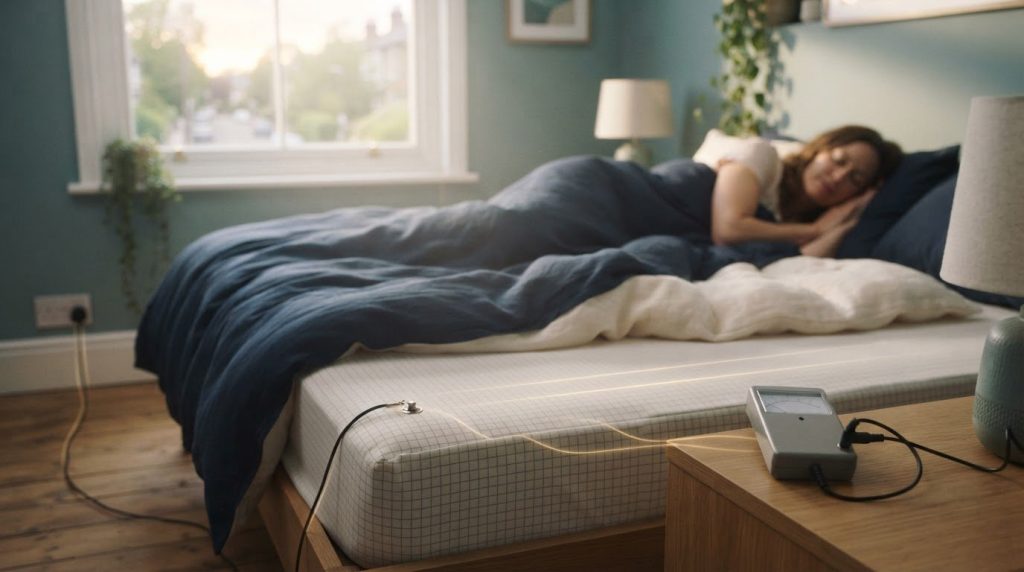
How to Know if Your Earthing Sheet Is Working: A Practical Guide
If you’re wondering how to know if my earthing sheet is working, check its electrical connection rather than judging it by how you sleep or feel. A connection can be present without an obvious sensation or change in sleep, so a suitable meter check is more useful than relying on personal experience.
It’s understandable to expect a noticeable change and wonder whether something is wrong when none appears. But personal experience isn’t an electrical test. A simple meter check can help you assess the connection more directly.
This guide explains how to check the setup, what a resistance reading can tell you and what to do if the result is unclear. It also covers how conductive silver-thread sheets differ from carbon-infused earthing mats, which rely on sweat to connect to earth. Sleep Earthed offers a dedicated test meter to help you check the electrical connection.
Key Takeaways
- Learn how to know if my earthing sheet is working by checking the connection from the sheet through its lead to earth.
- Follow the instructions supplied with your sheet and testing equipment for a careful connection check.
- Use test results as a guide. An unclear or unexpected reading is a reason to recheck the setup, not to jump to a conclusion.
- If the connection seems interrupted, check the lead attachment and earth connection before moving on to more detailed troubleshooting.
- Explore the Sleep Earthed Test Meter as a practical option for checking the electrical connection.
How to know if my earthing sheet is working
Check whether there’s an unbroken conductive path from the sheet, through its connecting lead, to the earth connection. Follow the product and meter instructions, then interpret the result as information about the connection only. It can’t confirm that you’ll notice a change in sleep or wellbeing.
What does it mean for an earthing sheet to be working?
“Working” has a specific, practical meaning here: the sheet, its connecting lead and the earth connection form an unbroken conductive path. A connection check can help you find out whether that path is present. It doesn’t show that the sheet will produce a particular change in sleep or health, and it can’t guarantee that you’ll notice a personal effect.
That distinction matters. If you’re asking how to know if my earthing sheet is working, focus on the electrical route rather than looking for a sensation. A meter can assess electrical properties; your mood, sleep or a feeling of warmth can’t tell you whether the connection is intact.
A useful definition: An earthing sheet is electrically connected when its conductive surface links through the lead to an earth connection. This describes the connection only, not a promised outcome for the person using it.
What connection are you checking?
Think of the setup as a route with three parts. First is the sheet’s conductive surface, which allows an electrical connection across the area being tested. Next is the lead, which links the sheet to the earth connection provided for the setup. Each part needs to meet the next. If one link is absent or interrupted, the complete path may not be present.
The materials can differ. Sleep Earthed sheets use conductive silver threads, while carbon-infused earthing mats rely on sweat to connect to earth. The intended contact and connection need to be in place. Exact checks depend on the product and equipment, so follow the supplied instructions rather than improvising a test.
The word “earthing” is used in more than one context. The Earthing (disambiguation) page outlines some of those meanings; here, the subject is the electrical connection of an earthing product.
Why how you feel is not a reliable test
People’s sensations and sleep experiences vary. One person may report a change quickly, whilst another may notice nothing obvious. Neither response measures continuity between the sheet and earth. A good night’s sleep doesn’t confirm an electrical connection, and an ordinary night doesn’t prove the connection has failed.
Keep the two questions separate: “Is there a conductive path?” is something suitable testing equipment can help assess. “Do I feel different?” is a personal observation influenced by more than the sheet. Don’t treat a quick change, or no change, as proof either way.
For a broader discussion of claims and evidence, see the science of whether earthing sheets work. A connection check answers a narrower question: whether the electrical route is intact, not what you should feel.
How can you check an earthing sheet’s conductive connection?
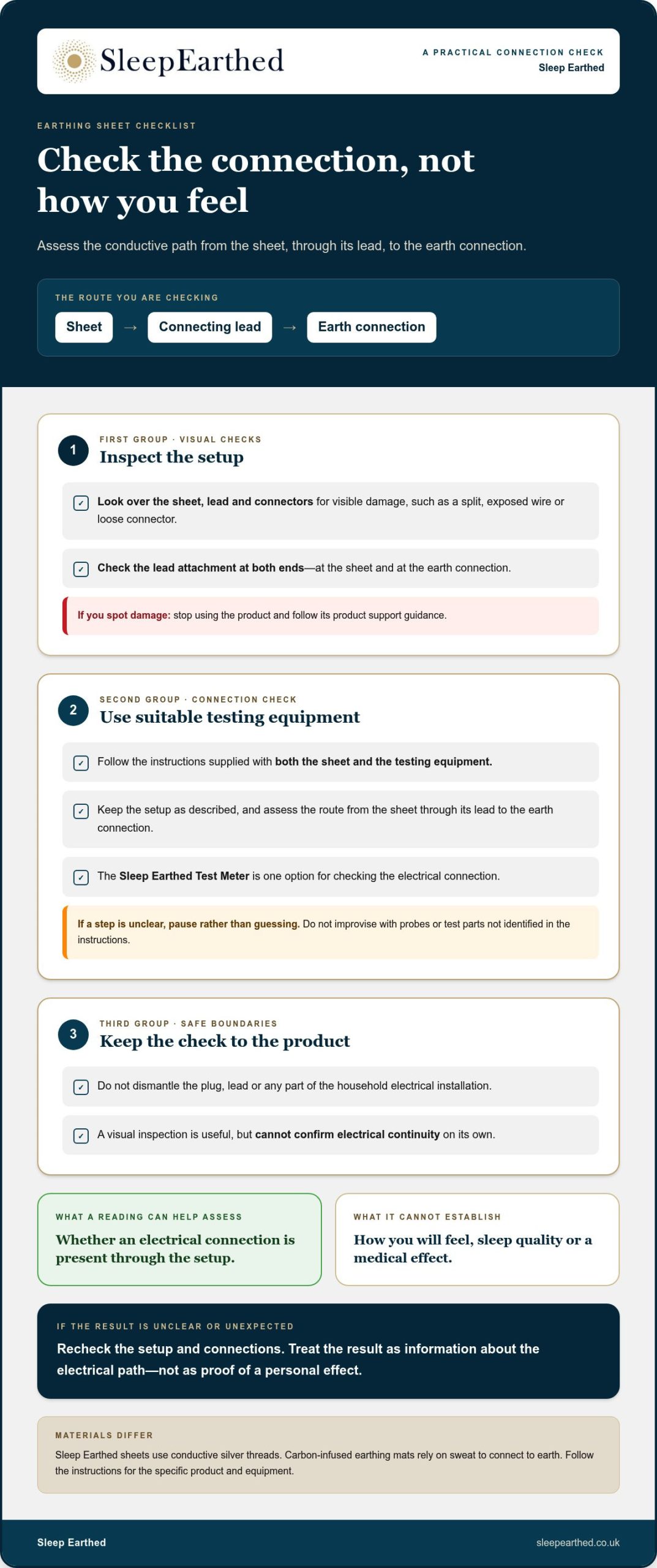
Check the visible parts first, confirm the lead is connected at both ends, then use testing equipment suitable for your sheet and follow the instructions supplied with both items. This helps you assess the electrical connection without guessing what a result should be.
Before testing, check the visible connections
Set up the sheet and lead as directed by the product instructions. Check that the lead is firmly attached at the sheet end and at the earth connection end. Look over the sheet, lead and connectors for visible damage, such as a split, exposed wire or loose connector. Don’t dismantle the plug, lead or any part of the household electrical installation.
If you spot damage, stop using the product and follow its product support guidance. If everything looks intact, move on to the connection check described in the instructions. A visual inspection is useful, but it can’t confirm electrical continuity on its own.
Use suitable testing equipment as directed
A suitable meter can help assess whether there’s a conductive connection through the setup. The Sleep Earthed Test Meter is an option for checking the connection. Use the method provided with your sheet and testing equipment. Don’t assume a procedure or expected reading for another product applies to yours.
The check should relate to the path you’re assessing, from the sheet through its lead to the earth connection. Keep the setup as described in the instructions, and avoid improvising with probes or making contact with parts that aren’t identified for testing. If a step isn’t clear, pause rather than guessing.
- Inspect the sheet, lead and connectors for visible damage.
- Check that the lead is attached securely at both ends.
- Use suitable testing equipment according to its instructions and the sheet’s guidance.
What a test meter can and cannot tell you
A meter reading can help you assess an electrical connection. It doesn’t measure sleep quality, tell you how you’ll feel, or establish a medical effect. An electrical test checks the connection, not a health outcome. It answers a practical question about the setup without promising an effect on wellbeing.
Research discussions of earthing, such as the NIH article Physiological Effects of Earthing, are separate from checking whether a particular sheet has a conductive path. A meter reading can’t confirm the claims discussed in a research paper, just as a paper can’t verify the connection in your bedroom.
If you’d like a purpose-made option for checking the connection, explore the Sleep Earthed Test Meter. Whatever equipment you use, follow its instructions and interpret the reading alongside the condition and connections of the setup.
How to interpret results without mistaking feelings for proof
Treat a test result as information about the connection, not a verdict on the whole product or your experience. If you’re working out how to know if my earthing sheet is working, use the result to decide whether to recheck the setup rather than drawing conclusions from one reading or one night’s sleep.
| Result | What it may suggest | A sensible next step |
|---|---|---|
| Connected | The test indicates a conductive path under the conditions of that check. | Confirm you followed the sheet and meter instructions. Treat this as a connection result, not proof of a health or sleep effect. |
| Uncertain | The result isn’t clear, is inconsistent or is difficult to interpret. | Review the test instructions and repeat the check carefully. Avoid changing several parts of the setup at once. |
| Apparently interrupted | The check may not be detecting a complete conductive path. | Recheck the visible connections and setup, then test again as directed. If the result remains unclear, follow the product support guidance. |
A connection result is not a wellbeing score
Electrical continuity and personal experience are different kinds of information. A meter can assess an electrical property of the setup; it can’t measure whether you slept well or establish a medical effect. Warmth, tingling or the absence of sensations doesn’t confirm that a sheet is connected. Nor does feeling no different mean that a connection check would fail.
Keep those observations separate. You might record a test result and independently notice how you feel over time, but don’t use one as proof of the other. Earthing research and individual outcomes are not a substitute for checking a particular setup. If you have a health concern, seek appropriate clinical advice rather than relying on a sheet or its test result.
Different products can use different materials
Conductive materials and contact methods vary between product types, so follow the guidance for the specific item rather than assuming one method applies to all. Sleep Earthed sheets use conductive silver threads, while carbon-infused earthing mats are another type of product. These differences describe the materials used; they don’t establish that one type is universally more effective.
Interpret a result in context: consider which product you tested, how its instructions say to test it and whether the setup was arranged accordingly. If the reading is uncertain, review those details before deciding that the product has failed. A careful recheck can clarify the electrical question, whilst your personal experience remains separate.
What to do if your earthing sheet seems not to be working
An uncertain test result doesn’t automatically mean the sheet is faulty. Start with the straightforward checks you can make safely: inspect the lead, confirm the connections and repeat the test using the product instructions. This gives you a clear order to follow without guessing from how the setup looks.
A short checklist for an uncertain connection
Work through these checks in order, pausing if anything appears damaged or a step isn’t clear:
- Check that the lead is fully attached at the sheet end and at the earth connection end. Look for visible damage to the lead or connectors, but don’t take them apart.
- Compare the setup with the instructions supplied with the sheet. A connection that appears secure may still need to be repositioned or attached as directed.
- If the result remains uncertain, use suitable testing equipment according to its instructions. Don’t assume a reading from a different meter or product applies to your setup.
Change one thing at a time and repeat the check as directed. This makes it easier to understand whether the result changed after correcting a connection. If you have setup questions, the grounding sheet setup guide can help you review how the bedding should be arranged.
When a basic check does not resolve the question
Limit troubleshooting to checks described in the product instructions. Don’t modify a plug, socket, lead or sheet to try to force a connection, and don’t dismantle household electrical fittings. If a component appears damaged, stop using it and follow the product-specific support guidance.
If the connections look intact but a suitable test still gives an unclear result, don’t treat one reading as a diagnosis. Check that you’ve followed the testing instructions precisely, including where and how the equipment should be used. Then consult the step-by-step earthing sheet troubleshooting guide for more detailed setup and connection checks.
Keep the original question in view: how to know if my earthing sheet is working is answered by checking its electrical connection, not by trying to provoke a sensation or expecting an immediate change in sleep. If the result remains unclear after the basic checks, pause and use the product guidance rather than making further alterations.
For a practical way to check the connection, explore the Sleep Earthed Test Meter.
Choosing a next step with Sleep Earthed
Choose your next step according to what you found. If the lead was loose, reconnect it as instructed and repeat the check. If the setup looks right but you don’t have a clear reading, use suitable testing equipment and follow its instructions. If you’re unsure how the sheet should be arranged, return to its product guidance before changing anything.
A check can help assess the conductive connection, but it can’t predict whether you’ll notice a change in sleep or wellbeing. Keep the reading and your personal experience separate, and don’t treat either as a substitute for the other.
When a dedicated test meter may help
If you’d like to check the conductive connection directly, the Sleep Earthed Test Meter is a purpose-relevant option. Use the meter’s instructions to carry out the check and interpret its result alongside the guidance supplied with your sheet. Don’t assume an unfamiliar reading means the sheet has failed; first make sure you’ve followed the specified method.
A meter can provide information about the connection under the conditions of the test. It doesn’t measure sleep quality or diagnose a health issue. If the result remains unclear, pause and review the product guidance rather than experimenting with the lead or household electrical fittings.
A calm next step if you remain unsure
Keep the sequence simple: check the lead and other connections, test appropriately if you still have a question, then interpret the result as electrical information only. If something appears damaged, stop using the product and follow its product-specific support guidance. For setup questions, return to the instructions for your sheet so that any recheck matches the product.
Sleep Earthed also offers a 90-day better-sleep guarantee. It relates to the stated better-sleep guarantee, not to an electrical test, and it isn’t a medical promise. It shouldn’t be used to decide whether a conductive path is present; that’s what a suitable connection check is for.
You don’t need to guess from sensations or make changes you’re not comfortable with. Review the setup, use a suitable meter or explore the product guidance. Explore Sleep Earthed earthing products to find relevant bedding and connection-checking options.
Make your next check a confident one
If you’ve been asking how to know if my earthing sheet is working, let the connection check answer the electrical question, and give yourself time to form your own view of the experience. You don’t need to chase a particular sensation or draw a firm conclusion from one night. Follow the product guidance, note what you checked and return to it if you need to review the setup later.
Choose a practical next step, whether that’s revisiting the instructions or exploring a meter for checking the connection. Sleep Earthed’s 90-day better-sleep guarantee relates to the stated guarantee, not proof of electrical function or a medical promise.
When you’re ready, explore Sleep Earthed earthing products and find a helpful next step for your setup.
Frequently Asked Questions
Can an earthing sheet work if I do not feel anything?
Yes. Not noticing a sensation doesn’t tell you whether the electrical connection is present. If you’re wondering how to know if my earthing sheet is working, use an appropriate connection check rather than relying on warmth, tingling or changes in sleep. People’s experiences differ, and no particular feeling is required to confirm a result. Keep personal observations separate from what the test equipment indicates.
How do I check whether my earthing sheet is connected to earth?
Check that the lead is attached as directed at both the sheet and earth-connection ends, then follow the instructions supplied with the sheet and testing equipment. For example, if you’ve moved the bed or reconnected the lead, check that the setup is arranged as instructed before testing. A visual check alone can’t verify the electrical connection, so use suitable equipment if you need a clearer result.
What should a test meter reading tell me about an earthing sheet?
A meter reading can provide information about the electrical property being tested, such as whether a conductive connection is detected using the specified method. Interpret it according to the meter’s instructions, because the meaning depends on the test and setup. Don’t treat a reading as a score for sleep, comfort or health, and don’t apply a threshold from another product unless your instructions say it’s relevant.
How often should I check whether my earthing sheet is working?
Follow the guidance supplied with your sheet and meter. It’s sensible to consider a check if you’ve reconnected or moved the setup, or if you have a specific reason to question the connection. You don’t need to repeat a test simply because you didn’t notice a change in how you slept; personal experience isn’t an electrical measurement.
Can I use an earthing sheet over a mattress protector?
It depends on the materials and the arrangement, so don’t assume every mattress protector allows the intended contact. Check the sheet’s setup guidance for advice about layers, and arrange the bedding as instructed. If you’re uncertain, test the setup in the same configuration you plan to use, where the test instructions allow it. Avoid removing or adding layers just to produce a preferred reading.
Can I test an earthing sheet with a standard multimeter?
A standard multimeter may be suitable for some connection checks, but only use it if its instructions and the sheet’s guidance describe a compatible method. Check which setting and contact points are specified, and don’t guess if they aren’t clear. A meter designed for checking earthing products, such as the Sleep Earthed Test Meter, is another option. Follow its instructions and interpret the result within the stated method.
What should I do if my earthing sheet test gives an uncertain result?
Pause and repeat the check carefully after reviewing the instructions. Confirm the lead is attached as directed and look for visible damage without dismantling any part. If you’re using a standard meter, make sure you’ve selected the method specified for the product rather than trying different settings at random. If the result remains unclear or something looks damaged, stop testing and follow the product-specific support guidance.