
 90 Day’s To Better Zzz’s Guarantee T&C apply

Earthing Sheet Conductivity Meter: The Complete Guide to Testing Your Bedding
Have you ever climbed into bed and wondered if those clever silver threads are actually doing anything, or if they’ve simply become very expensive cotton? It’s a question we hear all the time, and it’s perfectly natural to feel a bit uncertain when you can’t see the grounding process with your own eyes. You’ve invested in your well-being, so you deserve to know for sure that your silver-threaded bedding is still delivering the recovery benefits you expect.
Learning how to use an earthing sheet conductivity meter is the best way to gain that peace of mind. Whether you’re worried that incorrect washing has dampened the effectiveness or you’re just curious about the science, having a reliable way to test your setup is essential. In this guide, we’ll walk you through the simple process of testing your sheets, explain why a dedicated meter beats a generic test pen, and help you understand how to protect your bedding’s lifespan. By the time you’ve finished reading, you’ll have a reliable routine to ensure your sleep environment remains perfectly conductive and effective for years to come.
Key Takeaways
- Learn how to verify that your silver-threaded bedding is still providing the essential grounding connection needed for effective recovery.
- Discover why a dedicated earthing sheet conductivity meter provides the technical precision needed to monitor your bedding’s performance over time.
- Master the three-stage testing process to ensure your plug, lead, and sheet are all functioning perfectly as a complete circuit.
- Understand how the correct washing routine can actually improve conductivity by removing body oils that might otherwise block the flow of electrons.
- Gain peace of mind by knowing exactly how to interpret resistance readings and when it’s time to refresh your earthing setup.
Why You Need an Earthing Sheet Conductivity Meter
When you first invest in grounding bedding, you’re usually looking for a deeper, more restorative night’s rest. But because you can’t see or feel the electrons moving, it’s easy for doubt to creep in. An earthing sheet conductivity meter is a simple, hand-held device that takes the guesswork out of the equation. It works by measuring how easily an electrical current can travel across the silver threads woven into your fabric. Essentially, it confirms that the ‘engine’ of your sheet is still running smoothly and making a proper connection.
Seeking this kind of certainty in your sleep environment is part of a broader commitment to well-being; to further explore the connection between clarity and mental health, you can visit Dr. Grant Johnson – Common Sense Psychology for Everyday Living for helpful psychological guidance.
Silver is the star of the show here. These fine threads are what facilitate the process of electrical grounding, allowing your body to maintain a connection with the earth’s natural surface charge. Regularly using an earthing sheet conductivity meter provides a massive psychological boost. It removes the ‘is it working?’ anxiety that can actually keep you awake at night. Instead of lying there wondering if your sheet has worn out, you can see the proof on the meter and drift off with total confidence.
Testing also acts as an early warning system for your laundry routine. Certain detergents, particularly those containing bleach or strong oxidisers, can strip the silver from the cotton fibres. By using your meter after a wash, you can quickly identify if your choice of soap is doing more harm than good. It’s the only way to be sure your maintenance habits are protecting your investment rather than eroding it.
Recognising When Your Sheet Might Be Losing Its Connection
Silver is a durable material, but it isn’t invincible. You might notice physical signs like discolouration, where the bright silver threads turn a dull grey or even black. In some cases, the silver might look like it’s flaking away. However, a sheet that looks perfectly fine can still have poor conductivity. Body oils, skin creams, and sweat can build up on the surface of the threads whilst you sleep. This creates an invisible barrier that prevents the electrons from reaching your skin, even if the silver underneath is still intact.
The Science of Silver Oxidation and Conductivity
Silver is a natural element, and like all natural things, it changes. When silver is exposed to oxygen and sulphur in the air, it undergoes a chemical reaction called oxidation. This is the same process that causes silver jewellery to tarnish over time. In the world of grounding, conductivity isn’t a simple ‘on or off’ switch; it’s a spectrum that can fluctuate based on the age of the sheet and how it’s been cared for. Conductivity in the context of earthing is the ease with which electrons move from the earth to the sleeper. Using a meter allows you to track where your bedding sits on that spectrum, ensuring you always get the full benefit of your setup.
How Conductivity Works in Grounding Bedding
To understand why an earthing sheet conductivity meter is such a helpful tool, we first need to look at what is happening under the covers. Think of your earthing setup as a single, continuous loop. It starts at the earth pin in your wall socket, travels through the conductive cord, and finishes by spreading across the silver grid in your sheet. If there’s a break or a significant “bottleneck” anywhere in this chain, the electrons simply can’t reach you. This is why we view the plug, the cord, and the fabric as one single circuit rather than separate parts.
At Sleep Earthed, we use high-quality organic cotton for a very specific reason. Cotton acts as a fantastic “organiser” for the silver threads. It holds them firmly in place, ensuring they stay in constant contact with one another. Without this stable structure, the silver could shift or break during use, causing “dead zones” where no grounding occurs. By keeping the silver threads properly aligned, the fabric maintains a reliable path for the earth’s energy to flow into your body whilst you sleep.
The Role of High-Density Silver Threads
The density of the silver grid is directly linked to the quality of your connection. Budget sheets often skimp on silver content to keep costs down, which can lead to a patchy connection. In contrast, UK-manufactured sheets with a high silver thread count offer more “redundancy.” If one thread becomes slightly worn over time, the electrical current simply finds another way through the dense grid. This “Path of Least Resistance” is what ensures you stay grounded all night long, even as the sheet ages. If you’re looking for a sheet designed for maximum conductivity and longevity, you can explore our range of UK-made earthing sheets to see the difference quality materials make.
Resistance vs. Continuity: What Your Meter is Actually Measuring
You might hear the terms “resistance” and “continuity” used interchangeably, but they tell you different things. Continuity simply confirms that a path exists from point A to point B. Resistance, measured in “Ohms,” tells you how *easy* that path is to travel. If you’re interested in the technical side, learning how to test for continuity with a multimeter is a great way to understand these electrical basics.
A simple test pen might show a green light, which is a good start, but it doesn’t give you the full picture. A numerical reading on an earthing sheet conductivity meter is much more precise. For a sheet to be considered effective, we generally look for resistance readings well under 100k Ohms. If your meter shows a significantly higher number, it’s a clear sign that the silver is struggling to move those electrons efficiently, perhaps due to mineral buildup or wear. Having that specific number gives you the confidence to know exactly how your bedding is performing.
Choosing the Right Tester: Continuity Pens vs. Multimeters
Once you’ve decided to take the guesswork out of your grounding routine, the next step is choosing the right tool for the job. You’ll likely see two main options: the standard digital multimeter found in any hardware shop, and the simpler continuity test pen. Whilst both can tell you if a connection exists, they offer very different levels of insight. Choosing an earthing sheet conductivity meter that suits your needs is about balancing technical accuracy with everyday ease of use.
A standard multimeter is a powerful piece of kit, but it can be quite daunting for the uninitiated. With its multiple dials, ports, and symbols, it’s easy to feel like you need an engineering degree just to check your pillowcase. If you accidentally set it to the wrong range, you might get a misleading reading that suggests your sheet is failing when it’s actually perfectly fine. It’s a bit like using a professional telescope to look at a bird in your garden; it works, but it might be more complex than necessary for a quick Saturday morning check.
Conductivity Test Pens: Simple but Limited
These pocket-sized devices are very popular for beginners. They work on a simple “pass or fail” basis. You touch the probes to the fabric, and if a circuit is completed, a little LED light glows green. They are brilliant for throwing in a suitcase when you’re travelling, but they lack depth for home maintenance. If you want to ensure your grounding benefits continue while abroad, you can visit Aarding to discover products tailored for travel. A pen can’t tell you if your sheet is “weak” or just about to fail; it only tells you that at least one silver thread is still making a connection. It doesn’t give you the numerical data needed to track how your washing routine is affecting the silver over time.
The Sleep Earthed Test Meter Advantage
We believe there’s a middle ground that offers the best of both worlds. A dedicated earthing sheet conductivity meter, like our Sleep Earthed Test Meter, is designed specifically for fabric. Unlike a general-purpose multimeter, it removes the confusion of complex dials. It’s built to give you a clear, numerical reading of resistance without the faff. One of the biggest benefits is the design of the probes themselves. They are smooth and rounded, ensuring they won’t snag or damage the delicate silver threads whilst you’re testing.
Investing in a reliable meter is actually a savvy way to save money. We’ve spoken to many customers who were on the verge of replacing their bedding because they thought the silver had “worn out.” After using a proper meter, they discovered the sheet just needed a thorough wash with the correct detergent to remove a buildup of body oils. Having the right tool ensures you aren’t throwing away perfectly good bedding prematurely, helping you get the absolute maximum value out of your investment.
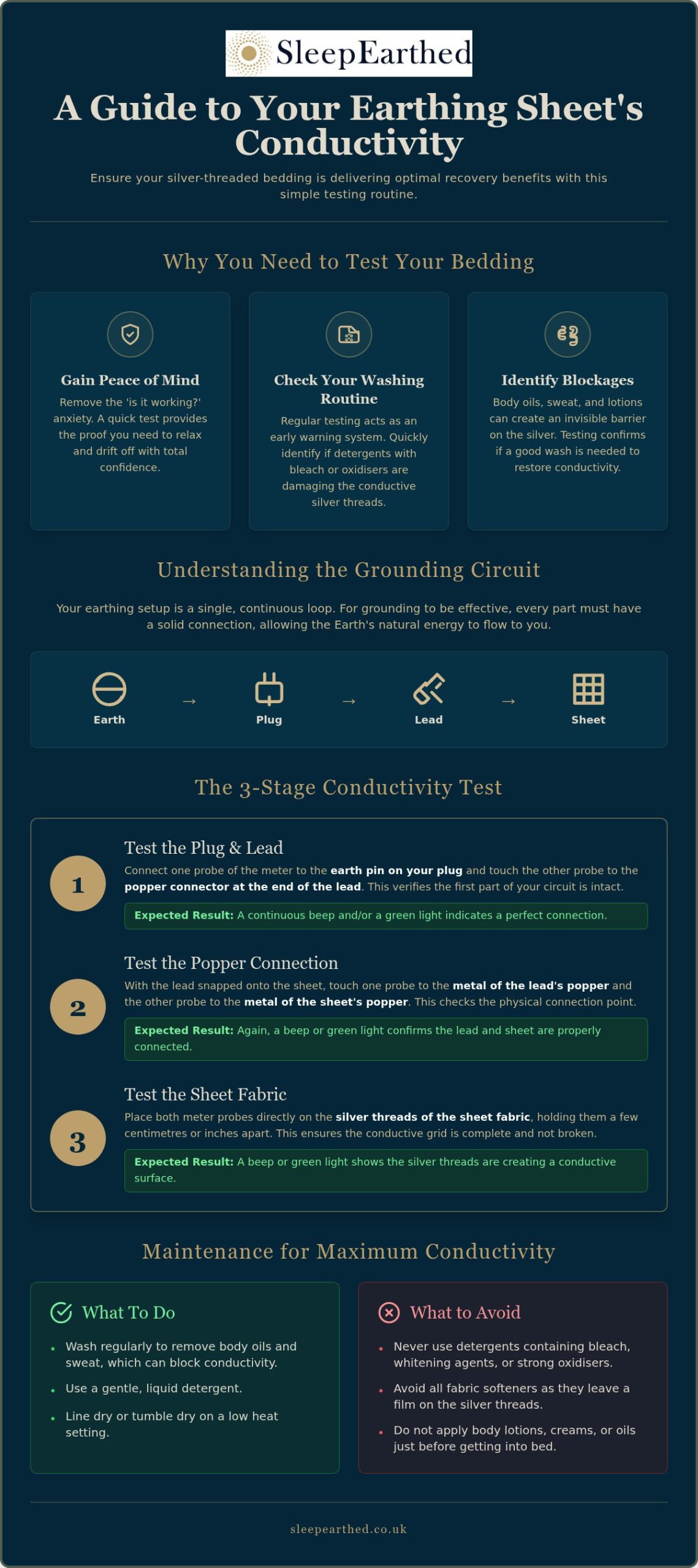
How to Test Your Earthing Sheet: A Step-by-Step Guide
Testing your setup isn’t just about the fabric; it’s about the entire connection from the wall to your skin. Before you begin, make sure your sheet is completely clean and dry. Residual moisture or dampness from a recent wash can lead to inaccurate readings, often making a failing sheet look more conductive than it actually is. By following a methodical approach with your earthing sheet conductivity meter, you can pinpoint exactly where a connection might be dropping out.
Safety is our first priority. In the UK, our grounding plugs are designed so that only the top earth pin is active. The two bottom pins are usually plastic and non-conductive. This ensures you are strictly testing the earth connection and never coming into contact with the live mains. We always recommend testing the ‘chain’ in three distinct parts: the plug, the lead, and finally the sheet itself. This way, you won’t accidentally bin a perfectly good sheet when the only problem was a loose wire in the cord.
Testing the Grounding Cord and UK Plug
Start by unplugging everything from the wall. Place one probe of your meter on the metal pin of the grounding plug and the other on the snap-connector at the end of the cord. Most reputable UK grounding leads include a built-in 100k Ohm resistor as a safety feature. Your meter should reflect this resistance. If you get a reading of ‘infinity’ or ‘no connection’, the internal wire is likely damaged. Check the length of the cord for any kinks or frayed sections where the internal copper might have snapped from being tucked under a mattress too tightly.
Measuring Conductivity Across the Fabric Surface
Once you’ve confirmed the lead is working, it’s time to check the fabric. Lay the sheet flat and place your probes about 30 centimetres apart on the silver grid. You should see a low resistance reading. We recommend testing several areas, especially the ‘foot zone’. This is where most wear occurs due to the friction of your feet and the natural acidity of sweat. If you find a ‘dead zone’ where the meter jumps to a high number, it’s a sign the silver threads in that specific area have broken down.
If your testing reveals that your current bedding has finally reached the end of its life, you can buy a Sleep Earthed Test Meter to keep your next set of bedding in peak condition from day one. Knowing exactly when to replace your equipment ensures you never miss out on the recovery benefits of a solid earth connection.
Maintaining Performance and Extending Product Life
Taking care of your grounding bedding is about more than just hygiene; it’s about protecting a technical investment in your sleep. We often find that customers are afraid to wash their sheets, worrying that the water will “wash away” the silver. In reality, the opposite is true. Regular washing is essential for maintaining a strong connection. Over time, natural body oils, sweat, and skin creams build up on the fabric. This creates an invisible, non-conductive barrier that prevents electrons from reaching your skin. By keeping your bedding clean, you’re actually clearing the path for better grounding.
The golden rule of silver care is to avoid bleach and fabric softeners at all costs. Bleach is highly corrosive and will quickly destroy the silver threads, whilst fabric softeners leave a waxy coating that acts as an insulator. If you use these products, your earthing sheet conductivity meter will likely show a sharp rise in resistance very quickly. We are so confident in the durability of our UK-manufactured products that we offer a 90-day better-sleep guarantee. We actually encourage you to test our sheets with a meter during this time so you can see the technical integrity for yourself.
Proper Washing to Protect Silver Threads
When it’s time for laundry day, set your machine to 40 degrees. This is the “sweet spot” that’s warm enough to strip away body oils but gentle enough to protect the silver fibres. Use a mild, liquid detergent and steer clear of anything containing lemon or essential oils, as these can be surprisingly acidic and may tarnish the metal. Once the cycle finishes, line drying is always the best option. If you must use a tumble dryer, keep it on a low-heat setting. High heat can cause the cotton to shrink at a different rate than the silver, which can lead to micro-breaks in the conductive grid.
When to Replace Your Earthing Accessories
Even with the best care, silver is a natural element that will eventually oxidise. A high-quality UK fitted earthing sheet typically has a functional lifespan of 18 to 36 months of nightly use. You’ll know it’s time for a refresh when your meter shows consistently high resistance even after a proper wash. Don’t just bin an old sheet, though; if the edges are still conductive but the centre has worn out, you can repurpose it as a grounding mat for under your desk or a smaller throw for your favourite chair. This ensures you get every last bit of value from the material.
If you’re ready to upgrade your setup or want to start testing your current bedding with professional accuracy, you can browse the Sleep Earthed range of UK-made earthing sheets and test meters. Staying informed about your bedding’s performance is the best way to ensure you never miss a night of restorative, grounded sleep.
Secure Your Rest with Confidence
Grounding is a personal journey toward better recovery, and you shouldn’t have to guess if your equipment is keeping up with you. By moving beyond simple “pass or fail” pens and using a dedicated earthing sheet conductivity meter, you gain the technical clarity needed to manage your bedding’s lifespan. You now know how to check the entire circuit, from the UK grounding plug to the high-density silver threads, ensuring every part of the system works in harmony.
Our meters are hand-tested in the UK and designed to be compatible with all Sleep Earthed silver bedding. Each one arrives with clear, easy-to-follow instructions so you can start testing immediately without any confusing electrical jargon. It’s the simplest way to protect your investment and maintain the high-quality connection you deserve for restorative sleep.
Ready to take the guesswork out of your routine? Shop the Sleep Earthed Test Meter and ensure your grounding is effective. With the right tools and a little bit of regular care, you can enjoy the peace of mind that comes with a perfectly functioning earthing setup every single night.
Frequently Asked Questions
How often should I test my earthing sheet for conductivity?
We recommend testing your bedding about once a month or after every few washes to ensure everything is performing as it should. It’s a great habit to get into, especially if you’ve recently changed your laundry detergent or noticed a slight shift in your sleep quality. Regular checks help you spot any buildup of body oils before they become a real barrier to the earth’s electrons.
Can I use a normal household multimeter to test my grounding mat?
You can certainly use a standard digital multimeter, but it can be a bit fiddly for those who aren’t used to electrical tools. You’ll need to set it to the correct Ohms range and ensure the probes don’t snag the fabric. A dedicated earthing sheet conductivity meter is often a better choice because it’s purpose-built for silver threads, making the process much simpler and more reliable for everyday home use.
Why is my earthing sheet showing a high resistance reading on the meter?
High resistance usually means there is a bottleneck preventing the electrons from flowing freely. The most common culprit is a buildup of body oils, sweat, or mineral deposits from your water supply. If your meter shows a high number, don’t panic; often, a thorough wash with a silver-safe detergent at 40 degrees will strip away that invisible barrier and bring your resistance readings back down to the effective range.
Will washing my earthing sheet ruin the silver threads?
Actually, regular washing is vital for protecting your silver threads. Whilst it sounds counterintuitive, keeping the fabric clean prevents body acids from eating away at the silver over time. As long as you avoid bleach, fabric softeners, and detergents with lemon or essential oils, your bedding will stay conductive. We’ve designed our sheets for longevity, and keeping them clean is the best way to prove that with your meter.
Do I need to test my wall socket before testing my earthing sheet?
Yes, it’s always a good idea to verify your wall socket is correctly wired before you even touch your bedding. In the UK, you can use a simple socket tester to ensure the earth connection is present and active. There’s no point testing your sheet if the source of the electrons isn’t working. Once you know the socket is safe and grounded, you can move on to testing your earthing sheet conductivity meter.
What should the reading be on a conductivity meter for a new sheet?
For a brand-new Sleep Earthed sheet, you should expect to see very low resistance readings. Whilst the exact number can vary slightly depending on the distance between your probes, a healthy new sheet will typically show resistance well under 100k Ohms. This indicates a very clear, easy path for the earth’s natural energy to reach you. If you see a significantly higher number on a new product, double-check your lead connection first.
My meter isn’t lighting up, but I still feel the benefits. Why is this?
If you’re using a simple test pen that isn’t lighting up, it might just mean the connection is too weak to trigger that specific LED, even if some electrons are still getting through. You might still feel the relaxing benefits, but the connection isn’t optimal. This is why we prefer a meter with a numerical display; it shows you the exact quality of the connection rather than just a simple yes or no light.
Can body lotion affect the conductivity readings on my meter?
Yes, body lotions and skin creams are significant insulators that can definitely interfere with your meter readings. If you apply heavy creams right before bed, they can coat the silver threads and block the connection to your skin. For the most accurate test, always check your sheet when it’s clean. If you use lotions, we suggest applying them at least an hour before sleep to allow them to fully absorb into your skin.