
 90 Day’s To Better Zzz’s Guarantee T&C apply


The proposed explanation for how earthing might reduce inflammation is that electrons from the earth enter the body and neutralise reactive oxygen species, molecules involved in oxidative stress and inflammatory processes. This is a hypothesis, not an established treatment mechanism: early studies do not show that earthing cures inflammatory conditions. Barefoot contact with natural surfaces is the basic idea; indoor products aim to create a similar electrical connection.
It is understandable to wonder whether walking barefoot or using a conductive mat can ease inflammation. The theory sounds straightforward, but a plausible mechanism is not the same as proof of a health benefit.
Here, we explain the earthing hypothesis in plain language, how contact with grass, soil or sand is thought to work, and what indoor experiments involving mats or conductive sheets have examined. We also look at their limitations, so you can distinguish an interesting early finding from reliable evidence for a treatment.
Key Takeaways
- Understand the proposed idea: electrons from the earth may help neutralise reactive oxygen species linked with inflammation.
- Learn what indoor earthing studies have explored, and why small studies cannot establish that earthing treats inflammatory conditions.
- See how barefoot contact with grass, soil, sand or natural stone is thought to work, and what practical safety considerations matter.
- Put earthing’s claimed benefits in context: it may be considered alongside conventional care, not as a replacement for established treatment.
Evidence and limitations of indoor-earthing experiments
Indoor experiments let researchers study grounding without asking participants to spend time outside. Mats and sheets provide conductive contact while people work, practise yoga or sleep. Some indoor mats connect by wire to the earth terminal of an electrical socket. This setup makes exposure easier to study, but also raises practical safety questions. If using a plug-in grounding product, avoid using it during thunderstorms.
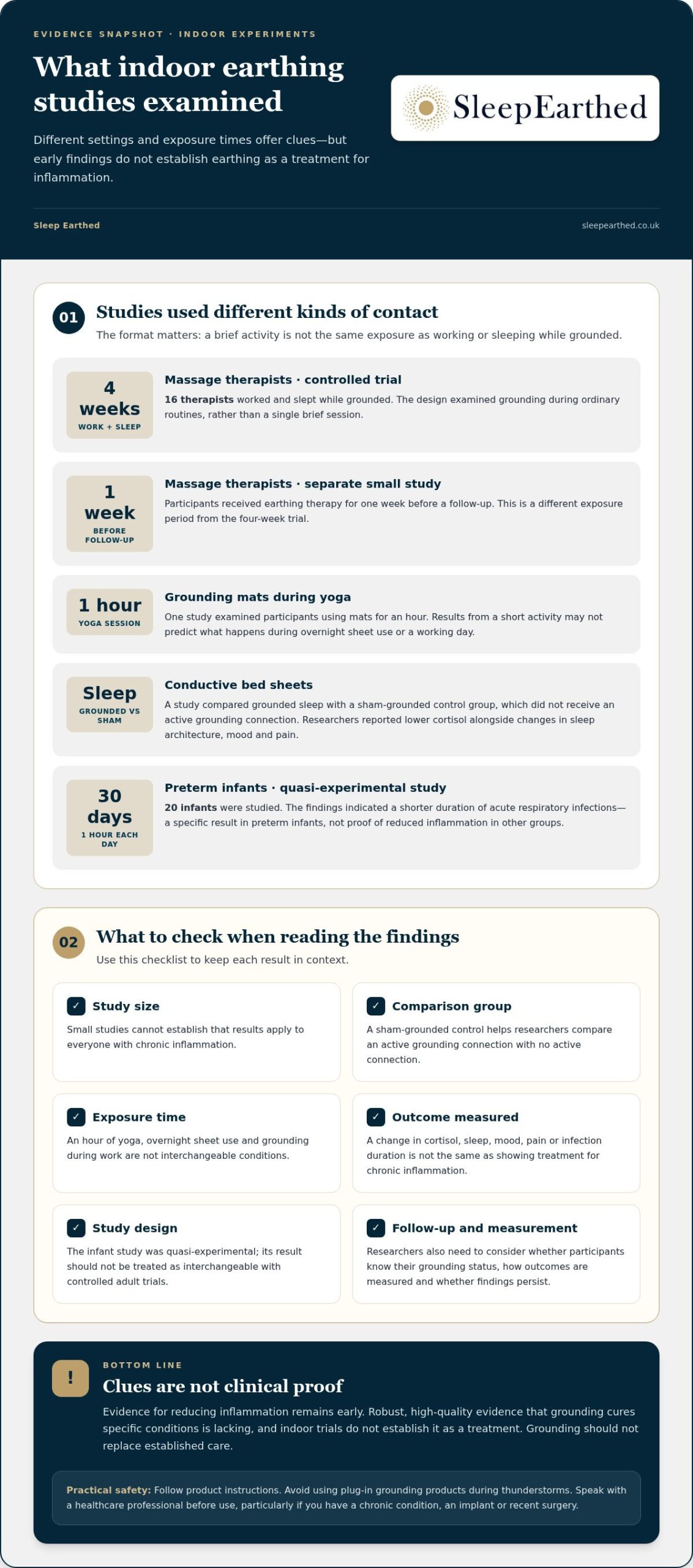
One controlled trial involved 16 massage therapists, who worked and slept while grounded for 4 weeks. This design allowed researchers to examine grounding during ordinary routines, rather than a single brief session. A separate small study gave massage therapists earthing therapy for one week before a follow-up. These studies offer examples of different exposure periods, but their results cannot automatically apply to everyone with chronic inflammation.
Sleep research has also examined conductive bed sheets. One study compared grounded sleep with a sham-grounded control group, whose participants did not receive an active grounding connection. Researchers reported lower cortisol levels alongside changes in sleep architecture, mood and pain. The comparison helps distinguish the proposed effect from simply using a sheet. However, these reported changes do not establish that earthing treats an inflammatory disease.
Other indoor experiments have examined shorter activities. In one study, participants doing yoga used grounding mats for an hour. This differs from overnight sheet use or therapists working throughout the day. Results from one activity may not predict what happens during another. Researchers also need to consider whether participants know their grounding status, how outcomes are measured and whether findings persist after the experiment.
A quasi-experimental study involving 20 preterm infants examined grounding for 1 hour per day over 30 days. It indicated a shorter duration of acute respiratory infections. This is a specific finding about infections in preterm infants, not proof of reduced inflammation across other groups. The study design also differs from controlled adult trials, so the result should not be treated as interchangeable evidence.
Available evidence is not strong enough to recommend grounding devices, including mats, sheets and rods, either for or against their use. Evidence for reducing inflammation remains early, and robust, high-quality evidence that grounding cures specific conditions is lacking. For readers asking how does earthing reduce inflammation, indoor trials offer clues about possible effects, not a settled clinical answer.
Study size, comparison groups, exposure time and the outcome measured all shape what a result can show. A change in cortisol, sleep or muscle discomfort is not the same as demonstrating treatment for chronic inflammation. Follow product instructions, and speak with a healthcare professional before use, particularly if you have a chronic condition, an implant or recent surgery. A mat experiment can inform the question, but it cannot replace established care.
The earthing hypothesis and electron absorption
The earthing hypothesis begins with a proposed transfer of electrons from the earth to the body. In this explanation, contact with a conductive surface lets the body reach the earth’s electrical potential. Supporters suggest these electrons may neutralise reactive oxygen species, often shortened to ROS. These molecules form naturally during processes such as energy production in cells. The hypothesis links their neutralisation with a possible reduction in oxidative stress and inflammation.
Reactive oxygen species are not simply harmful waste. The body also uses them in normal cell signalling and immune responses. Problems can arise when their production and the body’s defences fall out of balance. The earthing proposal suggests that available electrons could alter this balance. That describes a possible chemical pathway, not proof that electrons from the ground reach inflamed tissue in a useful amount.
Direct contact is central to the idea. Bare feet touching damp soil provide a different kind of contact from standing on an insulating indoor floor. A grounding mat aims to create a conductive route indoors, while conductive sheets are intended to maintain contact during sleep. In each case, the proposed chain is similar: contact with an earthed surface, electrical connection, then electron transfer. Each step needs to occur for the hypothesis to apply.
Materials and conditions can affect that connection. Some carbon-infused earthing mats rely on sweat to connect the body to the earth, so skin moisture may matter. Clothing, bedding or another insulating layer between skin and the conductive surface can also interrupt direct contact. For example, a mat under a thick, non-conductive covering may not provide the same contact as bare skin touching its surface.
There is another distinction to keep in mind. A measurable electrical connection does not by itself show that the body has absorbed electrons in a way that changes inflammation. Researchers would need to establish each link, from contact and electron movement to changes in biological markers and symptoms. Measuring an electrical property at the skin answers a different question from showing a lasting change in an inflammatory process.
So, how does earthing reduce inflammation according to the hypothesis? Earth-derived electrons may neutralise ROS and influence oxidative stress. That is the proposed mechanism, not a settled explanation for clinical improvement. The difference matters: a plausible account can guide experiments, but evidence must show that the suggested transfer occurs and produces a meaningful biological effect. Separating these steps helps readers assess claims about grounding mats and sheets without treating the theory as established fact.
Barefoot contact with natural surfaces
Earthing outdoors involves direct skin contact with a natural surface. Grass, soil, sand and natural stone are described as possible contact points. The proposed practice is simple: remove your footwear and let bare skin touch the ground. One suggested starting point in the UK is ten to twenty minutes barefoot on grass or soil on a dry day. This describes a practice, not a proven treatment for inflammation.
The surface changes the experience. A lawn may feel soft underfoot, while sand shifts as you walk and natural stone can feel uneven. Before walking barefoot, look over the ground and choose a familiar, comfortable place. Dry conditions are suggested for the grass-or-soil practice; dampness and rough patches can make contact feel quite different.
Grass, soil, sand and natural stone offer different ways to make contact with the earth. Walking across a lawn is one example; standing on sand at the beach is another. Swimming at the beach is also described as a relatively safe grounding technique. Each involves a different setting and activity, so the experience is not identical, even if the intended point of contact is natural ground.
Footwear makes a practical difference to the proposed practice. Shoes and soles sit between the skin and the ground, whereas bare feet provide direct contact. If you prefer not to walk barefoot, you can sit outside and touch the grass or soil with a hand. This allows contact without making a barefoot walk the only way to try the idea.
Keep the setting in mind as well as the surface. Grass can conceal small objects, and uneven ground may be uncomfortable to cross. A brief look around before sitting or walking helps you choose a suitable patch. Barefoot contact is not the same as walking freely without considering where you place your feet.
Outdoor time can include several experiences at once. For example, a walk combines movement with being outside, while sitting on grass is quieter and less active. Nutrition and immune health are separate topics; neither can be inferred simply from touching the ground. These distinctions help separate the earthing hypothesis from the broader effects people may associate with outdoor activity.
A measured approach is to choose a natural surface, make comfortable skin contact and notice how it feels. The suggested ten-to-twenty-minute period on dry grass or soil is one example, not an established anti-inflammatory dose. Walking barefoot can help you explore earthing outdoors, but the effects of that practice on inflammation remain a separate question from the experience itself.
Claims about earthing’s health benefits
Earthing is not established here as an NHS treatment recommendation for inflammation. The evidence described for reducing inflammation is early, and reported study findings should not be mistaken for a clinical recommendation. Robust, high-quality evidence that grounding cures specific conditions is lacking, so it is useful to distinguish an interesting result from an established treatment.
Some studies have reported changes in particular outcomes. A study in the Journal of Environmental and Public Health reported reduced inflammation markers, pain and stress, alongside improved sleep quality and autonomic nervous system function. Its participants had chronic pain and sleep disturbance. Those findings may be interesting, but they do not establish that earthing treats every disease linked with inflammation.
Exercise recovery is another area researchers have explored. One study reported that grounding after exercise accelerated recovery from delayed-onset muscle soreness. Participants had lower inflammatory markers and returned to baseline muscle function sooner than controls. That result concerns recovery from a specific exercise-related injury, not treatment for an inflammatory illness or a replacement for care.
A small study involving 21 people with diabetes examined wound healing. Participants used grounding for 1 hour per day for a month, and the study indicated faster healing. Wound healing is a meaningful outcome, but one small study cannot show that grounding manages diabetes itself. Nor does a finding about one type of wound establish effects across different injuries or health conditions.
Other reported observations focus on shorter-term changes. One study described pain easing after 30 minutes of grounding; another small study observed heart-rate variability changes after 20 minutes. A separate study reported improved mood after 1 hour. These outcomes differ, and a short-term change in pain, mood or heart-rate variability doesn’t by itself demonstrate reduced inflammation.
Cortisol findings also need careful interpretation. One study described grounding as aligning cortisol with the body’s natural 24-hour circadian rhythm. Cortisol follows daily patterns, so the timing of a measurement matters when interpreting a reported change. A result about this hormone doesn’t automatically show that an inflammatory disease has improved.
Walking outdoors can be part of a healthy lifestyle, but it does not prove earthing’s proposed effects. Movement, rest and nutrition are separate influences on health, and studies need suitable comparisons to distinguish them. Treat the practice as an area of investigation, not an established treatment. To assess claims, consider the condition studied, the outcome measured and whether findings have been replicated. A result about muscle soreness or diabetes-related wounds should not become a broad claim about disease.
How does earthing compare with proven anti-inflammatory treatments?
The key difference is the strength of evidence. Grounding studies have reported changes in inflammation markers, pain and sleep, but the evidence remains early. Conventional management for chronic inflammatory conditions is established care. Earthing is described as a possible adjunct, not a replacement for that care. This distinction matters if you are considering grounding for a diagnosed condition.
Established treatment is matched to the condition and the person’s circumstances. Inflammation can have different causes, so the right approach for one person may not suit another. For example, managing a diagnosed chronic condition involves more than trying a general wellness practice. Earthing research does not establish a treatment plan for a particular disease or show that it can replace recommended care.
It also helps to distinguish between outcomes. A study reporting less muscle soreness after exercise examines recovery from exertion. A report of better sleep examines a different outcome. Neither finding, by itself, demonstrates that a disease-related inflammatory process has been controlled. The same applies to a change in a laboratory marker: it needs to be considered alongside symptoms, function and the condition being studied.
If you are weighing up earthing, distinguish between an optional practice and treatment. Grounding may be explored as an addition to usual care, but it should not be a reason to stop prescribed treatment or delay assessment of a new or worsening symptom. Ongoing pain, swelling or a diagnosed inflammatory condition calls for care focused on that health issue, rather than relying on claims about electron transfer.
This boundary is particularly important for chronic illness. A small study or a personal account can raise a question, but it cannot establish that the same result will occur across different people and conditions. Evidence for a particular treatment is assessed through its results in the relevant condition. Grounding claims require the same careful distinction between an early signal and dependable clinical evidence.
In practice, keep the roles clear. Follow the care plan already agreed for your condition, and treat grounding as separate from the treatments intended to manage it. If considering a mat or conductive sheet, follow its instructions and discuss use with a healthcare professional, especially if you have a chronic condition, an implant or recent surgery. That advice is relevant to the device itself; it does not mean grounding has been shown to treat inflammation.
The comparison, then, is not between two equally proven options. Established anti-inflammatory care remains the basis for managing diagnosed conditions, while earthing is an area of ongoing investigation. This framing lets you consider the hypothesis without mistaking early findings for an alternative treatment or putting established care aside.
Sleep Earthed: UK Sized Fitted Earthing Bed Sheets
Sleep Earthed offers UK Sized Fitted Earthing Bed Sheets for people interested in exploring indoor earthing during sleep. They provide a practical way to use a conductive sheet at home rather than relying on barefoot contact outdoors. Earthing Pillow Cases and an Earthing Half Sheet offer other options for different sleeping arrangements.
These products relate to the indoor grounding approach discussed above, not a proven treatment for inflammation. Research remains early, so use earthing as a personal practice alongside established care, not in place of it. Choose a format that suits how you sleep and follow the product instructions.
For more information about the available options, contact Sleep Earthed.
Choose your next step with confidence
Understanding how earthing might reduce inflammation can help you decide whether it belongs in your routine, but keep that choice separate from decisions about medical care. Earthing remains an area of investigation, so it should not replace treatment for a diagnosed condition. If you are curious about trying indoor grounding, consider which sleeping arrangement suits you best and read the product guidance before use.
Sleep Earthed offers UK Sized Fitted Earthing Bed Sheets, Earthing Pillow Cases and an Earthing Half Sheet for different ways to explore conductive contact during rest. These are options for trying earthing at home, not a promise of an anti-inflammatory effect.
If you’d like to explore the available options, contact Sleep Earthed. Take the next step at your own pace, with clear expectations and your established care kept in place.
Frequently Asked Questions
What Is Grounding?
Grounding, also called earthing, means making conductive contact with the earth, either outdoors or through a connected indoor product. For example, you might stand barefoot on grass or use a conductive surface designed for contact at home. The term describes the practice, not a medical diagnosis or established treatment. Its proposed health effects are separate questions that need to be assessed through research.
Grounding: Can Walking Barefoot on the Earth Heal You?
Walking barefoot cannot be relied on to heal an illness or injury. It may be a way to spend time outdoors, but that experience does not prove a medical effect from contact with the ground. For example, a walk combines movement and being outside, which are different from the earthing hypothesis itself. Anyone with reduced foot sensation should avoid risking unnoticed cuts or other injuries.
How Does It Work?
Earthing’s proposed mechanism is that electrons pass from the earth into the body through conductive contact. The hypothesis suggests these electrons could neutralise reactive oxygen species, which are involved in oxidative processes. This describes a possible explanation, not a demonstrated treatment pathway. To establish it, research would need to show that electron transfer occurs and produces relevant biological changes, rather than only a measurable electrical connection.
What Is Earthing and Is It Beneficial?
Earthing is a practice intended to connect the body electrically with the earth. Whether it benefits health remains uncertain because reported findings do not establish reliable effects across conditions. You might explore it as a wellbeing practice while keeping expectations distinct from evidence for treatment. For instance, feeling relaxed after sitting outside is a personal experience, not proof that earthing has changed an underlying health condition.
What Is The Relationship Between Grounding and Inflammation?
The proposed relationship is that electrons received through grounding may affect reactive oxygen species and, in turn, inflammatory processes. Inflammation markers are measurements used to examine biological activity, but a change in a marker does not automatically mean symptoms or disease have improved. Researchers need to connect laboratory changes with meaningful health outcomes before grounding can be considered an established approach to managing inflammation.
What is earthing or grounding, and how is it supposed to work?
Earthing and grounding are two names for practices intended to create an electrical connection between the body and the earth. The idea can involve skin touching a natural surface or a conductive indoor surface providing that connection. The proposed next step is electron movement into the body. This explanation remains a hypothesis, so it should not be confused with a proven account of how inflammation is treated.
What scientific evidence shows earthing reduces inflammation?
Small studies have reported changes in inflammatory markers alongside outcomes such as pain, sleep or exercise recovery. Those findings are preliminary and do not show that grounding treats inflammatory disease. To judge the evidence, consider whether a study used a suitable comparison group, measured the condition directly and produced repeatable results. A physician at Nebraska Medicine describes the evidence for reducing inflammation as early.
How could contact with the Earth affect inflammatory markers in the body?
Under the earthing hypothesis, electrons from the earth could neutralise reactive oxygen species, potentially influencing processes associated with inflammation. Researchers can measure markers to look for changes, but those measurements are only part of the picture. A marker result needs to be interpreted alongside symptoms, function and the condition being studied. By itself, it does not show that someone feels better or that a disease is under control.