
 90 Day’s To Better Zzz’s Guarantee T&C apply

Grounding sheets for menopause symptoms are often claimed to support better sleep and ease hot flushes, mood changes, stress and joint pain. Evidence is limited, and personal accounts are not proof that a sheet will relieve symptoms. Treat them as reports about a possible wellbeing aid, not as a replacement for menopause care.
If night sweats are disrupting your rest, it’s understandable to be curious about ways to sleep more comfortably. Some people say they notice changes in sleep and energy after trying grounding, but experiences vary.
This guide explains what grounding sheets are claimed to do, what testimonials report about sleep and energy, and how to try grounding in practical ways. It also distinguishes personal accounts from scientific evidence, helping you decide whether this approach is worth exploring.
Key Takeaways
- Testimonials describe possible changes in sleep and energy, but personal experiences aren’t proof that grounding relieves menopause symptoms.
- Separate reported benefits from the limited rigorous evidence before deciding what claims to trust.
- Grounding can be tried outdoors through barefoot contact with grass, sand or soil, or indoors with a grounding product.
- Consider how sleep disruption, night sweats and other symptoms affect you when weighing whether to explore grounding.
- Learn what grounding sheets are claimed to do and how their proposed effects on circulation and inflammation are explained.
Customer testimonials about sleep and energy
Menopause-related night sweats can interrupt rest, affecting sleep and daytime energy. Testimonials describe possible changes after grounding, but these are personal accounts, not proof of treatment.
For another perspective, watch the WellnessPulse video review of grounding sheets and their sleep-related claims:
Hot flashes and disrupted sleep
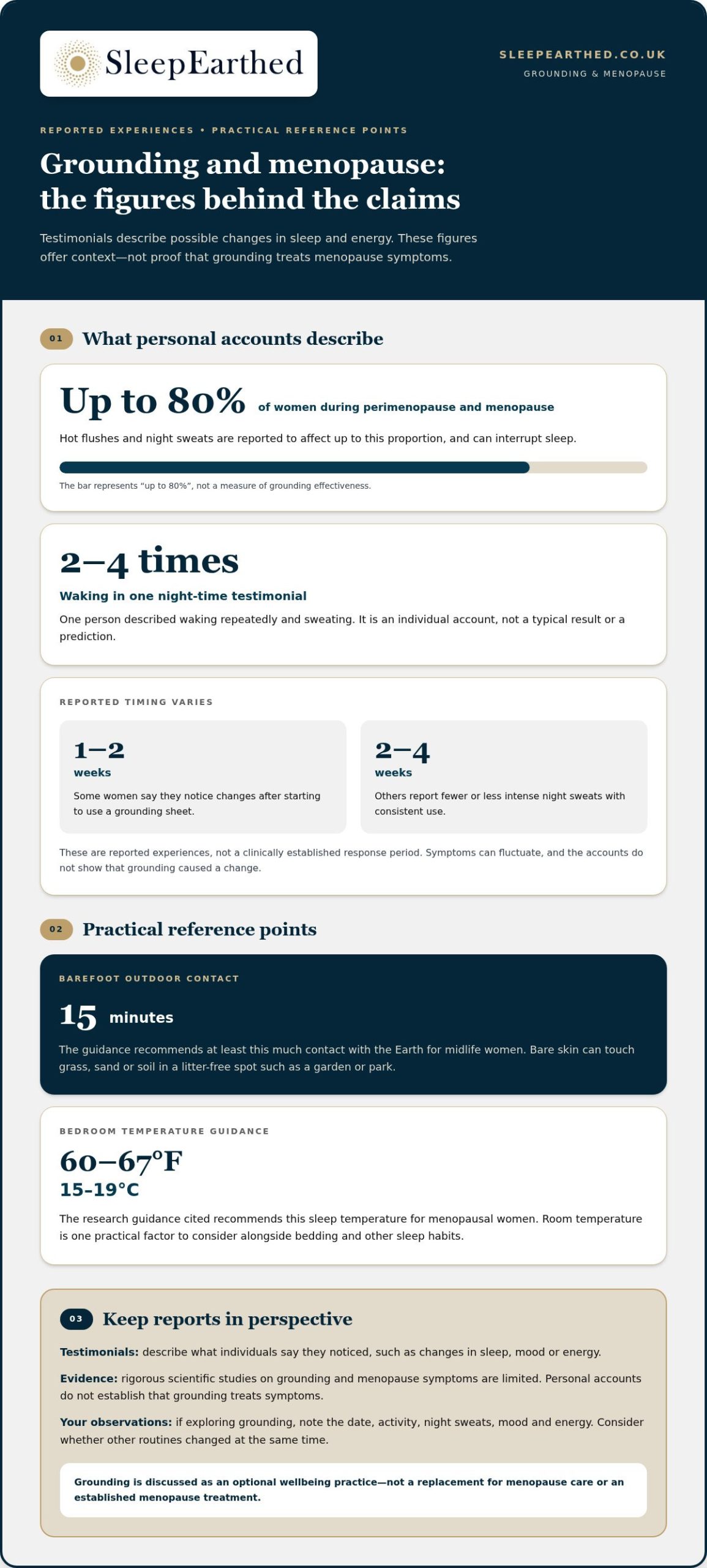
Hot flushes and night sweats can wake someone repeatedly, breaking up sleep during perimenopause and menopause. Reports indicate they affect up to 80% of women during these stages. One testimonial describes waking two to four times nightly, sweating. That example shows why a claimed improvement in sleep can matter: fewer interruptions could make nights feel more settled and days less tiring.
Grounding and sleep quality
Grounding is claimed to connect the body with the Earth and support circadian rhythm, potentially making it easier to fall asleep and sleep more deeply or for longer. Testimonials describe sleep changes over the weeks after starting. These accounts show what some users notice, but don’t establish that grounding caused the change or that everyone will experience it.
Individual stories often describe gradual changes rather than overnight results. One writer had experienced perimenopausal symptoms for two years before trying grounding sheets, then reported feeling happier, healthier and more confident after a month. Another reported going several days without a hot flush after a week. These are personal timelines, not a schedule to expect.
Bedroom conditions also matter to sleep. The guidance in the research recommends a sleep temperature of 60-67°F (15-19°C) for menopausal women. If night-time warmth is disturbing rest, consider the room temperature alongside bedding and other sleep habits. This gives you practical factors to observe, rather than attributing every change in sleep to grounding alone.
Claims also link grounding with reduced stress, less fatigue and improved energy. To assess a testimonial, note what changed, when it changed and whether other routines changed at the same time. For example, record night waking and daytime energy before trying a new bedtime practice, then compare your notes over the following weeks.
Studies and personal accounts answer different questions: testimonials describe individual experiences, while studies examine outcomes in a more structured way. Grounding is discussed as a way to support sleep quality, but reports of better rest or energy don’t demonstrate that it treats menopause symptoms. Assess the claimed benefit separately from the evidence behind it.
Grounding and menopause symptoms
Grounding is the practice of making direct contact with the Earth, often by walking barefoot outdoors or using a conductive indoor surface. Claims connect it with menopause symptoms, but rigorous scientific studies are limited, while anecdotal reports are plentiful.
Menopause can involve hot flushes, mood swings, stress and joint pain. Symptoms may overlap, so someone experiencing poor sleep and daytime fatigue may want support with several parts of daily life. Grounding is discussed as a possible wellbeing practice, not an established menopause treatment.
The proposed explanation centres on electrical charge: advocates suggest contact with the Earth allows charge to move between the body and the ground. This idea is used to explain claims about inflammation, stress and sleep. It is separate from evidence that grounding reliably changes menopause symptoms. A proposed mechanism describes how an effect might happen, but does not demonstrate that it does.
Reports about timing also vary. Some women say they notice changes within 1-2 weeks of using a grounding sheet, while others report fewer or less intense night sweats after 2-4 weeks of consistent use. These timeframes describe reported experiences, not a clinically established response period. Symptoms can also fluctuate, which makes it difficult to attribute a change to one new habit alone.
For a simple way to explore grounding, try bare-skin contact with a natural surface such as grass, sand or soil. The guidance recommends at least 15 minutes of contact with the Earth for midlife women. Choose a litter-free spot, such as a garden or park, and notice how you feel during and afterwards. This is a practical grounding activity, not a test of whether menopause symptoms have been treated.
Keep a short record to understand your own experience. Note the date, grounding activity, night sweats, mood and energy levels. For example, record whether you woke sweating, then compare your notes after trying regular barefoot contact. Tracking symptoms separately can help you see whether a reported change is consistent or occasional.
Sleep disruption, fatigue and joint pain can affect everyday routines in different ways. If you explore grounding sheets for menopause symptoms, try one practice at a time and note what changes alongside it. This makes personal observations clearer without confusing a possible association with proof of cause.
Indoor grounding is another option described in this area. An indoor setup may connect through a grounded outlet or a rod placed in the ground. A grounding setup is one way to learn about this approach; the proposed menopause benefits remain claims rather than established outcomes. Grounding sheets for menopause symptoms are best considered as an optional practice, rather than a proven treatment.
Circulation and thermoregulation
Grounding is sometimes linked with circulation and the body’s ability to manage heat. These claims may seem relevant during menopause, when night-time warmth can disturb rest and make it harder to fall asleep.
One study suggests grounding reduced blood pressure in participants with hypertension. This finding concerns people with hypertension, not menopause symptoms specifically. It doesn’t show that grounding prevents hot flushes or controls body temperature. Blood pressure and thermoregulation are different measures, so one result is not evidence for the other.
Research by Chevalier et al. found grounding significantly improved blood flow and tissue perfusion. Tissue perfusion describes blood reaching the body’s tissues. This finding offers a possible reason researchers discuss circulation, but it doesn’t establish that improved blood flow reduces menopausal night sweats. Circulation outcomes and a person’s experience of heat are separate things.
Thermoregulation is the body’s process for balancing heat. During a hot flush, someone might feel suddenly warm, then notice sweating or chills. That experience is not the same as measuring blood flow. A claim about circulation alone cannot explain why a person wakes warm or whether grounding changes that pattern.
For a clearer picture, record what happens during the night rather than relying on a general impression. Note whether you woke feeling hot, whether sweating interrupted sleep, and how rested you felt in the morning. If you try grounding, include it in the same record. Comparing specific details can help distinguish a change in night-time comfort from a change in sleep quality.
Keep other conditions in view, too. Note whether the room felt warm, whether your bedding felt comfortable and whether you woke after a hot flush. These observations don’t diagnose a cause, but they add useful context when considering claims about reducing heat or supporting circulation. They also help avoid assuming one new practice explains every change.
Research findings and individual experiences answer different questions. Chevalier et al.’s reported improvement in tissue perfusion relates to circulation, while a testimonial about fewer night sweats describes someone’s experience. Neither proves that grounding treats menopause-related temperature changes. Consider the specific outcome to keep the claim in proportion.
In short, circulation findings suggest a possible connection, not a direct explanation for thermoregulation during menopause. If you explore grounding, track night-time warmth, sleep interruptions and morning energy separately. This gives you a more useful account than combining them into a single impression of feeling better.
Claims about electrons and inflammation
Grounding claims often centre on electrons and inflammation. The proposed explanation is that contact with the Earth allows free electrons to enter the body and interact with reactive oxygen species, which are involved in processes associated with inflammation. This describes a suggested mechanism, not direct proof that grounding relieves menopause symptoms.
A 2015 review outlined proposed mechanisms by which earthing could neutralise reactive oxygen species. In simple terms, the theory suggests that free electrons could affect molecules involved in oxidative processes. The review’s proposed mechanism helps explain why grounding is discussed in relation to inflammation. It doesn’t establish that a person using a grounding sheet will experience a particular health outcome.
Grounding has been shown to have anti-inflammatory effects by reducing inflammatory markers in the body. An inflammatory marker is a measurable sign associated with inflammation, rather than a symptom itself. This distinction matters: a change in a marker isn’t automatically the same as less joint pain, fewer hot flushes or improved sleep. Each outcome needs separate consideration.
For someone experiencing menopause-related joint discomfort, the practical question is whether a claimed change in inflammation leads to a noticeable difference in daily life. Consider whether movement feels easier, discomfort changes or sleep is interrupted less often. These are separate experiences, and none proves that free electrons caused an improvement.
The proposed electron explanation also relies on a chain of steps: contact with the Earth, movement of charge, interaction with reactive oxygen species and a possible change in inflammatory activity. Each step is part of the theory. Evidence for one proposed step does not confirm every later effect or show that the process treats menopause symptoms.
It helps to separate three kinds of claim. The first is the proposed mechanism involving electrons. The second is a measured change in an inflammatory marker. The third is a practical result, such as less discomfort or better sleep. These ideas are related, but not interchangeable. A report about one does not establish the others.
When assessing a grounding claim, identify its stated outcome first. Does it describe a mechanism, a marker or a change someone noticed? For example, “neutralising reactive oxygen species” describes a proposed mechanism, while “less joint discomfort” describes a person’s experience. Keeping these categories distinct makes health claims easier to assess.
In short, the electron theory offers an explanation for grounding’s claimed relationship with inflammation, and the 2015 review described possible mechanisms. That explanation should not be mistaken for evidence that grounding treats menopause symptoms. Separating proposed biology from measured markers and personal outcomes gives a clearer basis for understanding the claim.
Grounding sheets and menopause symptoms
Grounding sheets connect a sleeper to the Earth through a grounded outlet or a rod placed in the ground. Claims include possible relief from night sweats, but weigh the evidence against established menopause treatments and consider practical safety checks.
How do grounding sheets compare with evidence-based menopause treatments? Grounding sheets are not an established menopause treatment, and testimonials are not equivalent to clinical treatment guidance. Treat them as a possible sleep-related wellbeing practice, not a replacement for prescribed care.
How much do grounding sheets cost in the UK? Sleep Earthed UK Sized Fitted Earthing Bed Sheets cost £102 per piece as of 21 October 2026. This is the listed price for that product, not a general price for all grounding sheets.
What does research say about grounding sheets and menopause? Research on grounding sheets specifically for menopause symptoms is limited. A 2004 study by Ghaly and Teplitz found sleeping grounded significantly reduced night-time cortisol levels, but that finding does not establish relief from menopause symptoms.
Are grounding sheets safe to use during menopause? Menopause itself does not change how a sheet connects to an earth point. Use the sheet according to its instructions, and don’t treat it as a substitute for prescribed menopause care or advice about your health.
What are the risks or side effects of grounding sheets? Check the cord, connection and fabric for damage before use, and stop if the sheet causes discomfort or skin irritation. Keep electrical fittings unaltered; never force a plug or use damaged equipment.
How can I check whether a grounding sheet is properly earthed in the UK? Use a suitable socket tester or meter according to its instructions to check the outlet’s earth connection, then follow the sheet’s setup guidance. Don’t open a socket or modify household wiring; a test meter can help assess the connection.
Can grounding sheets interfere with medicines or medical devices? A sheet doesn’t change a medicine dose, so don’t stop or alter prescribed medicines because you’re trying grounding. If you use an implanted or bed-connected medical device, ask your clinician or device team about using a conductive sheet alongside it.
For a non-electrical way to explore grounding, try barefoot contact with grass or soil in a litter-free place. If an indoor sheet suits your routine, explore grounding sheet options and follow their setup instructions carefully.
Sleep Earthed: UK Sized Fitted Earthing Bed Sheets
Sleep Earthed offers UK Sized Fitted Earthing Bed Sheets for people who want to explore indoor grounding during sleep. They provide a practical way to try the approach discussed here, while keeping expectations realistic: testimonials and proposed mechanisms don’t establish that grounding sheets relieve menopause symptoms.
If a fitted style doesn’t suit your bed or routine, Sleep Earthed also offers an Earthing Half Sheet, Earthing Pillow Cases and a Recovery Sleeping Bag. Consider which format fits your sleeping arrangements and how you’d prefer to make contact with a grounding surface. Follow the product’s setup guidance and keep any prescribed menopause care unchanged.
For a straightforward next step, explore Sleep Earthed’s earthing bedding and choose the format that suits your needs. Contact Sleep Earthed if you have questions.
Choose a next step that feels right for you
If you’re considering grounding sheets for menopause symptoms, first decide what you want to learn from trying them. You might focus on whether your bedtime routine feels comfortable or whether keeping a simple sleep note helps you understand your own patterns. Having a clear personal aim makes it easier to judge whether the practice fits your life.
Grounding sheets aren’t an established treatment for menopause symptoms, so keep any existing care and prescribed medicines separate from this experiment. Explore the idea at your own pace, without treating testimonials as a promise of what will happen for you. Choose a next step that leaves you informed and comfortable with your decision.
If you’d like to ask about Sleep Earthed’s earthing bedding, contact Sleep Earthed with your questions. Take the time you need, and choose an approach that feels practical for your routine.
Frequently Asked Questions
So how do you try grounding?
Try barefoot contact with grass, sand or soil in a clean, comfortable outdoor spot. A garden or park offers a simple place to walk, sit or stand directly on the ground. If you’d rather stay indoors, an earthing sheet connects through its earth lead and a grounded outlet, following the product’s setup instructions. Choose one approach that fits your routine, then note how you feel afterwards.
How quickly will I notice results for menopause sleep problems?
Testimonials describe changes on different timescales, rather than one reliable timetable. Some women report noticing changes within 1-2 weeks, while reports of fewer or less intense night sweats describe 2-4 weeks of consistent use. Those are personal accounts, not a prediction. If you’re trying grounding, keep a brief sleep diary with bedtime, night wakings and morning energy, so you can compare your own experience.
What size grounding sheet should I choose?
Choose a sheet that matches your mattress size and depth, so it fits securely rather than shifting overnight. Sleep Earthed offers fitted sizes including Single, Double, King and Emperor, alongside custom sizes. Its depth options are Standard, for mattresses up to 28 cm, and Deep, up to 32 cm. Measure your mattress before choosing, especially if it has a deeper profile or a topper.
Do grounding sheets help relieve menopause symptoms?
Grounding sheets aren’t an established treatment for menopause symptoms. Reports describe experiences such as better sleep or changes in night sweats, but don’t prove that grounding caused them. If you’re curious, treat a sheet as an optional addition to your sleep routine, not a substitute for menopause care. Track the specific symptom you’re interested in rather than relying on a general impression.
Can grounding sheets reduce hot flushes, night sweats or insomnia?
Some testimonials report fewer night sweats or improved sleep, but grounding sheets haven’t been shown to reliably reduce hot flushes, night sweats or insomnia. Symptoms affect people differently, so record each separately if you’re exploring a new bedtime routine. For instance, note whether you woke sweating, how often sleep was interrupted and how rested you felt the following morning.
How do grounding sheets work and how are they used?
Conductive silver threads in organic cotton connect the sheet to Earth through its lead and the ground pin of a three-hole UK socket. The sheet uses the earth connection, not mains electricity. Set it up according to its instructions and keep the conductive surface in contact with your skin. Sleep Earthed advises against placing an ordinary sheet over an earthing sheet if you want full contact.
Which grounding sheets are best for menopause symptoms in the UK?
There isn’t an evidence-based ranking of sheets for menopause symptoms. Choose based on practical fit: mattress dimensions, depth, preferred coverage and how you plan to use the sheet. Sleep Earthed offers UK Sized Fitted Earthing Bed Sheets in several sizes, as well as an Earthing Half Sheet. A fitted option suits those wanting bed coverage, while a half sheet offers a different format for sleeping.