
 90 Day’s To Better Zzz’s Guarantee T&C apply
Earthing Sheets for Deep Sleep: What to Expect
Could grounding sheets for deep sleep be a sensible part of your bedtime routine, without being a guaranteed fix? It’s understandable to be curious. These sheets are designed to bring earthing into the hours you spend in bed, but bold claims can make it hard to tell what’s established and what remains uncertain.
The evidence does not establish a dependable sleep benefit, so it’s best to treat grounding bedding as an optional addition, not a solution or replacement for habits and care that support good rest. Before choosing a sheet, understand how it is intended to work, check that it suits your bed and routine, and decide what you’ll use to assess your own experience.
In this guide, we explain the idea behind earthing sheets, what research can and can’t tell us, and practical points to consider before trying one. We also cover Sleep Earthed’s fitted sheets, which combine organic cotton with conductive silver threads, without promising a particular sleep result. By the end, you’ll have a clearer basis for deciding whether earthing bedding feels like a worthwhile fit for you.
Key Takeaways
- Learn how grounding sheets are intended to create an earth connection, and why the proposed mechanism isn’t proof of a sleep benefit.
- See what the evidence can and can’t tell you about grounding sheets for deep sleep, including whether a reliable improvement has been established.
- Set a simple baseline and keep your bedtime habits steady if you try a sheet, so you can reflect more usefully on your experience.
- Compare bedding format, bed fit, material and intended use before deciding whether an earthing sheet suits your sleep setup.
- Explore Sleep Earthed’s UK-sized fitted sheets and earthing pillowcases as different ways to bring earthing bedding into your routine.
Grounding Sheets for Deep Sleep: What They Are and What They Promise
Can a bedding choice support a more restful night? A grounding sheet is designed for use as part of an earthing setup. Its intended purpose differs from that of a standard sheet, but this shouldn’t be confused with proof that it improves sleep. The phrase grounding sheets for deep sleep can sound like a definite outcome. In practice, what a product is designed to do and what an individual sleeper experiences are separate questions.
That distinction helps when assessing product descriptions. A description can explain a product’s design and intended use, but a claim about sleeping more deeply needs evidence that directly supports it. Neither a product’s name nor its intended function predicts how a particular person will sleep.
How a grounding sheet differs from ordinary bedding
Ordinary bedding covers the mattress and provides a surface for sleep. A grounding sheet has an additional intended function: it is designed to be used in a setup that provides an earth connection. That describes how the product is meant to be used, not a guarantee that every sleeper will feel or perform differently.
When comparing bedding, consider practical qualities such as fit and comfort alongside the earthing purpose. Check the product size against your bed and think about how the sheet will sit with your usual bedding. A sheet can suit your bed and still have no noticeable effect on your sleep. Similarly, a change in how you feel after trying it doesn’t by itself show what caused the change. Separating the design from the possible experience makes for a fairer assessment.
What people mean by deep sleep
Deep sleep is one stage within the broader sleep cycle. It’s only one part of the night, so “better sleep” can mean different things: feeling more rested on waking, settling more easily or having fewer interruptions. These experiences may matter to you, but they aren’t the same as evidence that a product changes a particular sleep stage.
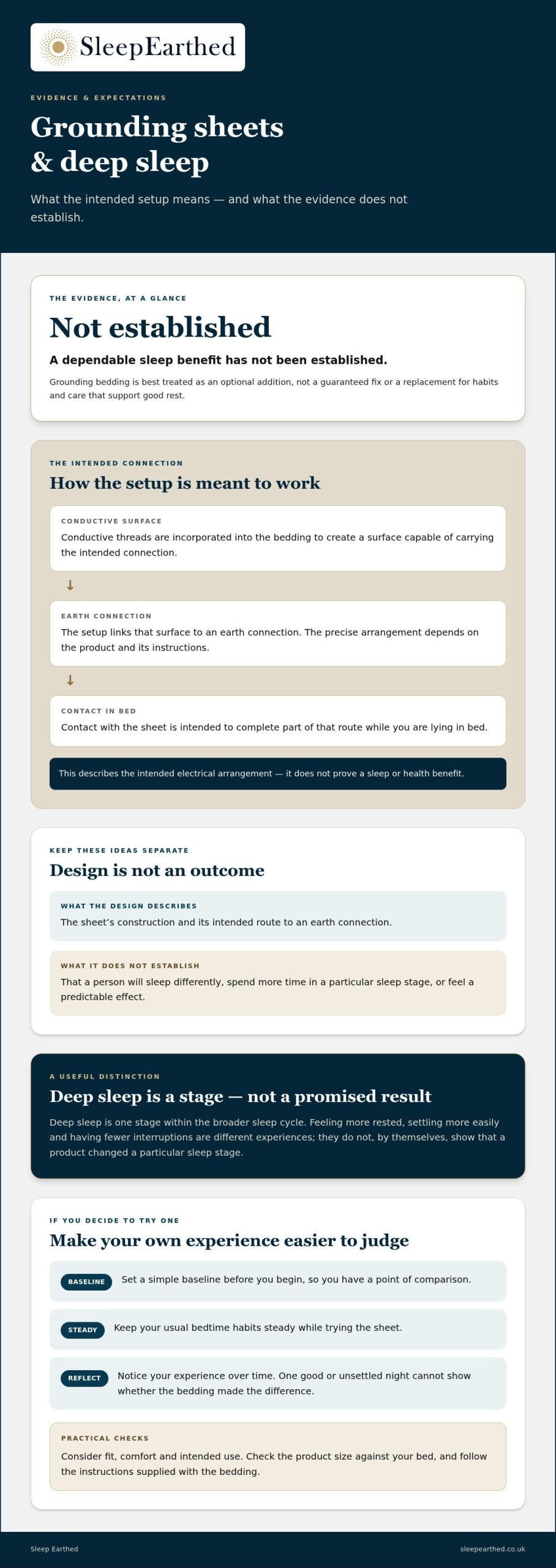
Deep sleep is a stage of sleep, not an outcome a bedding product can promise.
It’s also difficult to judge sleep quality from a single night. A good or unsettled night can happen for many reasons, and one experience cannot show whether a bedding choice made the difference. If you decide to explore earthing bedding, treat it as an optional part of your routine. Notice your experience over time without expecting a guaranteed result.
This is a useful starting point if you’re curious but cautious. Consider whether the idea and intended use suit your routine, while keeping claims about deeper sleep in perspective. A product may be designed with a particular purpose in mind, but that alone doesn’t establish a predictable effect for every person.
How Earthing Sheets Connect Sleepers to the Earth
What does “connected to the earth” mean in practice? In an earthing setup, the conductive part of the bedding is intended to form a route to an earth connection. The idea is that contact with the sheet completes part of that route while you’re lying in bed. This describes the product’s intended electrical arrangement, not proof that it changes how the body works during sleep.
A simple way to picture it is as a pathway: the sheet provides a surface, and the setup links that surface to earth. The precise arrangement depends on the product and its instructions, so don’t assume every sheet works in exactly the same way. Follow the guidance supplied with the bedding rather than relying on a general description of earthing products.
Earthing bedding is intended to provide a conductive route between its surface and an earth connection, but that route doesn’t establish a sleep or health benefit.
What conductive threads do in the bedding
Conductive threads are incorporated into the fabric to create a surface capable of carrying the intended connection. Their role is part of the sheet’s construction and setup, not evidence of a particular effect on the person using it. If you’re comparing fabric choices and how they relate to sheet design, this guide to cotton and grounding sheets offers further context.
Separate what can be described directly from claims about outcomes. The bedding’s construction and intended connection can be explained in practical terms. A resulting change in sleep, comfort or recovery is a different matter and needs evidence that specifically supports that outcome.
Why the proposed connection is not a sleep guarantee
An electrical pathway, even when set up as intended, doesn’t tell you whether an individual will sleep differently. Research discussing earthing may explore possible physiological effects, but a proposed mechanism shouldn’t be treated as established proof that a sheet changes sleep stages, hormones or recovery. The NIH research overview of earthing provides broader research context; it isn’t a guarantee of an outcome for a particular sleeper.
When considering a sleep-related claim, check whether the evidence directly examines sleep and measures the outcome being claimed. Findings about one aspect of wellbeing don’t automatically demonstrate an effect on deep sleep. A result from a different type of earthing product also can’t necessarily establish what someone will experience with bedding.
This distinction helps you assess the idea without dismissing it or expecting too much. Understand how the setup is intended to work, then weigh claims about sleep separately and cautiously. To see how Sleep Earthed presents its bedding options, explore the earthing sheet range as one possible part of your routine.
Can Grounding Sheets Improve Deep Sleep? Evidence and Expectations
Do studies show that grounding bedding reliably improves deep sleep? The evidence doesn’t establish a dependable effect for every sleeper or prove that grounding sheets specifically increase deep sleep. Some findings are promising, but early or limited research isn’t enough to turn a possibility into a predictable outcome.
A 2025 double-blind, placebo-controlled trial in Korea reported increased sleep time among participants using grounding mats compared with a placebo group. That finding is worth noting, but mats are not the same as sheets, and sleep time isn’t necessarily the same outcome as deep sleep. The study design is relevant, as are the number of participants and the duration of the study when judging how much weight to give its result. One trial cannot settle the question on its own.
Individual sleep outcomes aren’t guaranteed, so assess the evidence carefully and don’t treat a promising result as proof of a dependable benefit.
How to assess claims about sleep research
Start with what the study actually measured. Did researchers assess sleep directly, or ask participants to report how they slept? Then consider the number of participants, how long the study ran and whether independent research has repeated the finding. Small or preliminary studies can help shape further research, but they can’t establish a reliable effect by themselves.
It also matters whether the study tested earthing sheets or another product, and whether it measured deep sleep specifically. A result about overall sleep time, for instance, shouldn’t be presented as proof that deep sleep increased. In June 2026, Snopes described the claim that grounding sheets improve sleep as “unproven”, pointing to concerns including a lack of robust, large-scale studies. That’s a useful reminder to look at the measured outcome, not just a product claim.
What a sensible expectation looks like
If you’re interested, think of grounding bedding as an optional personal experiment, not a treatment for sleep problems. You might notice a change, or you might not. Even if your sleep feels different, other influences, such as changes to your routine or surroundings, could have played a part. Keeping your habits steady and noting how you feel over time can make your observations more useful, though it won’t prove what caused a change.
For grounding sheets for deep sleep, a balanced view means being open to new research without assuming the result in advance. An evidence review can help you see how different claims compare with the studies behind them. You can also browse Sleep Earthed earthing bedding as an option, while keeping realistic expectations about what it can and can’t tell you about your sleep.
Ongoing or severe sleep difficulties deserve attention beyond trying a bedding change. A sheet shouldn’t replace appropriate medical advice or established support for persistent problems.
How to Try a Grounding Sheet Alongside a Better Sleep Routine
If you decide to try a grounding sheet, a steady approach can make your own observations easier to interpret. The aim isn’t to diagnose your sleep or prove a product works. It’s to notice how your nights feel while keeping other parts of your routine as consistent as you reasonably can.
Use this simple sequence:
- Establish a baseline. Before making a change, note your usual bedtime, wake time and how rested you feel in the morning. Include simple observations, such as waking during the night or finding it hard to settle.
- Set up the sheet as directed. Follow the guidance supplied with your product. Sleep Earthed’s grounding sheet setup guide explains how to install its bedding.
- Keep your routine steady. Where practical, avoid changing several sleep habits or products at once. A regular sleep and wake schedule gives you a more consistent basis for noticing how you feel.
- Reflect on the pattern. Look at your notes across a period of use rather than drawing a conclusion from one unusually good or poor night. Consider whether other changes might also explain what you noticed.
Create a simple sleep baseline before trying one
Keep the record brief enough to maintain. Each morning, jot down roughly when you went to bed and got up, how rested you feel, and whether you remember waking. Use the same simple descriptions each day, such as “rested”, “about the same” or “tired”. This is a personal log, not a clinical measurement, and it can’t establish that a sheet caused a change.
Keep sleep habits steady while you evaluate
Give your observations context. A later bedtime, a noisy night or a warmer room may affect how rested you feel, so note relevant changes without turning tracking into a nightly scorecard. The aim is to notice broad patterns, not monitor every detail or put pressure on yourself to sleep perfectly.
If you’re also changing your bedtime routine, bedding or other sleep products, consider spacing those changes out where practical. That makes it easier to keep track of what you’ve tried, though it still can’t prove cause and effect. Grounding sheets for deep sleep are best approached as an optional part of a consistent routine, not a replacement for habits that support rest.
Persistent or worrying sleep difficulties are worth discussing with a qualified health professional, particularly if they’re affecting your daytime wellbeing. A personal trial shouldn’t delay getting appropriate advice. If you’d like to explore bedding options for your routine, browse Sleep Earthed earthing bedding.
Choosing a Sleep Earthed Grounding Sheet for Your Bed
Once you’ve decided whether to explore earthing bedding, start with practical fit rather than a promise about sleep. Think about your bed size, the bedding format you prefer and how it will sit within your usual routine. A sheet should make sense for your sleeping setup first; its intended purpose can’t guarantee a particular night’s rest.
Match the bedding format to your needs
A fitted sheet and a pillowcase serve different parts of the bed, so they aren’t interchangeable. Start with the size and style of bedding you normally use, then consider which format feels like the most straightforward fit. Sleep Earthed offers UK-sized fitted earthing bed sheets and earthing pillowcases. A guide to choosing a UK earthing sheet size can help you think through sizing before you decide.
Picture how you make the bed and which surface you’d prefer to use. If a fitted sheet fits naturally into your existing setup, that may be the easier format to consider first. A pillowcase is a separate option if you’d rather explore that type of bedding. The best starting point is the format that feels practical for your bed and routine.
Explore Sleep Earthed bedding without expecting a promised result
Compare the intended use and format with what you’re hoping to change in your bedtime routine. Sleep Earthed offers a 90-day better-sleep guarantee, though its existence shouldn’t be taken as evidence that every person will sleep better. Keep your expectations measured: individual experiences may differ, and bedding isn’t a substitute for addressing persistent sleep difficulties.
Before choosing, you might find it useful to ask yourself:
- Does this bedding format suit the way I use my bed?
- Have I considered the bed size and the product’s intended use?
- Am I comfortable exploring it without expecting it to resolve ongoing sleep difficulties?
If those points feel clear, explore Sleep Earthed earthing bedding and see whether a fitted sheet or pillowcase feels like a suitable option for your routine.
Choose a Next Step That Feels Right for You
Curiosity doesn’t have to become a commitment. If you’re still weighing up grounding sheets for deep sleep, consider what you want from a change to your bedtime routine and how you’ll judge whether it suits you. Realistic expectations can make exploring the option simpler, without turning sleep into another thing you need to perfect.
If you decide to try earthing bedding, choose a format that feels practical for your bed and give yourself room to notice your experience over time. You don’t need to draw a conclusion after one night, and you can decide it isn’t for you if it doesn’t feel like a good fit.
Ready to take a look? Explore Sleep Earthed earthing bedding at your own pace, then choose the next step that feels comfortable. A thoughtful routine is built one manageable choice at a time.
Frequently Asked Questions
Can grounding sheets work if you wear pyjamas?
Pyjamas don’t automatically rule out using a grounding sheet, but product guidance often discusses skin contact as part of its intended use. The amount of contact needed can depend on the product, so don’t assume clothing will or won’t make the connection effective. Follow the instructions supplied with your sheet. A conductive setup isn’t evidence that grounding sheets for deep sleep will change your sleep stages or quality.
How long does it take to notice a difference with a grounding sheet?
There’s no reliable universal timeline for noticing a difference. Sleep naturally varies, so one or two nights can’t show whether a change is a dependable pattern. If you choose to try a sheet, keep your usual routine steady and make brief notes over time, such as whether you woke during the night. Treat these as personal observations, not a medical test, and don’t assume the sheet caused any change.
Is it safe to sleep on a grounding sheet every night?
Whether nightly use is appropriate depends on the product instructions and your circumstances, so there isn’t a blanket safety answer for everyone. Use the sheet only as directed and stop if you notice a concern. If you have a relevant health or electrical safety question, seek advice from a qualified professional. A grounding sheet is bedding; it isn’t a replacement for medical care or a professional assessment.
Can a grounding sheet replace good sleep habits?
No. A bedding product shouldn’t take the place of steady habits that support rest. Keeping a regular sleep schedule and making your bedroom comfortable and calming are practical foundations. You might choose to add grounding bedding to your routine, but don’t expect it to make up for a frequently disrupted schedule or resolve an underlying cause of poor sleep. If difficulties continue, consider seeking appropriate health advice.
Can you use a grounding sheet with a mattress protector?
It depends on how the particular sheet is designed to make its intended conductive connection and on the product instructions. Don’t assume every protector is compatible with every sheet. Follow the setup guidance for your bedding, including any direction about layers between you and the conductive surface. If the instructions advise against an extra layer, avoid adding one, even if it’s part of your usual bed setup.
What should you do if a grounding sheet does not seem to help your sleep?
Accept that as a valid outcome. An improvement isn’t guaranteed, and it doesn’t mean you’ve done something wrong. You can review the setup instructions and consider whether other parts of your routine may be affecting your rest. There’s no need to keep using bedding that doesn’t suit you. If sleep problems persist or affect your day, speak with a qualified health professional rather than relying on a sheet alone.