
 90 Day’s To Better Zzz’s Guarantee T&C apply


Grounding may feel like a gradual shift from distress towards noticing the present moment. What grounding feels like varies: you might notice your breathing, tension in your body or ordinary sensory details around you. It doesn’t have to bring instant calm to be useful.
When you feel anxious or overwhelmed, it can be hard to focus on anything beyond the discomfort. Grounding offers a practical way to return your attention to what’s happening here and now, through your breath, body or surroundings. Try it gently, without forcing a particular result.
Below, we explore physical and sensory shifts you might notice, including outdoors, and explain how grounding may support you during stress or anxiety. You’ll also find simple ways to try the practice and guidance on when additional support may help.
Key Takeaways
- Grounding may help you shift attention during stress, but it isn’t a treatment for mental health conditions.
- Notice what changes in your breathing and body, such as a held breath or tight shoulders, without forcing yourself to feel calm.
- Try bringing your attention to natural textures, sounds and other sensory details when you’re outdoors.
- Practise a simple grounding exercise in a safe, low-stress moment so it feels more familiar when distress arises.
- Explore how grounding sheets fit into a bedtime routine if you’re interested in a way to connect with the earth indoors.
Can grounding relieve stress and anxiety?
Grounding may provide short-term relief from stress and anxiety by helping you focus on the present and manage your feelings. The effect can be modest: you might notice a little more space between a stressful thought and your response, rather than feeling instantly calm. For example, during a tense moment, pause and name the sensations you notice in your feet. This gives your attention a simple, immediate task.
Some small studies report changes in measures linked with stress, but their findings don’t prove that grounding works for everyone. One study observed improved heart rate variability after 20 minutes of grounding. In another study, participants practised yoga for an hour, with some using grounding mats. Two small human trials found improved measured stress levels. These are specific study observations, not a guaranteed result or a substitute for care.
It can help to practise before anxiety becomes intense. Choose a low-stress moment, such as sitting quietly at home, and try one simple action: feel your feet against the floor or name a few details in the room. Notice whether your breathing, attention or muscle tension changes. If the exercise feels awkward, try focusing on something else, such as the texture of a chair. Practising when you feel calm can make the steps more familiar if distress rises.
Claims about sleep and inflammation need careful interpretation. One grounding study reported that cortisol became more aligned with its natural 24-hour circadian rhythm. That finding concerns a measured biological pattern; it doesn’t show that grounding treats insomnia or inflammation. Grounding may be used alongside other ways of managing persistent stress, including when sleep is affected, but it is not a treatment for mental health conditions. A calmer feeling alone can’t show that inflammation has changed.
What should you do if grounding techniques do not help? Stop if the exercise increases your discomfort. When you feel ready, try a different approach, such as focusing on a familiar object rather than your breathing. If anxiety or distress continues to interfere with daily life, speak with a GP or mental health professional. Grounding is one coping technique, not something you have to rely on alone.
Learning a technique when stress is low may make it easier to try when feelings grow stronger, but it won’t necessarily help in every difficult moment. A study published in the Journal of Environmental and Public Health claims that earthing can help reduce stress. Consider that claim alongside the limits of the small studies described above; it is not proof that everyone will experience the same effect.
Grounding may also help with persistent stress and anxiety symptoms, such as insomnia, over time. That possibility doesn’t mean a brief exercise will resolve ongoing symptoms or that a change in how you feel confirms a lasting effect. If stress continues, grounding can be one coping technique alongside seeking support when needed. Notice whether it feels useful for you, without treating it as a requirement or a replacement for care.
Noticing tension, breathing and physical sensations
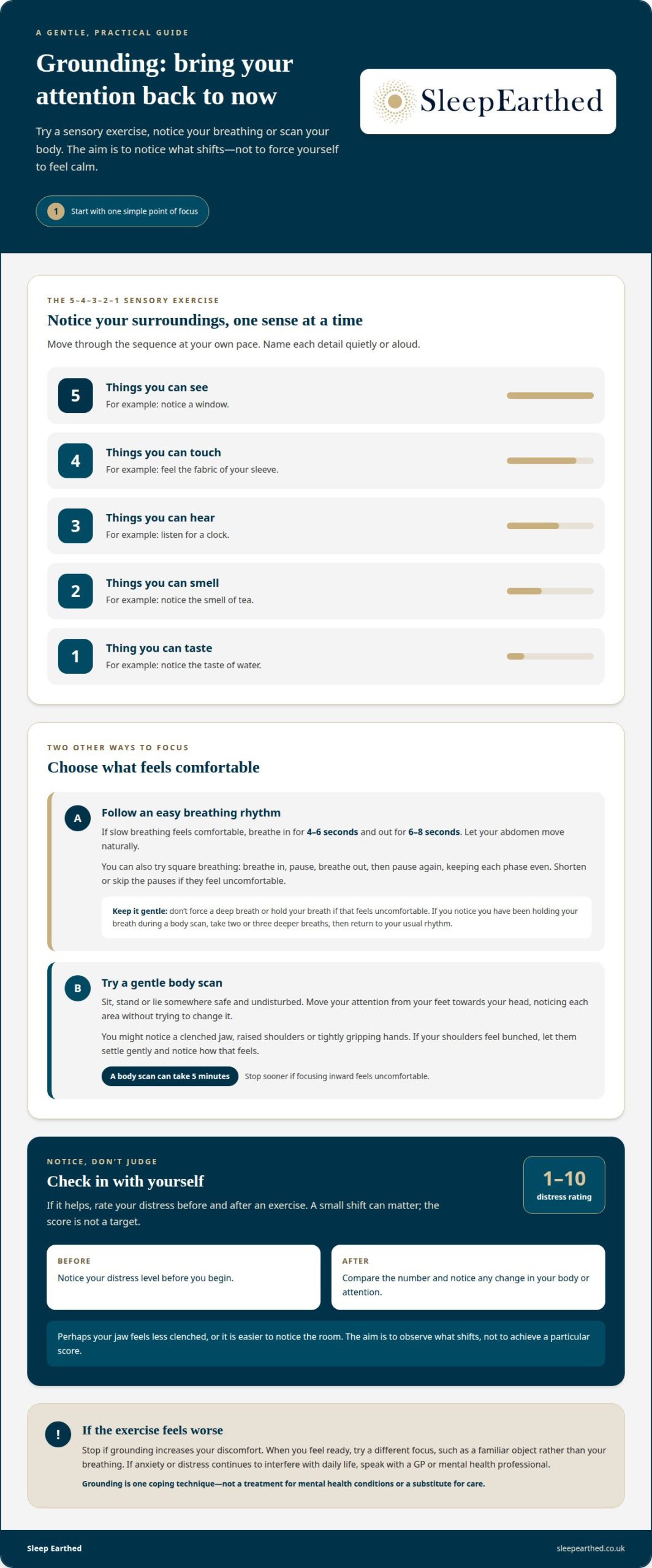
During distress, tension may show up as a clenched jaw, raised shoulders or tightly gripping hands. Try a brief body scan while sitting, standing or lying somewhere safe and undisturbed. Move your attention from your feet towards your head, noticing each area without trying to change it. If you notice your shoulders are bunched, let them settle gently and see how that feels.
Your breath can offer another point of focus. If slow breathing feels comfortable, breathe in for 4-6 seconds and out for 6-8 seconds, letting your abdomen move naturally. Don’t force a deep breath or hold it if that feels uncomfortable. If you notice you’ve been holding your breath during a body scan, take two or three deeper breaths, then return to your usual rhythm.
Square breathing gives your mind a simple pattern to follow: breathe in, pause, breathe out, then pause again, keeping each phase even. There’s no need to force a particular pace; shorten or skip the pauses if they feel uncomfortable. You can also add gentle movement. Slowly open and close your hands, for example, while noticing changes in muscle tension and the contact between your fingers.
How is sensory grounding different from mindfulness and meditation? Sensory grounding directs your attention to immediate details, such as a sound or the pressure of your feet on the floor. Mindfulness and meditation can include broader practices, such as observing thoughts or sustaining attention. The approaches can overlap, but grounding is often used to reconnect with the present during distress.
What does the 5-4-3-2-1 grounding technique involve? Name five things you can see, four you can touch, three you can hear, two you can smell and one you can taste. For example, notice a window, feel your sleeve, hear a clock, smell tea and taste water. Take each step at your own pace.
How can you tell whether a grounding exercise is working? Rate your distress from 1 to 10 before and after, then compare the numbers. A change might be small: perhaps your jaw feels less clenched or it’s easier to notice the room. A body scan can take five minutes, but you can stop sooner if focusing inward feels uncomfortable. The aim is to notice what shifts, not to achieve a particular score.
Grounding can reconnect you with your body during distress or discomfort by directing your attention to your breathing or physical sensations. This focuses on bodily experience without requiring you to change what you notice.
During a body scan, noticing that you’re holding your breath can be a cue to take two or three deep breaths, then return to your usual rhythm. This brings attention back to breathing while you continue to notice physical sensations, without treating your breath as something you must control.
Barefoot grounding and contact with the earth
Barefoot grounding means placing your skin directly on a natural surface, such as grass, sand or stones. The first sensation is usually physical and specific: cool blades under your toes, grains shifting beneath your feet, or a firm, uneven surface. These details give your attention something immediate to notice. For a simple start, stand still and observe where your feet feel pressure, then take a few slow steps.
One report recommends aiming for 10 to 20 minutes a day, or longer if possible. Treat that as a suggested routine, not a test you must pass. If you’re new to going barefoot outdoors, begin with a comfortable stretch on a familiar patch of grass. Notice the temperature and texture, then stop when you’ve had enough. The aim here is direct contact and sensory awareness, not a particular feeling.
Imagine stepping outside after a tense day and finding a quiet, safe spot in the garden. You take off your shoes, place both feet on the grass and notice its coolness. Your toes may register dampness, while the ground feels uneven beneath your heels. This example doesn’t promise to change your anxiety; it shows how attention can shift from racing thoughts to a clear physical sensation.
Direct contact doesn’t have to mean standing. Sit or lie on the ground and touch natural materials with your hands. For instance, rest your palm on grass or feel a smooth stone, noticing its surface and temperature. If standing barefoot feels uncomfortable, this offers another way to notice contact. Focus on the texture rather than looking for a dramatic sensation.
One author tried grounding for a week, then practised every morning in the days after her first outdoor session. Her account offers a practical example of building a routine: choose a regular time, find a suitable natural surface and notice how it feels underfoot. It doesn’t show that everyone will experience the same result. You might simply notice that grass feels colder in the morning or stones firmer than sand.
Choose the surface carefully. Before stepping down, check for sharp objects, rough stones or anything else that could hurt your feet. If the ground feels unpleasant, touch a natural material with your hands instead, or keep your footwear on and notice how your feet meet the ground through the soles. During a short walk, pause somewhere safe, feel the surface beneath you and describe its texture silently. That’s enough to practise noticing contact with the earth.
Sensory experiences of grounding outdoors
Outside, grounding can start with one easy-to-notice detail: wind against your cheek, birdsong or clouds above a roof. Choose one sensation and describe it silently in plain words. For example, “cool air on my face” is more specific than “I’m outside”. This gives your attention a focus in the present without requiring a particular feeling.
On a noisy street, sounds can compete for your attention. Pause somewhere safe, then choose one, such as footsteps or leaves moving in the breeze. Notice whether it stays steady, grows louder or fades. If traffic feels overwhelming, shift your attention to a quieter sound nearby. The aim is to find a detail you can follow, not to block out every other noise.
Light and colour offer another way to focus. Imagine walking through a park while tense: instead of replaying the day’s conversation, notice the contrast between a dark tree trunk and bright leaves. Follow a branch’s outline, then look at a patch of sky. This gives your eyes a simple task. Your focus may widen from one stressful thought to more of the scene around you.
Smell can also anchor your attention outdoors. Near a garden after rain, you might notice damp soil, crushed leaves or a flowering plant. Breathe normally and name the scent you detect. If you can’t identify it, describe it as earthy, sharp or faint. Don’t search for a strong smell; noticing that there’s little scent is a concrete observation too.
Try combining senses during a short pause. In a quiet garden, notice the breeze on your hands, a bird’s call and the colour of a nearby flower. Take in each detail slowly, then return to the one that’s easiest to notice. This can help when focusing on a single sensation feels difficult. You can shift your attention between your surroundings instead of forcing it onto one sense.
Outdoor conditions can change the experience. A gust of wind, cold rain or bright sunlight may feel uncomfortable, so choose a sheltered spot or stay indoors if the weather distracts you. For example, if a busy park feels unsettling, sit by a quiet window and watch branches move. You can still focus on a real sensory detail, such as shifting leaves, without going outside.
Afterwards, notice one small change in your attention: perhaps you can hear the birds more clearly or have stopped scanning the path ahead. There’s no need to judge the exercise as a success or failure. Write down a brief observation, such as “the wind felt cool” or “the traffic kept pulling my attention”. This can help you work out which outdoor cues are easiest to use next time.
Grounding for anxiety and distress
When anxiety narrows your attention to one frightening thought, choose a simple task that brings it back to the present. Try silently listing objects around you, such as a chair, a mug and a window. If naming objects feels difficult, count backwards from 100 at a steady pace. The task isn’t to erase the thought; it gives your attention something specific to follow.
A memory game can offer another focus during a tense moment. Look at a detailed picture for 5-10 seconds, then look away and recall its colours, shapes or small features. For example, picture where a person stood or which objects appeared in the background. If the image is hard to remember, return to it and notice one detail. This structured activity may help interrupt a spiral of anxious thoughts.
Grounding may help during a panic attack, or sometimes help prevent one, by directing attention to a manageable task. If you feel panic rising on a bus, for example, notice a seat’s pattern or the pressure of your feet inside your shoes. A grounded feeling may last from minutes to hours. Its duration varies, so focus on what’s happening now rather than expecting the effect to last.
Can grounding make anxiety or trauma symptoms worse for some people? Yes. Turning your attention inward or towards your surroundings can feel unsettling, including for people experiencing dissociation or hypervigilance, as can occur with PTSD. If this applies to you, seek specialist support before trying grounding exercises, and stop if a technique increases your distress.
Choose an exercise to suit the situation. If closing your eyes feels uncomfortable, keep them open and describe visible details. If focusing on your body makes distress stronger, shift to an external task, such as naming objects in the room. Practise in a calm, safe place first to learn which approach feels manageable before trying it during a difficult moment.
Don’t practise while driving or anywhere your personal safety is uncertain. Shifting attention away from traffic or immediate hazards can be dangerous. Grounding may also be insufficient when emotions feel overwhelming, including when you have suicidal thoughts. In that situation, prioritise immediate support from someone you trust or a mental health professional rather than relying on an exercise alone.
After trying a technique, note one concrete change: perhaps you can follow a conversation again or the room feels easier to take in. If nothing shifts, stop and choose another form of support rather than repeating the same exercise. Grounding is a tool for moments of distress, not a test of willpower or a substitute for specialist care when you need more help.
Sleep Earthed: UK Sized Fitted Earthing Bed Sheets
Sleep Earthed offers UK Sized Fitted Earthing Bed Sheets for people who want to explore earthing at home while resting. Unlike outdoor grounding, a fitted sheet lets you make contact with an earthing product in bed. Earthing Pillow Cases, an Earthing Half Sheet and an Earthing Recovery Bag provide other options for different routines.
These products aren’t a treatment for anxiety or a replacement for grounding exercises during distress. They may suit you if you’re curious about including earthing in your bedtime routine and want to explore different formats.
Visit sleepearthed.co.uk to explore the range or contact Sleep Earthed with your questions.
Choose a next step that suits you
If you’re still wondering what grounding feels like, try a small, repeatable practice and notice your experience rather than aiming for a particular outcome. You could note what feels comfortable, what you’d change and whether you prefer outdoor contact with the earth or exploring earthing at home.
For a bedtime option, Sleep Earthed offers UK Sized Fitted Earthing Bed Sheets, Earthing Pillow Cases and an Earthing Half Sheet. Results vary, and these products aren’t a substitute for support with anxiety or other health concerns.
If you’d like to explore the products or ask a question, contact Sleep Earthed. Take the next step at your own pace, and choose the approach that feels right for you.
Frequently Asked Questions
What Is Grounding?
Grounding can mean a technique for reconnecting your attention with the present, or physical contact with the earth through an earthing product. In everyday life, you might pause before a difficult conversation and notice the chair supporting you. That sensory practice differs from earthing bedding, which is designed to connect the sleeper to the earth through conductive material. The intended meaning depends on the context.
How Does It Work?
A sensory exercise gives your attention a concrete focus, such as the weight of a cup in your hand while you wait for an appointment. Earthing products work differently: Sleep Earthed bedding uses conductive silver threads and an earth connection, and benefits require direct skin contact. These are separate approaches, so noticing a sound or sensation isn’t the same as using a conductive product.
What does grounding feel like emotionally and physically?
Emotionally, you might feel more present or better able to follow a conversation, rather than completely relaxed. Physically, you may notice the temperature of a door handle, your feet pressing against the floor or your hands unclenching. These sensations can be subtle and vary between people. After a tense phone call, for example, you might simply realise you’re no longer gripping the handset tightly.