
 90 Day’s To Better Zzz’s Guarantee T&C apply


The nervous system manages many responses automatically, but grounding can bring your attention back to what’s happening around you. Grounding and nervous system regulation are linked through simple practices such as noticing your senses, feeling your feet on the floor or making physical contact with the earth. The sympathetic nervous system prepares you for action, while the parasympathetic system supports rest and recovery.
When stress leaves you feeling on edge, it’s natural to look for a practical way to feel more settled. This guide explains how the autonomic nervous system works, how sensory grounding differs from earthing, and how these practices may support regulation and relate to anxiety. It also covers simple exercises to try in everyday moments, so you can notice what helps you feel more present and at ease.
Key Takeaways
- Learn how the sympathetic system prepares your body for action and the parasympathetic system supports rest and recovery.
- Try box breathing with four counts for each inhale, hold, exhale and second hold, or explore 4-7-8 breathing at a comfortable pace.
- Use the 5-4-3-2-1 exercise to bring attention to what you can see, touch, hear, smell and taste around you.
- Understand how earthing involves physical contact with the earth, and how it differs from sensory grounding exercises.
- See how UK Sized Fitted Earthing Bed Sheets from Sleep Earthed may provide an earthing option while you rest.
What’s the difference between regulating and calming your nervous system?
Calming is a short-term shift towards feeling less activated; regulation is the ability to respond flexibly as stress changes. Grounding brings attention to the present, mindfulness involves noticing thoughts and sensations without judgement, and breathing exercises deliberately change your breathing pattern.
Try one method at a time when you feel anxious, without forcing a particular result. A slow exhale, for example, offers a simple breathing pattern to follow as you notice your body and surroundings.
For a visual demonstration of physical and sensory grounding, watch Barbara Heffernan’s video:
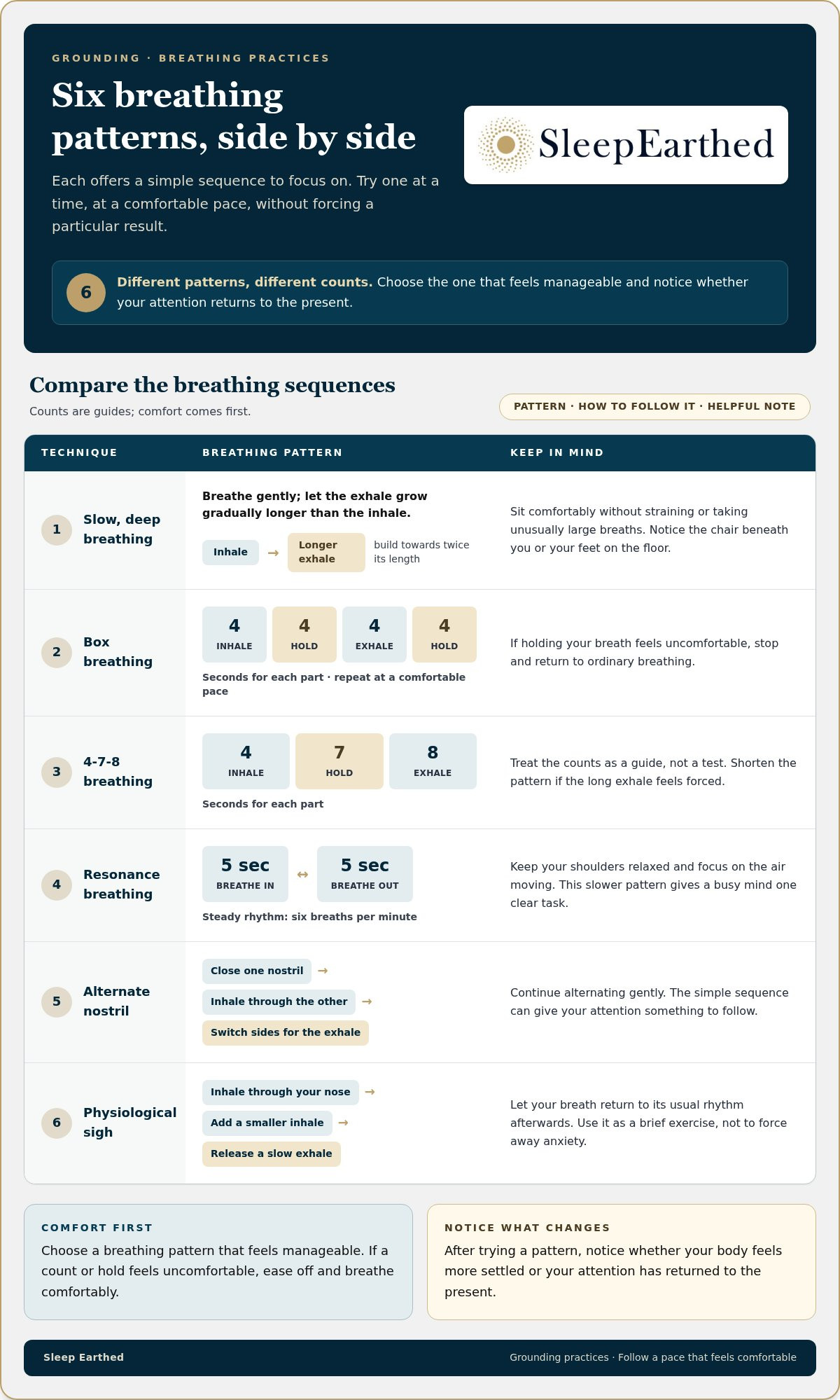
- Begin with slow, deep breathing. Sit comfortably and breathe gently, without straining or taking unusually large breaths. Let your exhale become gradually longer than your inhale, building towards twice its length. Notice the chair beneath you or your feet on the floor as you breathe.
- Try box breathing. Inhale through your nose for four seconds, hold for four, exhale through your mouth for four, then hold again for four. Repeat the sequence at a comfortable pace. If holding your breath feels uncomfortable, stop and return to ordinary breathing.
- Practise 4-7-8 breathing. Inhale for four seconds, hold your breath for seven, then exhale for eight. Treat the counts as a guide, not a test. If the long exhale feels forced, shorten the pattern and breathe comfortably instead.
- Explore resonance breathing. Breathe in for five seconds and out for five seconds, creating a steady rhythm of six breaths per minute. Keep your shoulders relaxed and your attention on the air moving. This slower pattern can give a busy mind one clear task.
- Use alternate nostril breathing. Close one nostril and inhale through the other, then switch sides for the exhale. Continue alternating gently. This gives your attention a simple sequence to follow, which may be useful when stress makes it hard to stay present.
- Try a physiological sigh. Take an inhale through your nose, add a second, smaller inhale, then release a slow exhale. Let the breath return to its usual rhythm afterwards. Use this as a brief breathing exercise, not as a way to force away anxiety.
Different grounding techniques suit different moments. Choose a breathing pattern that feels manageable, then notice whether your body feels more settled or your attention has returned to the present.
Earthing and physical contact with the earth
Physical grounding means noticing immediate sensations, such as your feet pressing against the floor. Earthing is a grounding activity involving physical contact between your body and the earth.
Use physical contact and sensory grounding
Try standing barefoot on a safe outdoor surface, or sit with both feet firmly on the ground. Notice the surface’s temperature and texture, then observe how your feet feel supported. These techniques bring attention to present sensations. Common grounding exercises include noticing your surroundings and the feeling of contact beneath you.
In anxious or overwhelming moments, physical and sensory grounding can redirect attention towards present safety. Press your hands together firmly, hold a cool object or feel the fabric of your sleeve. Choose a comfortable sensation, not one that feels painful or overwhelming. If outdoor contact with the ground isn’t practical, the floor beneath your feet can still provide a clear physical point of focus.
Practise physical grounding exercises
Choose one physical sensation and describe it silently, such as “my palms are warm” or “the chair supports my back”. You can also hold a smooth stone or piece of fabric and focus on its texture. If a sensation increases tension or discomfort, stop and choose a gentler activity, such as noticing your hands resting in your lap.
Grounding exercises have no set duration. Practise until your attention feels steadier, and repeat them regularly to learn which techniques suit different situations. Let your comfort and whether focusing on sensation feels helpful guide how long you continue.
- Settle your posture. Sit with your back supported or stand with both feet planted. Notice the points where your body meets the chair or floor.
- Name a sensation. Pick one detail, such as cool air on your hands, the pressure beneath your heels or the texture of a sleeve. Describe it plainly rather than judging it.
- Add movement if it feels comfortable. Press your feet gently into the floor, release, then notice the change in pressure. Keep the movement easy and pain-free.
- Reconnect with the earth if suitable. Place your feet on an outdoor surface and attend to its temperature and texture. Stop if the surface feels unsafe or uncomfortable.
Grounding techniques may help in the moment, but they aren’t a primary treatment for mental illness and shouldn’t be used in isolation. If anxiety, panic or difficulty relaxing persists, speak with a healthcare professional. Ongoing distress may need support beyond a self-guided exercise.
Somatic grounding and sensory awareness
Somatic grounding uses physical sensations to bring attention towards the present moment. Try the steps below and notice which sensory details feel clear and manageable.
Use the 5-4-3-2-1 sensory method
Start the 5-4-3-2-1 method by naming five things you can see, then four things you can touch. Continue with three things you hear, two things you smell and one thing you taste. This sensory sequence gives your mental attention a practical task, using familiar details such as a blue mug, a sleeve’s texture or distant traffic.
Move through the senses at your own pace. If a smell or taste is difficult to identify, choose another detail you can comfortably notice, such as the air in the room. The aim is to describe what’s present, not to perform the method perfectly or suppress emotions.
- Look around and name five details. Choose visible objects, colours or shapes, such as a lamp, a green book or a round clock. Describe each one plainly.
- Notice four points of touch. Feel your feet in your shoes, your hands on your lap or the fabric against your arm. Focus on pressure and texture.
- Listen for three sounds. You might notice a fan, a clock or voices outside. Name each sound without deciding whether it’s pleasant.
- Finish with two smells and one taste. Use ordinary details, such as soap in the room or water in your mouth. Don’t force a sensation that isn’t apparent.
Build sensory awareness for dissociation
If you feel disconnected from yourself or your surroundings, start by noticing one neutral sensation. Hold a fabric item and describe its texture, or feel your feet against the floor. Temperature, pressure and texture offer specific cues in the present moment. Avoid intense sensations if they make you feel more distressed.
Use a simple exercise to observe any shift without judging it. Rate your distress from 1 to 10 before and after grounding, where 1 is the low end and 10 the high end. You could also study a detailed picture for 5-10 seconds, then recall its colours, shapes and objects. These tasks engage attention through concrete sensory information.
- Choose a gentle anchor. Notice your hands resting on your lap, the weight of your body in a chair or a familiar fabric’s feel.
- Describe details aloud or silently. Name the object, its colour and its texture, such as “soft grey sleeve”. This turns a vague sensation into a clear observation.
- Try a mental focus task. Count backwards from 100, or study a detailed picture for 5-10 seconds and recall what you saw.
- Check how the exercise feels. Compare your distress rating before and after, using the 1-to-10 scale. If attention to a sensation increases distress, stop and choose a more neutral detail.
Different sensory methods suit different moments. Try more than one and notice which helps you reconnect with your surroundings.
Inflammation and anxiety-related effects
Grounding can redirect attention during anxiety or distress, but it isn’t a treatment for inflammation. Guidance describes grounding as a way to counterbalance sympathetic activation through the parasympathetic response.
Use grounding for anxiety and distress
When anxiety rises, choose a simple action: press your feet into the floor, name nearby objects or take a gentle walk. These steps direct attention to the present and offer a practical focus during distress. If a sensation intensifies fear or trauma-related memories, stop and choose a neutral detail instead.
Consider inflammation and anxiety-related effects
Use grounding as a supportive technique, not as proof that inflammation has changed. Feeling calmer after an exercise doesn’t establish a change in inflammation or treat a health condition. Grounding is described as a way to reconnect with the present during anxiety, panic or overwhelm, not as a primary treatment for mental illness or a practice to use alone.
- Notice what is happening. Name the feeling plainly, such as “I feel anxious” or “my shoulders are tense”. Identifying a muscle holding tension gives you a specific place to focus, without needing to judge the feeling.
- Orient yourself to your surroundings. Name a few objects in the room, including their colour or shape. For example, describe a blue cushion or a square window. This simple activity brings attention back to what is present, rather than trying to force distress away.
- Choose gentle movement. Walk at a comfortable pace, stretch your hands, or slowly shake out your arms. Notice how each movement feels and keep it pain-free. If movement increases discomfort, pause and use a still sensory focus instead.
- Respond carefully to panic. A panic attack can feel frightening, but it isn’t physically dangerous. Sit somewhere you feel safe, notice the floor beneath your feet, and let your breathing settle naturally. Avoid treating a grounding exercise as a substitute for support when panic keeps recurring.
- Keep trauma responses in mind. A sensory exercise can redirect attention from distressing memories towards present safety. Pick a neutral texture or familiar object, and stop if focusing on it makes the feeling more intense. Grounding supports the moment; it doesn’t replace treatment for trauma or anxiety.
- Seek support for persistent distress. If you remain jittery, anxious or unable to relax, speak with a healthcare professional. Grounding techniques are not a primary treatment for mental illness and shouldn’t be used in isolation. Persistent symptoms deserve care beyond a self-guided exercise.
Use these steps to manage an anxious moment, while keeping one distinction clear: a change in how you feel isn’t evidence of an effect on inflammation.
Grounding and autonomic nervous system regulation
The autonomic nervous system manages automatic responses, including changes in alertness and recovery. Grounding and nervous system regulation are linked by practical ways to notice your state and respond deliberately.
- Notice your current state. The sympathetic nervous system prepares your body for action, often called fight or flight. The parasympathetic nervous system supports rest, recovery and a return towards calm. Ask whether you feel keyed up, sluggish or disconnected, rather than labelling your response as a failure.
- Look for patterns, not a diagnosis. Anxiety, panic attacks, digestive issues, trouble sleeping, constant fatigue and persistent muscle pain can be signs associated with nervous system dysregulation. Note what you experience and when. A symptom by itself doesn’t explain its cause.
- Identify pressures affecting your balance. Chronic stress, burnout, traumatic events, poor sleep habits, an unhealthy diet and little time to relax can disrupt balance. Write down one relevant pressure, such as late-night work, then choose a manageable adjustment, such as setting aside time to unwind.
- Choose a grounding action for the moment. Feel your feet on the floor, listen to music, or try slow movement such as gentle stretching. Grounding exercises are designed to calm the nervous system and can direct attention from a stressor towards the present.
- Use your voice gently. Try humming or making a low “Voo” sound, then notice how your breathing and body feel. These practices are described as ways to stimulate the vagus nerve and promote relaxation. The vagus nerve is involved in functions including digestion, appetite regulation and metabolism.
- Make a small daily routine. Pair deep breathing, movement or mindfulness with an existing activity, such as stretching after getting dressed. With consistent daily practice, people may notice changes in regulation within a few weeks; deeper healing can take months of intentional work.
- Include rest and connection. Sleep gives the body time to rest and restore. Talking with someone you trust and practising empathy can also support emotional regulation through co-regulation. For example, share what feels difficult and listen together without rushing to solve it.
- Use grounding as support, not a full treatment plan. If symptoms persist or interfere with daily life, seek appropriate healthcare support. Grounding can sit alongside other care, but it isn’t a primary treatment for mental illness and shouldn’t be used in isolation.
As a practical guide, match your response to your state: try gentle movement or sensory focus when activated, and prioritise rest when depleted. Grounding and nervous system regulation involve noticing these patterns and choosing a manageable practice to support your response to stress.
Sleep Earthed: UK Sized Fitted Earthing Bed Sheets
Sleep Earthed offers UK Sized Fitted Earthing Bed Sheets for people who want to explore earthing as part of a sleep routine. When used for earthing, conductive silver threads in organic cotton connect the sleeper to the earth’s natural electrons. The sheets offer a way to bring physical contact with the earth into your resting space, alongside sensory grounding techniques during the day.
Choose a fitted sheet for your bed, or consider Earthing Pillow Cases, an Earthing Half Sheet or a Recovery Sleeping Bag. Earthing is a complementary practice, not a treatment for anxiety or other health conditions, and it doesn’t replace support from a healthcare professional when you need it.
Explore Sleep Earthed’s earthing products to find an option that suits your routine.
Choose a grounding routine that fits your life
Make your next step small and repeatable. Choose a comfortable grounding practice, then build it into a familiar part of your day, such as settling down before bed or pausing after work. Grounding and nervous system regulation aren’t about forcing a particular feeling; they create space to notice what supports you.
To explore earthing as part of your sleep routine, Sleep Earthed offers UK Sized Fitted Earthing Bed Sheets, Earthing Pillow Cases and an Earthing Half Sheet. Each brings earthing into your resting space in a different way. Choose the format that best fits how you sleep and what feels practical for your routine.
For more information about these options, contact Sleep Earthed. Keep experimenting gently with the practices that suit you, and take your next step at a pace that feels right.
Frequently Asked Questions
How does the automatic nervous system work?
The autonomic nervous system manages body processes that happen without conscious effort, including changes linked to alertness and rest. Its sympathetic branch prepares you to respond to demands, while its parasympathetic branch supports recovery. For example, a stressful meeting may leave you feeling activated afterwards. A quiet pause, gentle movement or familiar bedtime routine can help you notice how your body responds as the pressure passes.
What are the signs and causes of a dysregulated nervous system?
Possible signs include anxiety, panic attacks, digestive issues, trouble sleeping, constant fatigue and persistent muscle pain. These experiences can have different causes, so a symptom alone doesn’t identify nervous system dysregulation. Chronic stress, burnout, traumatic events, poor sleep habits, an unhealthy diet and little time to relax may all disrupt balance. Notice when symptoms appear, such as after a difficult day or during a period of poor sleep.
How do grounding techniques work?
Grounding techniques give your attention a specific task connected to the present, such as describing an object or feeling your hands on a table. This focus can interrupt a loop of worrying thoughts or distressing memories. For instance, name the colour and shape of a nearby mug, then notice its weight in your hand. If that sensation feels uncomfortable, choose a neutral detail you can observe without strain.
What is Grounding and Why is it Worth Doing?
Grounding means bringing attention back to your body, surroundings or the earth, rather than getting caught in distressing thoughts. It’s worth trying because it gives you something practical to do during an anxious or overwhelmed moment. Notice the chair supporting your back or describe objects in the room. Grounding isn’t a cure or a replacement for mental health care, but it can be one supportive way to manage difficult feelings.
What is grounding in the context of nervous system regulation?
Here, grounding means deliberately orienting yourself to the present and noticing your body’s state. It might involve physical contact with the earth, a sensory exercise or steady attention to your surroundings. For example, pause before starting a task and feel your feet inside your shoes. This can help you recognise whether you feel tense, settled or disconnected, then choose a suitable next step.
How does grounding affect the autonomic nervous system and stress response?
Grounding may support regulation by shifting attention away from a stressor and towards present sensations. The sympathetic nervous system prepares the body for action, while the parasympathetic system supports rest and recovery. A grounding practice doesn’t switch these systems on or off like a button. Instead, use a familiar cue, such as a slow walk, to notice your response and give yourself space to settle.
How to do the 5-4-3-2-1 sensory grounding exercise?
Look around and name five things you see, then four things you can touch. Next, notice three sounds, two smells and one taste. Use specific details, such as a striped cushion, cool glass or distant traffic. Move at a comfortable pace; don’t force a smell or taste that isn’t apparent. If one sense feels distracting, focus on a different present detail, such as the pressure of your feet on the floor.
Can grounding exercises trigger distress or worsen trauma symptoms, and what precautions should you take?
Yes. Focusing on a sensation or memory can feel distressing for some people, particularly during trauma-related symptoms. Start with a neutral, familiar cue, such as naming objects in the room, rather than an intense sensation. Stop if the exercise increases distress, and switch to a gentler activity or contact someone you trust. Grounding isn’t a primary treatment for mental illness. Seek professional support if distress persists or affects daily life.