
 90 Day’s To Better Zzz’s Guarantee T&C apply

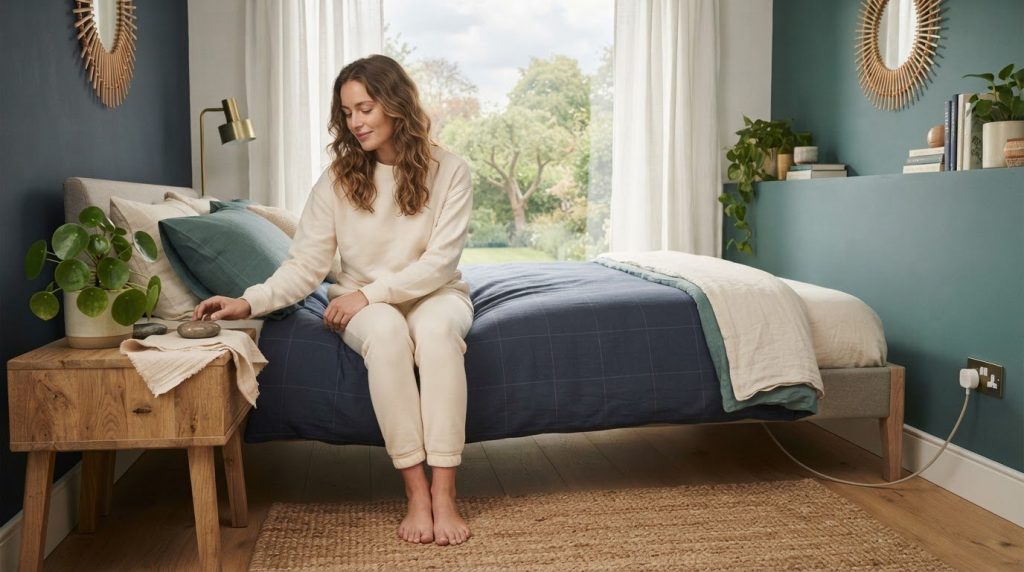
When someone tells you to “ground yourself”, do they mean calming a racing mind or making a physical connection with the Earth? The phrase can describe both, which makes grounding therapy at home confusing when you’re already feeling overwhelmed. A sensory exercise needs no special equipment, while physical earthing is a separate option, not another name for the same practice.
This guide explains the difference in practical terms. You’ll find a sensory exercise you can try at home, advice on how to adjust it if it feels uncomfortable, and an explanation of how physical earthing works. For example, an earthing sheet from Sleep Earthed connects to Earth through a UK socket’s earth connection. These approaches suit different preferences, but neither should be treated as a guaranteed medical treatment. By the end, you’ll have a clearer idea of what you can try and how to choose an approach thoughtfully.
Key Takeaways
- Grounding therapy at home can mean a sensory exercise or physical earthing. Choose based on what you want to try.
- The 5-4-3-2-1 method is one way to notice your surroundings. Adapt it or stop if it feels uncomfortable.
- A gentle routine can start with a pause and a comfortable place to sit. There’s no need to follow a fixed plan or expect a particular result.
- Sensory grounding and physical earthing have different purposes and methods. Don’t assume one proves the effects of the other.
- Sleep Earthed fitted sheets use organic cotton with conductive silver threads for an optional physical earthing setup at home.
What does grounding therapy at home mean? Two different ideas, clearly explained
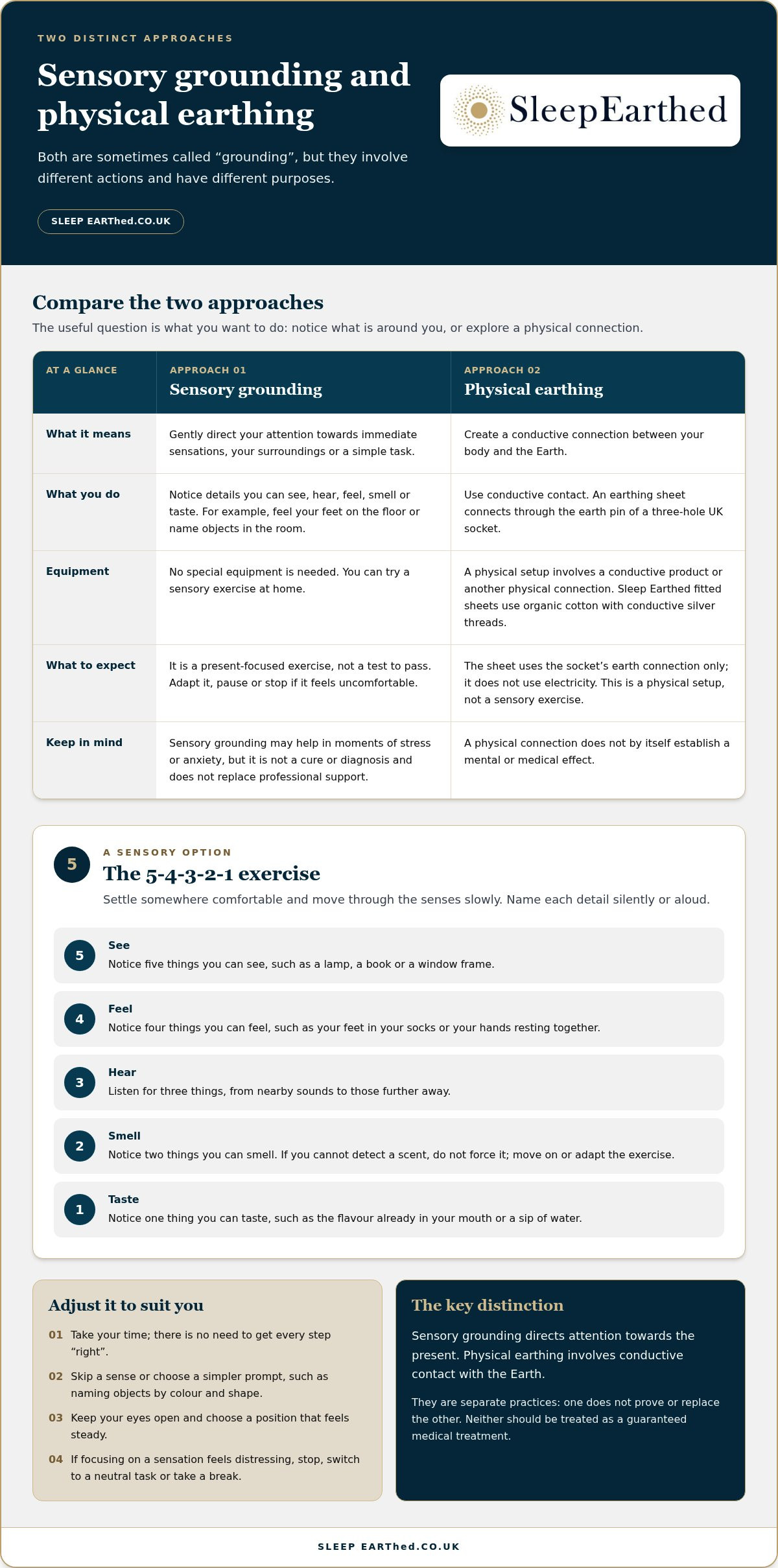
“Grounding” can mean a mental exercise that brings your attention back to the present, or physical earthing, which creates a conductive connection between your body and the Earth. The terms are sometimes used interchangeably, but the practices work in different ways and have different purposes. Knowing which one you mean makes it easier to choose an approach that fits what you’re looking for.
That distinction matters when you’re searching for grounding therapy at home. A sensory exercise focuses on what you notice; an earthing product provides a physical connection. The Earthing (disambiguation) page also shows how the term can refer to different ideas, including therapeutic practice and electrical grounding.
For a visual example of a psychological grounding exercise, you can watch this video from Therapy in a Nutshell:
What is a psychological grounding exercise?
Psychological grounding is a present-focused exercise. You deliberately bring your attention to immediate sensations, your surroundings or a simple task, rather than getting caught up in distressing thoughts. You might notice the feel of your feet on the floor or name objects in the room. NHS inform describes grounding as something that may help in moments of stress or anxiety. It isn’t a cure or diagnosis, and it doesn’t replace professional support.
What does physical earthing at home involve?
Physical earthing involves a conductive connection between the body and Earth. With an earthing sheet, that connection is made through the earth pin of a three-hole UK socket. The sheet uses the socket’s earth connection only; it doesn’t use electricity. This is a physical setup, not a sensory exercise, and it doesn’t by itself establish a mental or medical effect.
Sleep Earthed fitted sheets offer an optional way to make this physical connection at home. They use organic cotton with conductive silver threads. The plug connects to the socket’s earth connection, so the setup is distinct from simply noticing sensations around you.
In short, choose psychological grounding when you want to direct your attention towards the present moment. Physical earthing is a separate practice involving conductive contact with Earth. One doesn’t prove or replace the other, and neither should be treated as a guaranteed treatment. For a fuller overview of the difference, the article Grounding and Earthing: The Complete UK Guide to Better Sleep and Recovery explores the two terms in more detail.
How sensory grounding works: use your attention to reconnect with the present
Sensory grounding gives your attention a simple, immediate focus: details you can see, hear, feel, smell or taste. Rather than trying to force thoughts away, gently notice what’s around you. At home, you might look at the shape of a mug, feel the chair beneath you or listen for a familiar sound, such as a clock ticking.
“The 5-4-3-2-1 technique is a structured way to notice details around you through sight, touch, hearing, smell and taste.” It’s one option, not a test to pass or a routine that suits everyone. You can pause, skip a sense or choose a simpler exercise instead.
How to try the 5-4-3-2-1 grounding exercise
Settle somewhere comfortable and take your time. In a quiet room, you might notice light on a wall, the texture of a cushion and the faint sound of traffic outside. Move through the sequence slowly, naming each detail silently or aloud:
- Notice five things you can see, such as a lamp, a book or a window frame.
- Notice four things you can feel, perhaps your feet in your socks or your hands resting together.
- Listen for three things you can hear, from nearby sounds to those further away.
- Notice two things you can smell. If you can’t detect a scent, don’t force it. Move on or adapt the exercise.
- Notice one thing you can taste, such as the flavour already in your mouth or a sip of water.
The numbers give the exercise structure, but there’s no need to rush or get every step “right”. If a detail doesn’t come to mind, choose another or leave that sense out. The aim is to pay gentle attention to what’s present, not to complete a perfect count.
How to adapt a grounding exercise to your surroundings
Keep your eyes open if that feels more comfortable, and choose a position that feels steady. You could describe nearby objects by their colour and shape, or notice where your body meets the chair. These simpler prompts can be easier than scanning all five senses, particularly if you’re new to the practice.
Grounding therapy at home doesn’t need to follow a fixed script. If focusing on a sensation feels distressing, stop and switch to a neutral task, such as naming objects in the room, or take a break. Adjust the exercise to suit yourself.
The NCBI review on earthing concerns physical earthing, a separate subject from sensory attention exercises. If you’re curious about that physical option, Sleep Earthed earthing products offer a way to explore it at home.
Grounding exercises versus physical earthing: choose the approach that fits your aim
Both practices use the word “grounding”, but they involve different actions. A sensory exercise directs your attention towards the present environment. Physical earthing uses a conductive connection between the body and Earth. The useful question is not which one is better, but what you want to do: notice what’s around you, or explore a physical connection.
This distinction also helps keep expectations realistic. You can try a sensory exercise without buying equipment, while physical earthing involves a conductive product or another physical connection. Neither approach proves the effects of the other.
| Approach | Purpose and method | What it doesn’t establish |
|---|---|---|
| Sensory grounding | Bring attention to present details, such as objects, sounds or the feel of a chair. | It doesn’t establish a medical diagnosis or guarantee a particular response. |
| Physical earthing | Make a conductive connection between the body and Earth, for example through an earthing sheet. | The connection alone doesn’t establish that it treats anxiety or another health condition. |
When might a sensory grounding exercise be the more relevant choice?
If your immediate aim is to pay attention to the room around you, a sensory exercise may be a practical place to start. You don’t need to buy anything: describe the shapes and colours of nearby objects, notice a sound or feel your feet against the floor. The University of New Hampshire also describes sensory awareness as a grounding skill in its guide, What is Grounding?
People’s experiences can differ. You might find one prompt easy to follow and another distracting, so treat the exercise as an option rather than a routine you must complete. If focusing on sensations feels uncomfortable, stop or switch to something neutral.
What an earthing sheet does, and doesn’t claim to do
An earthing sheet provides a physical connection through the earth pin of a UK socket. It isn’t a psychological grounding exercise: it doesn’t ask you to notice your surroundings, and it shouldn’t be presented as a mental health treatment. Sleep Earthed fitted sheets use organic cotton with conductive silver threads to make this physical connection.
Carbon-infused earthing mats are another product category, not a Sleep Earthed product. They rely on sweat to connect to Earth, so they work differently from a fitted sheet. Comparing materials or setups doesn’t tell you whether either practice will meet your personal needs.
If you want to look more closely at the evidence around physical earthing, the article Do Earthing Sheets Work? Science vs Fiction in 2026 discusses that separate question. For grounding therapy at home, first identify whether you’re seeking a present-focused exercise or exploring physical earthing, then keep your expectations appropriate to the method.
A gentle at-home grounding routine: simple steps, with room to adjust
A grounding exercise doesn’t need to be elaborate. The aim is simply to give your attention a clear, manageable focus. This optional routine offers a starting point, not a prescribed therapy plan, and you can change or stop at any time.
Pause, settle, notice what’s around you, then choose one sensory detail to focus on at your own pace.
- Pause. Stop what you’re doing for a moment, if it’s safe and practical. There’s no need to make yourself feel a particular way.
- Settle somewhere comfortable. Sit in a chair or choose another steady position. Keep your eyes open if that feels better.
- Notice your surroundings. Let your attention rest on one ordinary feature of the room, such as a familiar object, a patch of colour or a sound in the background.
- Choose one sensory focus. Notice the feel of your feet on the floor, the support of the chair or the texture of a sleeve. Stay with it briefly, then decide whether to continue, change focus or finish.
There’s no need to count, measure your progress or complete every part of an exercise. A small focus can be enough to practise bringing attention to what’s present. If it feels neutral or useful, you can continue for a little longer. If not, try another approach or leave it there.
How to practise when you feel distracted or overwhelmed
Start with one neutral detail, such as the contact between your feet and the floor. You could describe it quietly to yourself: “My heels are resting on the carpet.” If speaking feels more comfortable, say it aloud. There’s no special wording to use. The point is to notice a specific detail, not to judge it or make it change.
If your attention wanders, that’s not a failure. Gently return to the same detail, or choose something else nearby, such as the colour of a book or the shape of a table. Keep the focus simple enough that it doesn’t become another task to get right.
What to do if grounding feels uncomfortable
You don’t have to force an exercise or finish every step. If noticing a body sensation feels unpleasant, shift your attention to a familiar, neutral part of the room, such as a doorway or a piece of furniture. You can also stop, take a break and decide whether to try a different exercise another time.
Grounding therapy at home may not feel helpful for everyone. If you have a difficult response, pause rather than push through. If distress is ongoing or severe, seek appropriate support from a health professional. These exercises are optional tools, not a substitute for professional care.
If you’re curious about a separate physical approach, you can explore Sleep Earthed earthing options. Physical earthing is distinct from this sensory routine, so choose based on what you want to try.
Physical earthing at home with Sleep Earthed: understand the simple setup
A fitted earthing sheet is an optional way to explore physical earthing at home. It’s separate from a mental grounding exercise: rather than directing your attention to sights or sensations, the sheet creates a conductive connection to Earth. That distinction helps set realistic expectations. The product is a physical earthing option, not a psychological exercise or a promised treatment for sleep, stress or any health condition.
Sleep Earthed fitted sheets combine organic cotton with conductive silver threads woven throughout the fabric. A three-pin UK plug and 4 m earth lead are included as standard. The plug connects to the earth pin of a three-hole UK socket, using its earth connection only. The sheet doesn’t run on electricity. It also has a built-in safety resistor to prevent electric shock if the mains become faulty.
What to know before using an earthing sheet
Think of the setup as a physical connection, not a technique for managing thoughts or feelings. It doesn’t replace sensory grounding, mental health care or advice from a health professional. For practical setup details, the Grounding Sheet Setup Guide: How to Properly Install Your Sleep Earthed Bedding explains how the bedding is set up. Use the sheet for its physical purpose, without assuming it will produce a particular therapeutic outcome.
The earth connection is not the same as powering an appliance: the sheet uses the socket’s earth connection and doesn’t use electricity. A plug can remain in the socket whether the socket is switched on or off. An extension lead can also be used if it has an earth connection. If you’re unsure whether a socket in your home is safe to use, don’t use it until the concern has been addressed by a suitably qualified electrician.
For the intended connection while sleeping, don’t put a normal bedsheet over the earthing sheet. The fitted sheet goes directly on the mattress, so your body can make contact with its conductive surface.
Explore a fitted earthing sheet from Sleep Earthed
Sleep Earthed fitted sheets are available in Single, Double, King and Emperor sizes, as well as custom sizes. Standard depth fits mattresses up to 28 cm; deep depth fits up to 32 cm. The 90-day Sleep Guarantee is a money-back guarantee if the product doesn’t work as expected. It relates to the product, not a guaranteed health, sleep or recovery result.
If a fitted sheet feels like a practical way to explore physical earthing, you can explore Sleep Earthed fitted sheets and consider whether this setup suits your home. If your immediate aim is to bring attention back to the present, a sensory exercise remains a separate, equipment-free option. Neither approach needs to be the right choice for everyone.
Choose a small next step that feels right for you
Your next step doesn’t need to be a big commitment. You might set aside a quiet moment to try a sensory exercise, or learn more about physical earthing before deciding whether it suits your home. Let your own comfort and aims guide you, and remember that you can pause or change direction if an approach doesn’t feel right.
If you’re exploring physical earthing as part of your grounding therapy at home, consider whether a fitted sheet fits your routine. Sleep Earthed offers an optional way to explore that approach without presenting it as a mental health treatment or a guaranteed result.
Explore Sleep Earthed fitted sheets and choose the approach that suits what you’re looking for.
Frequently Asked Questions
Can grounding exercises be done anywhere at home?
Yes, you can try a grounding exercise anywhere at home where you feel reasonably comfortable and can pause safely. A chair in the living room or a quiet spot in your bedroom may work well. You don’t need special equipment. If your surroundings feel busy, choose one easy detail to notice, such as a familiar object, rather than trying to take in everything at once.
How long should I practise a grounding exercise?
There’s no set duration you need to reach. Try noticing one or two details at an unhurried pace, then check how you feel about continuing. You can finish there or carry on if it still feels comfortable. The exercise isn’t a test, and spending longer doesn’t guarantee a better result. Choose a length that feels manageable for you on that occasion.
Can grounding therapy at home replace counselling or other mental health support?
No. Grounding exercises can be a personal tool for focusing attention, but they aren’t a substitute for counselling, treatment or advice from a qualified health professional. If distress is affecting daily life, or you’re finding it hard to manage on your own, consider speaking with your GP or a mental health professional. You can use a grounding exercise alongside appropriate support if it feels comfortable for you.
What should I do if the 5-4-3-2-1 method does not help?
You don’t have to finish the sequence or keep using a method that isn’t useful. Try focusing on one neutral detail instead, such as the shape of a nearby object, or pause the exercise altogether. Different prompts suit different people and situations. If the exercise increases discomfort, stop and choose something familiar and neutral to focus on. Seek professional support if distress continues or feels severe.
Is an earthing sheet the same as a grounding exercise?
No. A grounding exercise directs your attention, such as when you describe a few objects in your room. An earthing sheet is a physical product that makes a conductive connection to Earth while you use it. Noticing the feel of a chair requires no product; lying on an earthing sheet involves a physical setup. Neither approach should be assumed to provide the effects of the other.
Does an earthing sheet use electricity?
No. A Sleep Earthed sheet connects through the earth pin of a three-hole UK socket and uses the earth connection only. It doesn’t draw electricity to operate or power the sheet. This is different from plugging in an electrical appliance. If you’re unsure about the condition or safety of a socket in your home, don’t use it until the concern has been addressed by a suitably qualified electrician.