
 90 Day’s To Better Zzz’s Guarantee T&C apply

The Science Behind Earthing Sheets: What the Evidence Says
An earthing sheet’s electrical connection can be measured, but that does not prove its promised health benefits. This distinction is central to the science behind earthing sheets: a conductive path to earth is one thing, evidence that it improves sleep, recovery or pain is another.
It’s reasonable to feel unsure when claims sound confident but the research seems mixed. The proposed mechanism is often described as electrons moving from the Earth to the body. That theory alone does not establish a health effect. This guide explains how a sheet is intended to create an electrical connection, then looks at what studies can and can’t tell us about possible biological effects.
We’ll also consider what makes research more or less persuasive, and which product details help when weighing claims. Sleep Earthed fitted sheets use conductive silver threads in organic cotton. That describes their construction, not proof of a medical outcome. The aim is to help you assess the evidence without dismissing the question or accepting marketing claims at face value.
Key Takeaways
- The science behind earthing sheets raises two separate questions: whether an electrical connection is present and whether it produces specific health effects.
- Trace the proposed pathway from the sleeper through the conductive material and connection lead to the earth.
- When reading research, note what was measured and whether the findings support a proposed effect or establish a clinical outcome.
- Sort claims into electrical continuity, reported sleep experience or clinical outcomes before judging the strength of the evidence.
- Sleep Earthed fitted sheets use conductive silver threads in organic cotton. This describes their construction, not proof of a health benefit.
What does the science behind earthing sheets actually examine?
What can researchers measure directly, and what remains a proposed effect? That’s a useful starting point for understanding the science behind earthing sheets. A conductive connection can be examined as an electrical question. Whether that connection changes sleep, recovery or health is a separate question that requires its own evidence.
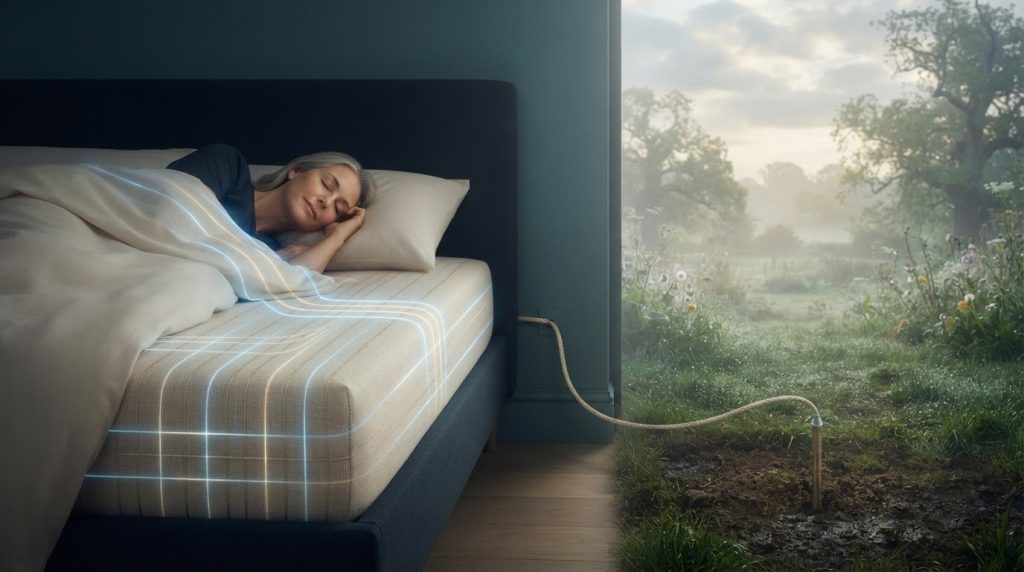
Earthing means making an electrical connection between the body and the Earth, either through direct contact or conductive material. With a sheet, the material is intended to form part of a path to earth. This describes the intended connection, not a source of electricity or a treatment in itself.
For a simple explanation of how advocates describe grounding, watch the video below. Its title makes a health claim, so consider it a viewpoint to assess, not proof of clinical benefit.
What does earthing mean in electrical terms?
A conductive path is a route that allows electrical charge to move between connected points. An earthing sheet is not intended to create charge; its conductive material is designed to connect the sleeper with the Earth. Whether that route is electrically continuous can be tested as a property of the connection.
Consider a metal object connected to earth: the relevant feature is the connection, not a health effect. Similarly, evidence that a sheet conducts or connects to earth would support a claim about electrical continuity. It would not, on its own, show what happens inside the body or establish a benefit.
Why are earthing sheets discussed in wellness research?
Some advocates and researchers propose that contact with the Earth allows naturally available electrons to move to the body, and suggest this might influence processes associated with oxidation or inflammation. This is a hypothesis about how a biological effect could occur, not a settled explanation or proof that the effect does occur.
Research can ask different questions: does the material connect electrically, do users report a change in sleep or comfort, or does a clinical measure change? Each needs a different kind of evidence. A person’s experience can be meaningful, but it can’t establish why a change happened. Likewise, a plausible mechanism doesn’t demonstrate a reliable outcome.
A proposed mechanism can guide research, but it isn’t proof of a health benefit. Keeping that distinction clear makes confident claims easier to assess. Next, consider how a sheet’s conductive construction is intended to create a connection, and what evidence can establish about it.
How does an earthing sheet create a conductive connection?
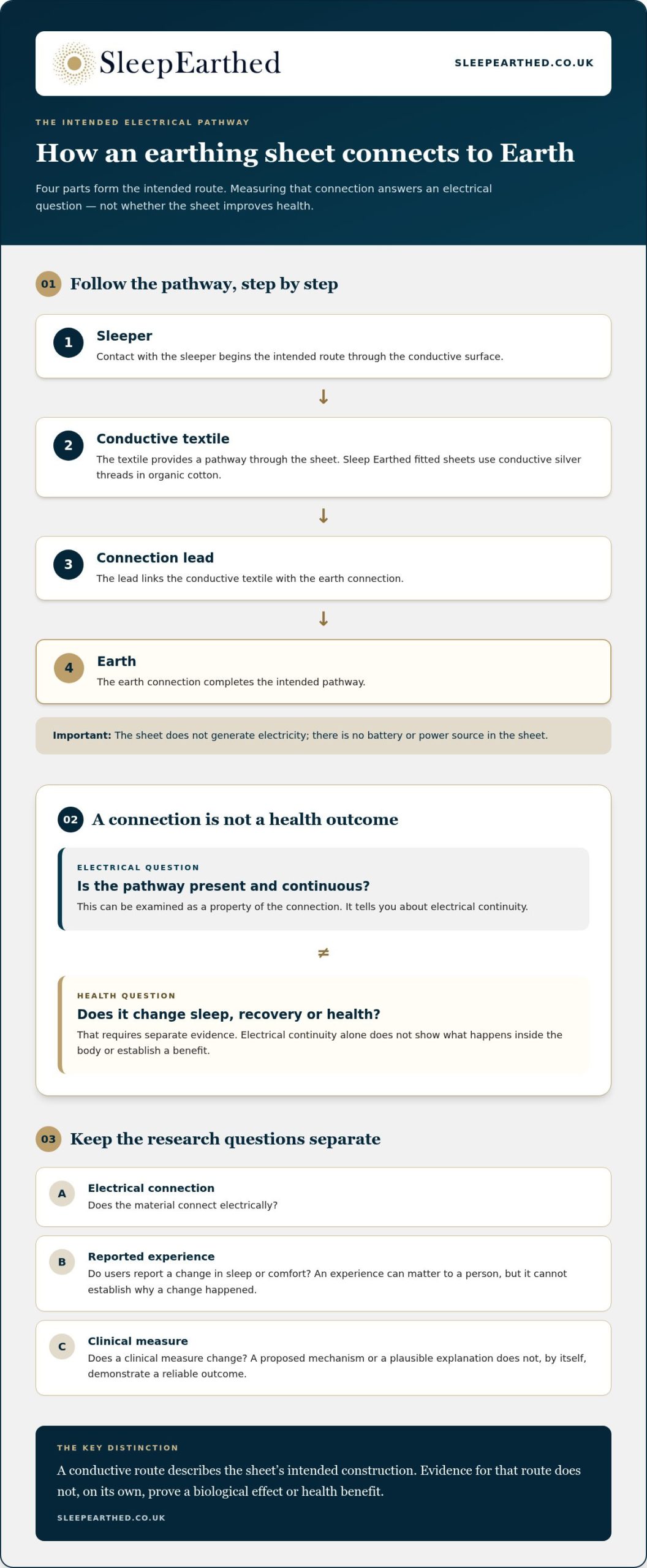
An earthing sheet is one part of a pathway, rather than a device that powers itself. In the intended arrangement, contact with the sleeper, conductive material, a connection lead and an earth connection form a route. Product details can vary, but the central idea is continuity along that route.
Here’s a simple labelled diagram of the concept:
Sleeper → contacts the conductive surface
Conductive textile → provides a pathway through the sheet
Connection lead → links the textile to the earth connection
Earth → completes the intended connection
Not present: a battery or power source in the sheet. The sheet doesn’t generate electricity.
This distinction matters. Conductivity describes an electrical property: whether a material can provide a pathway for charge. It doesn’t show that a particular biological response takes place or that using the sheet improves health.
What role do conductive silver threads play?
Sleep Earthed fitted sheets use conductive silver threads in organic cotton. The threads provide a conductive pathway across the sheet’s surface, so contact with the material can form part of the intended route to earth. Their presence describes the sheet’s construction; by itself, it doesn’t establish a physiological effect or prove a health outcome.
Separate the material question from the body-response question. The first concerns the sheet’s electrical properties. The second asks whether being connected in this way leads to a measurable change in a person. Evidence for one doesn’t automatically answer the other.
How is the sheet connected to the earth?
The connection lead links the conductive textile with an earth connection, completing the intended pathway. A grounding rod kit is one product in the Sleep Earthed range. The right arrangement depends on the product and its setup. This explanation isn’t an installation guide, so follow the separate setup guide rather than improvising a connection.
In practical terms, the science behind earthing sheets begins with whether the pathway is present and continuous. That’s different from asking whether it changes sleep or another health measure. A product can be designed to conduct without that feature proving a clinical benefit.
If you’re comparing conductive bedding, Sleep Earthed’s earthing sheet range offers a practical example of sheets made with conductive silver threads in organic cotton. Consider that construction as one part of understanding the connection, not evidence of a treatment effect.
What does research on earthing sheets show, and what can’t it prove?
Research on earthing can address several different questions, and an answer to one doesn’t settle the others. Evidence that a conductive material makes an electrical connection is not the same as evidence that sleeping on it improves sleep or recovery. To judge the science behind earthing sheets fairly, check what each study measured, who took part and what the comparison was.
It also matters whether research tested a sheet, another type of earthing product or direct contact with the ground. Results from one setup can’t automatically be applied to another. A personal report may describe a genuine experience, but it can’t establish that earthing caused the change.
| Research question | Type of evidence | What it can support | What remains uncertain |
|---|---|---|---|
| Does the material make an electrical connection? | Electrical measurements of the material and pathway | Whether a connection is present under the test conditions | Whether that connection produces a biological or health effect |
| Does sleep change? | Controlled studies, sleep measurements or participant reports | Whether sleep-related outcomes changed in the studied group | Whether earthing caused the change, and whether it applies to other people or sheets |
| Does recovery or pain improve? | Outcome-specific clinical measures and reports | Whether the measured outcome changed during the study | How reliable, lasting or broadly applicable any observed change is |
| Could a proposed mechanism explain an effect? | Laboratory findings or biological hypotheses | Whether an explanation is plausible enough to investigate | Whether the mechanism occurs in everyday use and leads to a meaningful benefit |
How should readers assess earthing research?
Start with the full paper, not just a headline or short summary. Check whether researchers studied earthing sheets specifically or a different form of grounding, and whether participants had a comparison group. Then look at the sample size, study duration, funding and outcomes measured. Independent replication matters too: a result is more persuasive when separate research teams find similar results using sound methods.
These details help you judge how much weight a finding can carry. A small or short study may help shape further research, but it can’t settle a broad health claim. If the full methods and limitations aren’t available, treat the reported result cautiously rather than filling gaps with assumptions.
Why doesn’t a plausible mechanism prove a health benefit?
A proposed explanation is a starting point for research, not a demonstration of clinical effectiveness. To claim that a sheet improves sleep, for example, researchers need to measure sleep outcomes in a design that can help distinguish the sheet’s effect from expectation, chance or other influences. The same principle applies to recovery and other health claims.
Uncertainty cuts both ways: limited evidence doesn’t prove that earthing is ineffective, but it also doesn’t justify presenting possible benefits as established. Judge the evidence against the specific claim, the study design and the outcome measured, not the appeal of the proposed mechanism.
How can you evaluate earthing-sheet science without overreading the claims?
Before weighing a claim, ask what kind of evidence would support it. The science behind earthing sheets can involve electrical measurements, reports of sleep experiences or clinical outcomes, but these aren’t interchangeable. A conductivity reading can indicate an electrical connection under the conditions tested. It can’t, by itself, show that a sheet improves sleep or health.
Use this short checklist:
- Identify the claim. Is it about a connection, a personal experience or a specific health outcome?
- Check the evidence. Is it a measurement, a controlled study, a personal report or a proposed explanation?
- Assess what was measured. Does the result directly address the claim, and are the methods and limitations clear?
What can a conductivity reading tell you?
A reading can provide information about an electrical connection in the setup and conditions tested. It doesn’t measure sleep quality, recovery or a medical outcome. Sleep Earthed offers a Sleep Earthed Test Meter; any reading should be understood as electrical information, not a health test or prediction of how someone will feel.
If you’re trying to understand a practical connection issue, the Earthing Sheet Troubleshooting guide is the relevant resource. Keep the question specific: are you checking the intended electrical pathway, or looking for evidence of a biological effect? Those require different kinds of assessment.
Which claims deserve closer scrutiny?
Look for a clear description of the outcome, research methods, participant group, comparison and limitations. It also helps to know whether findings have been independently replicated. If a claim promises broad benefits but gives no study details, don’t treat confident wording as a substitute for evidence.
Check whether the research examined an earthing sheet or a different practice. A study involving another product or direct contact with the ground may raise questions for further research, but it doesn’t automatically demonstrate the same result for a sheet. Personal accounts can describe someone’s experience; they can’t establish cause and effect on their own.
For questions about how a product is connected, the Grounding Sheet Setup Guide addresses setup rather than health claims. Keeping practical setup information separate from research findings makes both easier to assess.
A balanced approach means neither accepting every benefit claim nor dismissing the topic outright. Ask whether the evidence matches the statement being made, and keep conclusions within the limits of what was measured. If you’d like to look at conductive bedding as a product, explore Sleep Earthed earthing sheets and assess their construction separately from proposed outcomes.
What does the science mean when choosing a Sleep Earthed sheet?
A sensible choice starts with two separate considerations: how a sheet is constructed and connected, and what research says about possible effects. That material detail helps explain the intended electrical pathway, but it doesn’t establish that an individual will sleep better or experience a particular health outcome.
When considering the science behind earthing sheets, keep the questions distinct. Is the product designed to provide a conductive route to earth? That’s a question about construction and electrical connection. Does using it improve sleep or recovery? That requires evidence measuring those outcomes, and the answer may depend on what researchers studied and how.
What product details are relevant to the science?
Conductive thread matters because it forms part of the sheet’s intended pathway. The connection arrangement matters too: conductive material alone doesn’t tell you whether the complete route to earth is in place. These details help explain how the product is meant to work electrically, but they don’t prove what it will do for someone’s health.
For a broader discussion of claims and evidence, the article Do Earthing Sheets Work? Science vs Fiction in 2026 is a useful companion. Look for a clear distinction between measured electrical properties and studies of sleep or other outcomes. A description of materials, however precise, answers a different question from a clinical study.
How can you set realistic expectations?
Earthing involves proposed mechanisms and continuing scientific discussion. It’s reasonable to be curious while recognising that a proposed explanation isn’t the same as established clinical evidence. Don’t treat a product’s construction, a connection reading or a personal account as a guarantee of better sleep, faster recovery or medical improvement.
Sleep Earthed offers a 90-day better-sleep guarantee. This is a customer guarantee relating to better sleep, not proof that a sheet produces a clinical result or that every person will have the same experience. Keeping that distinction clear lets you consider the offer without mistaking it for scientific evidence.
If conductive bedding interests you, explore Sleep Earthed fitted sheets with their materials and intended connection in mind, and weigh any health claims separately against evidence for those outcomes. A measured, open-minded approach leaves room for personal experience while keeping expectations grounded in what research can show.
Take your next step with clear expectations
Deciding whether to try earthing bedding is a personal choice. Consider what matters most to you: the materials, the intended connection or whether the idea suits your bedtime routine. Keep those practical considerations separate from claims about health, and make your own decision as research develops.
The science behind earthing sheets is best approached with curiosity and care. You can question bold promises without dismissing the subject, and explore products without accepting every claim. Clear information helps you decide what you’re comfortable trying, without assuming a particular result.
To compare the available bedding and its product details, explore Sleep Earthed earthing bedding. Take your time, stay guided by evidence and choose a sensible next step for you.
Frequently Asked Questions
Are earthing sheets electrically powered?
No. An earthing sheet is intended to connect with the earth, not generate electricity like a powered appliance. Its conductive material forms part of a pathway rather than acting as a battery or power supply. That electrical arrangement is separate from claims about possible effects on the body. Even if a connection can be measured, that alone doesn’t show that the sheet changes sleep or health.
Can earthing sheets replace medical treatment?
No. An earthing sheet shouldn’t replace medical advice, diagnosis or treatment, and the evidence discussed here doesn’t establish that it treats a health condition. If you’re experiencing symptoms, speak with an appropriately qualified healthcare professional. If you’re thinking of changing or stopping treatment, discuss that decision with your healthcare professional rather than relying on a bedding product or claims made about it.
Is earthing the same as grounding?
Often, earthing and grounding describe making an electrical connection with the Earth. Their meanings can vary across settings, so check how a particular source uses them. In this article, both refer to the proposed earth connection associated with an earthing sheet. Neither word, on its own, means that a health benefit has been demonstrated.
How much scientific evidence is there for earthing sheets?
There isn’t one answer for every claim; evidence needs to be assessed against the specific outcome being discussed. A test of an electrical connection, for instance, doesn’t establish a sleep effect. Before drawing a conclusion, look for the full study, its methods and limitations, and whether independent researchers have replicated the finding. If only a headline or brief extract is available, there may not be enough detail to judge its strength.
Can an earthing sheet improve sleep for everyone?
No reliable basis here supports promising better sleep for everyone. People can report different experiences, and one person’s account can’t establish a consistent effect across users. If you’re considering a sheet, treat sleep improvement as a possibility to investigate rather than an expected result. Keep other influences on sleep in mind, such as changes in routine, and don’t interpret a product’s intended connection as proof of a sleep benefit.
What does it mean if an earthing sheet is conductive?
It means the material can provide an electrical pathway under particular conditions. A conductivity measurement relates to the tested material or setup, not to a person’s diagnosis or wellbeing. Results may depend on what was tested and how the measurement was taken. A reading can’t establish that a medical effect has occurred, and it shouldn’t be used to diagnose or treat a condition.
Are claims about earthing sheets scientifically proven?
Claims need to be considered individually rather than given one blanket yes or no. The intended electrical connection is a different question from whether a sheet improves sleep, recovery or another health outcome. For any specific claim, check whether the evidence measures that outcome, how the research was conducted and what limitations the authors report. Broad promises deserve caution when supporting study details aren’t provided.